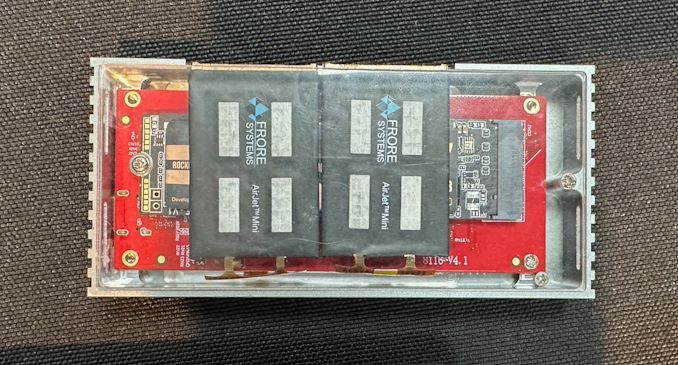

In recent months, Frore Systems has been turning heads with their fanless solid-state air cooler technology. The AirJet, as it's come to be called, was previously shown off at CES this year; and for Computex, the company is back with a fresh round of demonstrations.
For the show, Frore has a number of demonstrations running in a fairly large showroom. The company is looking to address a wide range of products, from tablets to notebooks to small PCs, as well as embedded tablets. But there were two showcases in particular that caught my immediate attention: a Samsung Galaxy Book with and without Frore's AirJet, and an 8 TB Sabrent SSD in an external enclosure.
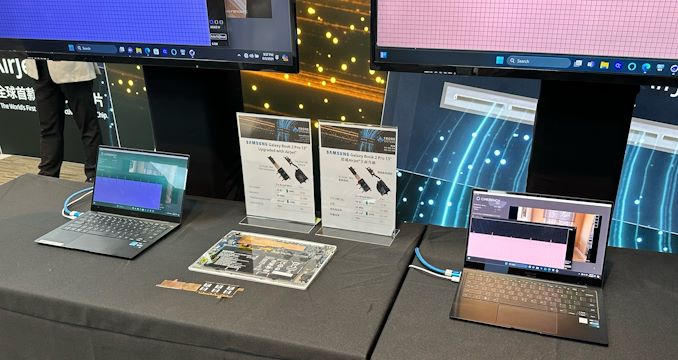
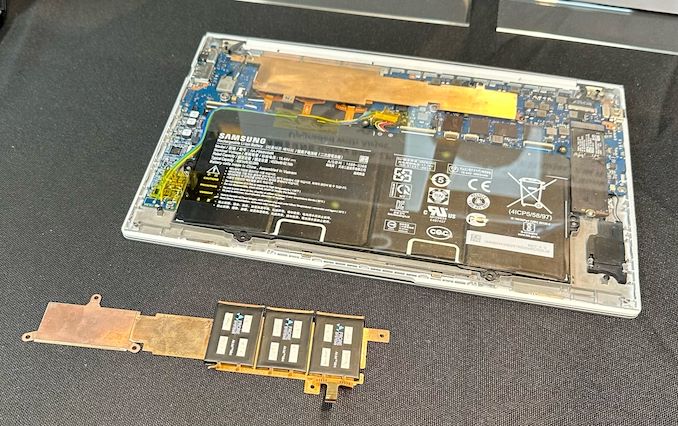
The Samsung Galaxy Book 2 Pro is an ultra-thin notebook that is normally cooled by a fan that, as argued by Flore, does not do its job properly. According to the company, the stock laptop only has enough cooling capacity to sustain 12W heat/power before it hits Tmax, whereas a retrofitted version with Frore's AirJet installed allows it to hold steady-state operation at 16W – and consequently delivering higher performance. In terms of Cinebench R23 multi-threaded results, we are talking about 5330 points for the modded notebook, versus 4255 for the off-the-shelf Galaxy Book 2 Pro.
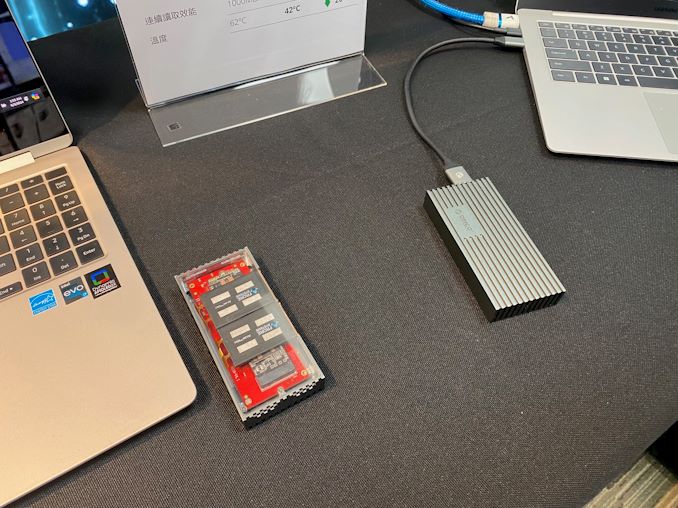
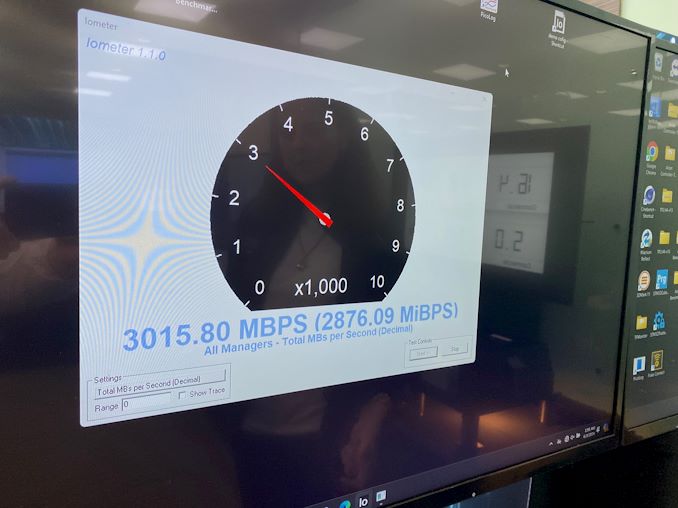
The potential use cases for Frore Systems's AirJet solid-state cooling technology do not end with CPUs, either. As mentioned previously, the company is also demonstrating the AirJet Mini on Sabrent 8TB SSDs in Orico external enclosures, showcasing the advantage of the silent active cooler over passive cooling. The passively-cooled drive reached 62°C and leveled out at 1,320 MB/s due to thermal throttling. In contrast, the AirJet-cooled drive maintained a temperature of 42°C and achieved a considerably higher performance of 3,016 MB/s.
According to Frore, this significant improvement in both temperature and performance has already led to one major external SSD vendor adopting AirJet technology to improve the performance of their drives. Unfortunately, Frore isn't naming any names, only stating that it's a "big name."
Now, Frore's AirJet Mini and Mini Slim coolers can dissipate up to 5W of power each, and can be combined in to larger blocks of up to 5 coolers (we are talking about announced solutions, technologically scaling could he higher, but this is an entirely different conversation). So the technology does have some scalability limitations that makes it best-suited for lower-power devices. None the less, removing 25W of thermal energy from a modern laptop without a fan can make a huge difference in the performance of these normally passively-cooled devices.
Of course, the main goal for these Computex demos is far more than just showing off AirJets to the public; what Frore would really like to do is to land a deal for its solid-state cooling solution with a major PC vendor (e.g., Apple, Samsung, etc.). Though to do that, Frore has to pass qualification tests and ensure availability of its products, which is something the company says it's currently working on. Meanwhile, from performance point of view, especially given their dimensions, AirJets look very impressive.
Cases/Cooling/PSUs

UPDATE 5/17, 6 PM: Western Digital has confirmed that the new 2.5-inch T GB HDDs uses 6 SMR platters
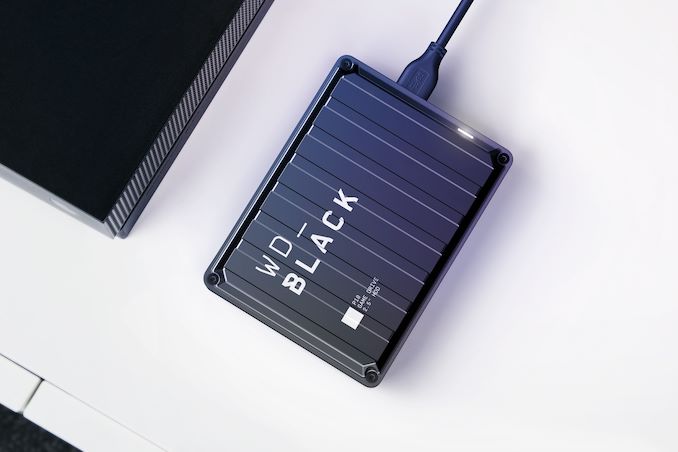
The vast majority of laptops nowadays use solid-state drives, which is why the development of new, higher-capacity 2.5-inch hard drives has all but come to a halt. Or rather, it almost has. It seems that the 2.5-inch form factor has a bit more life left in it after all, as today Western Digital has released a slate of new external storage products based on a new, high-capacity 6 TB 2.5-inch hard drive.
WD's new 6 TB spinner is being used to offer upgraded versions of the company's My Passport, Black P10, and and G-DRIVE ArmorATD portable storage products. Notably, however, WD isn't selling the bare 2.5-inch drive on a standalone basis – at least not yet – so for the time being it's entirely reserved for use in external storage.
Consequently, WD isn't publishing much about the 6 TB hard drive itself. The maximum read speed for these products is listed at 130 MB/sec – the same as WD's existing externals – and write performance goes unmentioned.
Notably, all of these 6 TB devices are thicker than their existing 5 TB counterparts, which strongly suggests that WD has increased their storage capacity not by improving their areal density, but by adding another platter to their existing drive platform (which WD has since confirmed). This, in turn, would help to explain why these new drives are being used in external storage products, as WD's 5 TB 2.5-inch drives are already 15mm thick and using 5 platters. 15mm is the highest standard thickness for a 2.5-inch form-factor, and already incompatible with a decent number of portable devices. External drives, in turn, are the only place these even thicker 2.5-inch drives would fit.
WD's specifications also gloss over whether these drives are based on shingled magnetic recording (SMR) technology. The company was already using SMR for their 5 TB drives in order to hit the necessary storage density there, and WD has since confirmed that this is exactly the case. Which is likely why the company isn't publishing write performance specifications for the drives, as we've seen device-managed SMR drives bottom out as low as 10 MB/second in our testing when the drive needs to rewrite data.
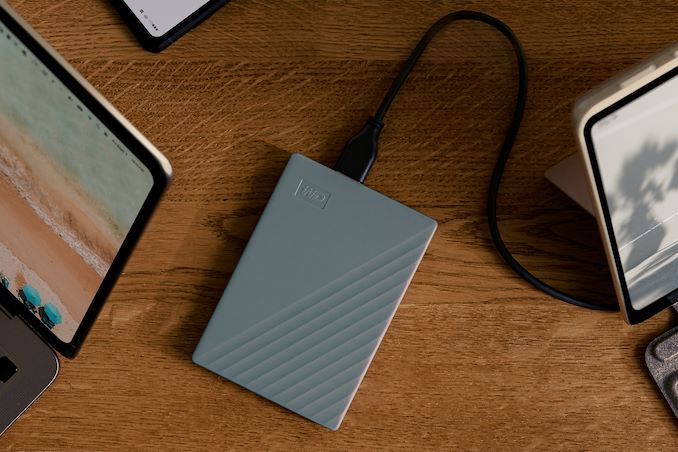
Depending on the specific drive model, all of the external storage drives use either a USB-C connector, or the very quaint USB Micro-B 3.0 connector. Though regardless of the physical connector used, all of the drives feature a USB 3.2 Gen 1 (5Gbps) electrical interface, which is more than ample given the drives' physically-limited transfer speeds.
Wrapping things up, according to WD the new drives are available at retail immediately. The WD My Passport Ultra and WD My Passport Ultra for Mac with USB-C both retail for $199.99; the WD My Passport and WD My Passport for Mac are $179.99; the WD My Passport Works With USB-C is $184.99; the gaming-focused WD_Black P10 Game Drive sells for $184.99, and the SanDisk Professional G-Drive ArmorATD is $229.99. All of Western Digital's external storage drives are backed with a three-year limited warranty.
Storage
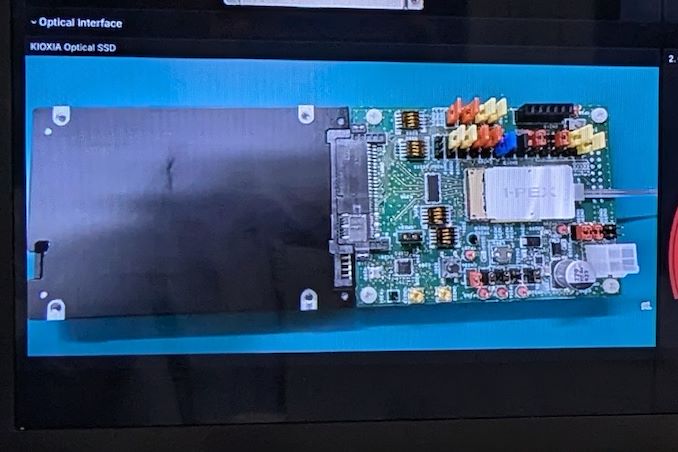
A few years back, the Japanese government's New Energy and Industrial Technology Development Organization (NEDO ) allocated funding for the development of green datacenter technologies. With the aim to obtain up to 40% savings in overall power consumption, several Japanese companies have been developing an optical interface for their enterprise SSDs. And at this year's FMS, Kioxia had their optical interface on display.
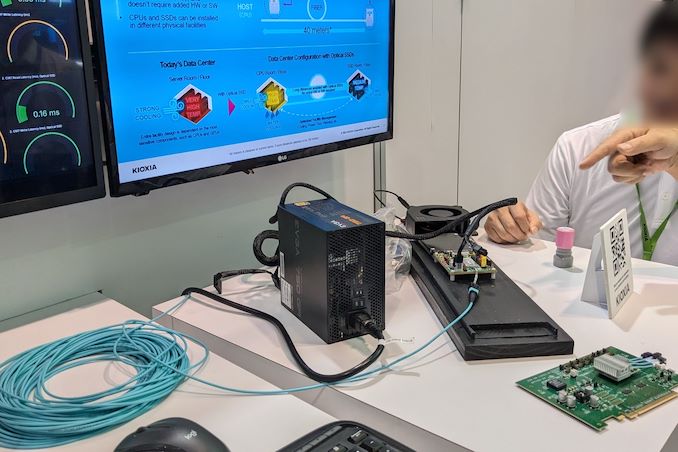
For this demonstration, Kioxia took its existing CM7 enterprise SSD and created an optical interface for it. A PCIe card with on-board optics developed by Kyocera is installed in the server slot. An optical interface allows data transfer over long distances (it was 40m in the demo, but Kioxia promises lengths of up to 100m for the cable in the future). This allows the storage to be kept in a separate room with minimal cooling requirements compared to the rack with the CPUs and GPUs. Disaggregation of different server components will become an option as very high throughput interfaces such as PCIe 7.0 (with 128 GT/s rates) become available.
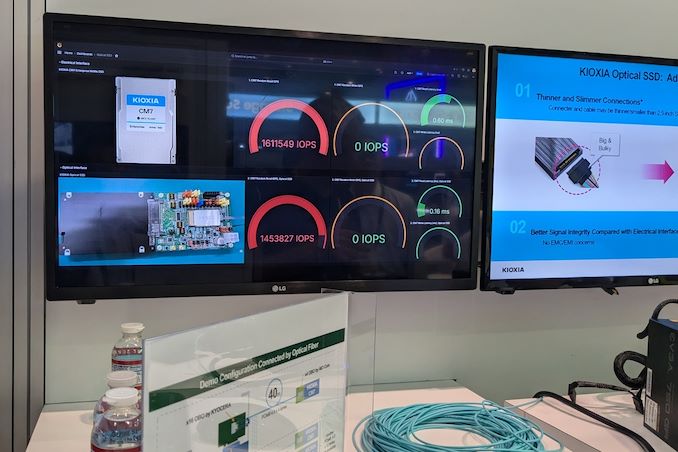
The demonstration of the optical SSD showed a slight loss in IOPS performance, but a significant advantage in the latency metric over the shipping enterprise SSD behind a copper network link. Obviously, there are advantages in wiring requirements and signal integrity maintenance with optical links.
Being a proof-of-concept demonstration, we do see the requirement for an industry-standard approach if this were to gain adoption among different datacenter vendors. The PCI-SIG optical workgroup will need to get its act together soon to create a standards-based approach to this problem.
Storage
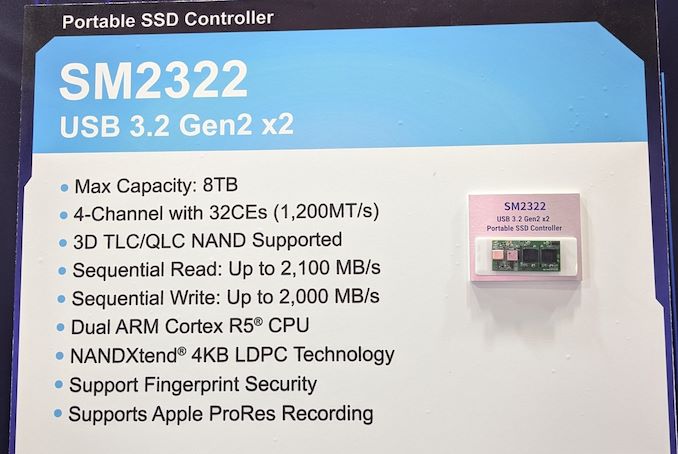
Silicon Motion's SM2320 native USB 3.2 Gen 2x2 controller for USB flash drives and portable SSDs has enjoyed great market success with a large number of design wins over the last few years. Silicon Motion proudly displayed a selection of products based on the SM2320 on the show floor at FMS 2024.
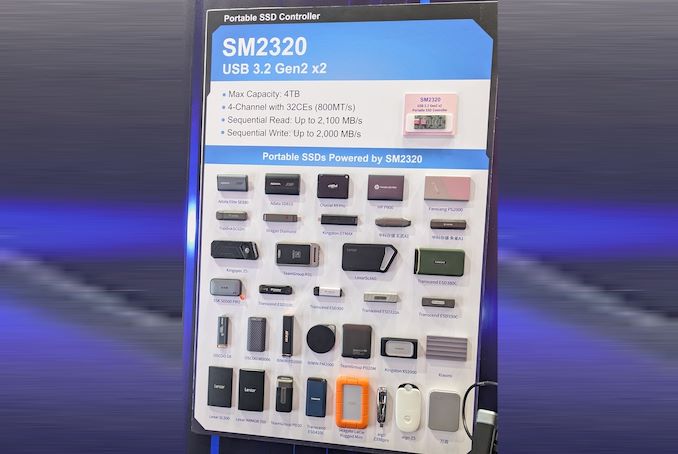
The SM2320 went into mass production in Q3 2021. Since then, the NAND flash market has seen considerable change. QLC is becoming more and more reliable and common, leading to the launch of high-capacity cost-effective 4 TB and 8 TB SSDs. Newer NAND generations with flash operating at higher speeds have also made an appearance.
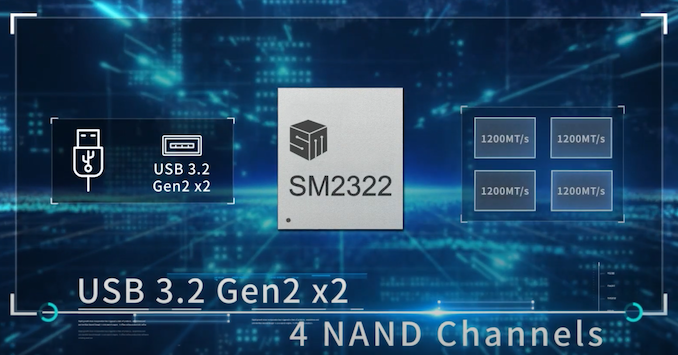
The SM2320, fabricated in TSMC's 28nm node, supported four channels of NAND flash running at up to 800 MT/s. The new SM2322 uses the same process node and retains support for the same number of flash channels and chip enables (8 CEs per channel). However, the NAND can now operate at up to 1200 MT/s.
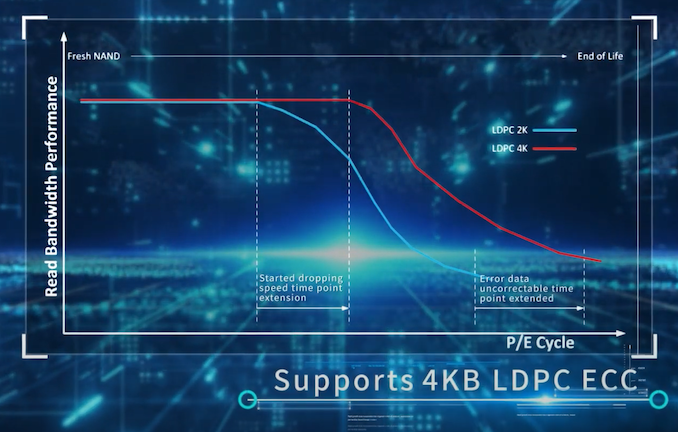
The SM2322 also improves the QLC support, thanks to the implementation of a better ECC scheme. While the SM2320 opted for a 2KB LDPC implementation, the SM2322 goes in for a 4KB LDPC solution. The use of a larger region enables extension of the NAND's useful life.
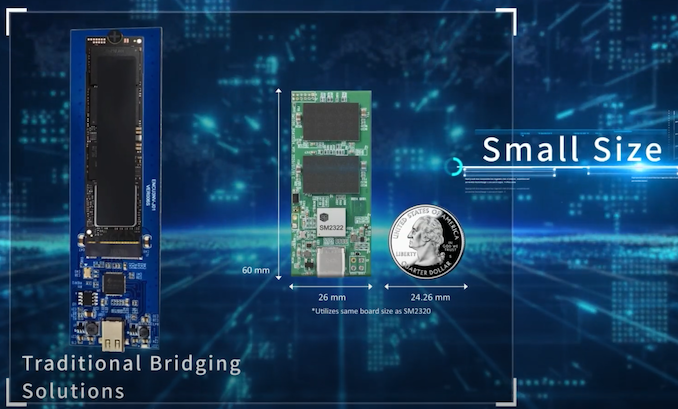
The SM2322 and SM2320 packages are similar in size, and Silicon Motion expects PSSD designs using the SM2320 to adopt the SM2322 with different NAND (higher capacity / speeds) using the same enclosure. Products based on the SM2322 are expected to appear in the market before the end of the year.
Storage
UPDATE 5/17, 6 PM: Western Digital has confirmed that the new 2.5-inch T GB HDDs uses 6 SMR platters
The vast majority of laptops nowadays use solid-state drives, which is why the development of new, higher-capacity 2.5-inch hard drives has all but come to a halt. Or rather, it almost has. It seems that the 2.5-inch form factor has a bit more life left in it after all, as today Western Digital has released a slate of new external storage products based on a new, high-capacity 6 TB 2.5-inch hard drive.
WD's new 6 TB spinner is being used to offer upgraded versions of the company's My Passport, Black P10, and and G-DRIVE ArmorATD portable storage products. Notably, however, WD isn't selling the bare 2.5-inch drive on a standalone basis – at least not yet – so for the time being it's entirely reserved for use in external storage.
Consequently, WD isn't publishing much about the 6 TB hard drive itself. The maximum read speed for these products is listed at 130 MB/sec – the same as WD's existing externals – and write performance goes unmentioned.
Notably, all of these 6 TB devices are thicker than their existing 5 TB counterparts, which strongly suggests that WD has increased their storage capacity not by improving their areal density, but by adding another platter to their existing drive platform (which WD has since confirmed). This, in turn, would help to explain why these new drives are being used in external storage products, as WD's 5 TB 2.5-inch drives are already 15mm thick and using 5 platters. 15mm is the highest standard thickness for a 2.5-inch form-factor, and already incompatible with a decent number of portable devices. External drives, in turn, are the only place these even thicker 2.5-inch drives would fit.
WD's specifications also gloss over whether these drives are based on shingled magnetic recording (SMR) technology. The company was already using SMR for their 5 TB drives in order to hit the necessary storage density there, and WD has since confirmed that this is exactly the case. Which is likely why the company isn't publishing write performance specifications for the drives, as we've seen device-managed SMR drives bottom out as low as 10 MB/second in our testing when the drive needs to rewrite data.
Depending on the specific drive model, all of the external storage drives use either a USB-C connector, or the very quaint USB Micro-B 3.0 connector. Though regardless of the physical connector used, all of the drives feature a USB 3.2 Gen 1 (5Gbps) electrical interface, which is more than ample given the drives' physically-limited transfer speeds.
Wrapping things up, according to WD the new drives are available at retail immediately. The WD My Passport Ultra and WD My Passport Ultra for Mac with USB-C both retail for $199.99; the WD My Passport and WD My Passport for Mac are $179.99; the WD My Passport Works With USB-C is $184.99; the gaming-focused WD_Black P10 Game Drive sells for $184.99, and the SanDisk Professional G-Drive ArmorATD is $229.99. All of Western Digital's external storage drives are backed with a three-year limited warranty.
Storage
A few years back, the Japanese government's New Energy and Industrial Technology Development Organization (NEDO ) allocated funding for the development of green datacenter technologies. With the aim to obtain up to 40% savings in overall power consumption, several Japanese companies have been developing an optical interface for their enterprise SSDs. And at this year's FMS, Kioxia had their optical interface on display.
For this demonstration, Kioxia took its existing CM7 enterprise SSD and created an optical interface for it. A PCIe card with on-board optics developed by Kyocera is installed in the server slot. An optical interface allows data transfer over long distances (it was 40m in the demo, but Kioxia promises lengths of up to 100m for the cable in the future). This allows the storage to be kept in a separate room with minimal cooling requirements compared to the rack with the CPUs and GPUs. Disaggregation of different server components will become an option as very high throughput interfaces such as PCIe 7.0 (with 128 GT/s rates) become available.
The demonstration of the optical SSD showed a slight loss in IOPS performance, but a significant advantage in the latency metric over the shipping enterprise SSD behind a copper network link. Obviously, there are advantages in wiring requirements and signal integrity maintenance with optical links.
Being a proof-of-concept demonstration, we do see the requirement for an industry-standard approach if this were to gain adoption among different datacenter vendors. The PCI-SIG optical workgroup will need to get its act together soon to create a standards-based approach to this problem.
Storage
Silicon Motion's SM2320 native USB 3.2 Gen 2x2 controller for USB flash drives and portable SSDs has enjoyed great market success with a large number of design wins over the last few years. Silicon Motion proudly displayed a selection of products based on the SM2320 on the show floor at FMS 2024.
The SM2320 went into mass production in Q3 2021. Since then, the NAND flash market has seen considerable change. QLC is becoming more and more reliable and common, leading to the launch of high-capacity cost-effective 4 TB and 8 TB SSDs. Newer NAND generations with flash operating at higher speeds have also made an appearance.
The SM2320, fabricated in TSMC's 28nm node, supported four channels of NAND flash running at up to 800 MT/s. The new SM2322 uses the same process node and retains support for the same number of flash channels and chip enables (8 CEs per channel). However, the NAND can now operate at up to 1200 MT/s.
The SM2322 also improves the QLC support, thanks to the implementation of a better ECC scheme. While the SM2320 opted for a 2KB LDPC implementation, the SM2322 goes in for a 4KB LDPC solution. The use of a larger region enables extension of the NAND's useful life.
The SM2322 and SM2320 packages are similar in size, and Silicon Motion expects PSSD designs using the SM2320 to adopt the SM2322 with different NAND (higher capacity / speeds) using the same enclosure. Products based on the SM2322 are expected to appear in the market before the end of the year.
Storage
In recent months, Frore Systems has been turning heads with their fanless solid-state air cooler technology. The AirJet, as it's come to be called, was previously shown off at CES this year; and for Computex, the company is back with a fresh round of demonstrations.
For the show, Frore has a number of demonstrations running in a fairly large showroom. The company is looking to address a wide range of products, from tablets to notebooks to small PCs, as well as embedded tablets. But there were two showcases in particular that caught my immediate attention: a Samsung Galaxy Book with and without Frore's AirJet, and an 8 TB Sabrent SSD in an external enclosure.
The Samsung Galaxy Book 2 Pro is an ultra-thin notebook that is normally cooled by a fan that, as argued by Flore, does not do its job properly. According to the company, the stock laptop only has enough cooling capacity to sustain 12W heat/power before it hits Tmax, whereas a retrofitted version with Frore's AirJet installed allows it to hold steady-state operation at 16W – and consequently delivering higher performance. In terms of Cinebench R23 multi-threaded results, we are talking about 5330 points for the modded notebook, versus 4255 for the off-the-shelf Galaxy Book 2 Pro.
The potential use cases for Frore Systems's AirJet solid-state cooling technology do not end with CPUs, either. As mentioned previously, the company is also demonstrating the AirJet Mini on Sabrent 8TB SSDs in Orico external enclosures, showcasing the advantage of the silent active cooler over passive cooling. The passively-cooled drive reached 62°C and leveled out at 1,320 MB/s due to thermal throttling. In contrast, the AirJet-cooled drive maintained a temperature of 42°C and achieved a considerably higher performance of 3,016 MB/s.
According to Frore, this significant improvement in both temperature and performance has already led to one major external SSD vendor adopting AirJet technology to improve the performance of their drives. Unfortunately, Frore isn't naming any names, only stating that it's a "big name."
Now, Frore's AirJet Mini and Mini Slim coolers can dissipate up to 5W of power each, and can be combined in to larger blocks of up to 5 coolers (we are talking about announced solutions, technologically scaling could he higher, but this is an entirely different conversation). So the technology does have some scalability limitations that makes it best-suited for lower-power devices. None the less, removing 25W of thermal energy from a modern laptop without a fan can make a huge difference in the performance of these normally passively-cooled devices.
Of course, the main goal for these Computex demos is far more than just showing off AirJets to the public; what Frore would really like to do is to land a deal for its solid-state cooling solution with a major PC vendor (e.g., Apple, Samsung, etc.). Though to do that, Frore has to pass qualification tests and ensure availability of its products, which is something the company says it's currently working on. Meanwhile, from performance point of view, especially given their dimensions, AirJets look very impressive.
Cases/Cooling/PSUs
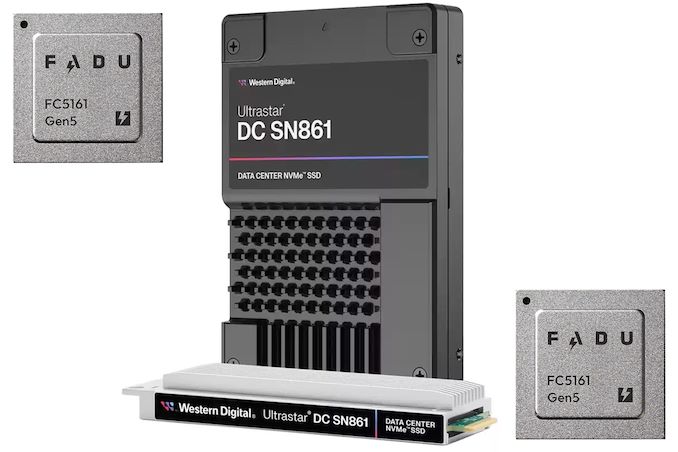
When Western Digital introduced its Ultrastar DC SN861 SSDs earlier this year, the company did not disclose which controller it used for these drives, which made many observers presume that WD was using an in-house controller. But a recent teardown of the drive shows that is not the case; instead, the company is using a controller from Fadu, a South Korean company founded in 2015 that specializes on enterprise-grade turnkey SSD solutions.
The Western Digital Ultrastar DC SN861 SSD is aimed at performance-hungry hyperscale datacenters and enterprise customers which are adopting PCIe Gen5 storage devices these days. And, as uncovered in photos from a recent Storage Review article, the drive is based on Fadu's FC5161 NVMe 2.0-compliant controller. The FC5161 utilizes 16 NAND channels supporting an ONFi 5.0 2400 MT/s interface, and features a combination of enterprise-grade capabilities (OCP Cloud Spec 2.0, SR-IOV, up to 512 name spaces for ZNS support, flexible data placement, NVMe-MI 1.2, advanced security, telemetry, power loss protection) not available on other off-the-shelf controllers – or on any previous Western Digital controllers.
The Ultrastar DC SN861 SSD offers sequential read speeds up to 13.7 GB/s as well as sequential write speeds up to 7.5 GB/s. As for random performance, it boasts with an up to 3.3 million random 4K read IOPS and up to 0.8 million random 4K write IOPS. The drives are available in capacities between 1.6 TB and 7.68 TB with one or three drive writes per day (DWPD) over five years rating as well as in U.2 and E1.S form-factors.
While the two form factors of the SN861 share a similar technical design, Western Digital has tailored each version for distinct workloads: the E1.S supports FDP and performance enhancements specifically for cloud environments. By contrast, the U.2 model is geared towards high-performance enterprise tasks and emerging applications like AI.
Without any doubts, Western Digital's Ultrastar DC SN861 is a feature-rich high-performance enterprise-grade SSD. It has another distinctive feature: a 5W idle power consumption, which is rather low by the standards of enterprise-grade drives (e.g., it is 1W lower compared to the SN840). While the difference with predecessors may be just 1W, hyperscalers deploy thousands of drives and for their TCO every watt counts.
Western Digital's Ultrastar DC SN861 SSDs are now available for purchase to select customers (such as Meta) and to interested parties. Prices are unknown, but they will depend on such factors as volumes.
Sources: Fadu, Storage Review
Storage
Silicon Motion's SM2320 native USB 3.2 Gen 2x2 controller for USB flash drives and portable SSDs has enjoyed great market success with a large number of design wins over the last few years. Silicon Motion proudly displayed a selection of products based on the SM2320 on the show floor at FMS 2024.
The SM2320 went into mass production in Q3 2021. Since then, the NAND flash market has seen considerable change. QLC is becoming more and more reliable and common, leading to the launch of high-capacity cost-effective 4 TB and 8 TB SSDs. Newer NAND generations with flash operating at higher speeds have also made an appearance.
The SM2320, fabricated in TSMC's 28nm node, supported four channels of NAND flash running at up to 800 MT/s. The new SM2322 uses the same process node and retains support for the same number of flash channels and chip enables (8 CEs per channel). However, the NAND can now operate at up to 1200 MT/s.
The SM2322 also improves the QLC support, thanks to the implementation of a better ECC scheme. While the SM2320 opted for a 2KB LDPC implementation, the SM2322 goes in for a 4KB LDPC solution. The use of a larger region enables extension of the NAND's useful life.
The SM2322 and SM2320 packages are similar in size, and Silicon Motion expects PSSD designs using the SM2320 to adopt the SM2322 with different NAND (higher capacity / speeds) using the same enclosure. Products based on the SM2322 are expected to appear in the market before the end of the year.
Storage
Lorem Ipsum is simply dummy text of the printing and typesetting industry. Lorem Ipsum has been the industry's.
UPDATE 5/17, 6 PM: Western Digital has confirmed that the new 2.5-inch T GB HDDs uses 6 SMR platters
The vast majority of laptops nowadays use solid-state drives, which is why the development of new, higher-capacity 2.5-inch hard drives has all but come to a halt. Or rather, it almost has. It seems that the 2.5-inch form factor has a bit more life left in it after all, as today Western Digital has released a slate of new external storage products based on a new, high-capacity 6 TB 2.5-inch hard drive.
WD's new 6 TB spinner is being used to offer upgraded versions of the company's My Passport, Black P10, and and G-DRIVE ArmorATD portable storage products. Notably, however, WD isn't selling the bare 2.5-inch drive on a standalone basis – at least not yet – so for the time being it's entirely reserved for use in external storage.
Consequently, WD isn't publishing much about the 6 TB hard drive itself. The maximum read speed for these products is listed at 130 MB/sec – the same as WD's existing externals – and write performance goes unmentioned.
Notably, all of these 6 TB devices are thicker than their existing 5 TB counterparts, which strongly suggests that WD has increased their storage capacity not by improving their areal density, but by adding another platter to their existing drive platform (which WD has since confirmed). This, in turn, would help to explain why these new drives are being used in external storage products, as WD's 5 TB 2.5-inch drives are already 15mm thick and using 5 platters. 15mm is the highest standard thickness for a 2.5-inch form-factor, and already incompatible with a decent number of portable devices. External drives, in turn, are the only place these even thicker 2.5-inch drives would fit.
WD's specifications also gloss over whether these drives are based on shingled magnetic recording (SMR) technology. The company was already using SMR for their 5 TB drives in order to hit the necessary storage density there, and WD has since confirmed that this is exactly the case. Which is likely why the company isn't publishing write performance specifications for the drives, as we've seen device-managed SMR drives bottom out as low as 10 MB/second in our testing when the drive needs to rewrite data.
Depending on the specific drive model, all of the external storage drives use either a USB-C connector, or the very quaint USB Micro-B 3.0 connector. Though regardless of the physical connector used, all of the drives feature a USB 3.2 Gen 1 (5Gbps) electrical interface, which is more than ample given the drives' physically-limited transfer speeds.
Wrapping things up, according to WD the new drives are available at retail immediately. The WD My Passport Ultra and WD My Passport Ultra for Mac with USB-C both retail for $199.99; the WD My Passport and WD My Passport for Mac are $179.99; the WD My Passport Works With USB-C is $184.99; the gaming-focused WD_Black P10 Game Drive sells for $184.99, and the SanDisk Professional G-Drive ArmorATD is $229.99. All of Western Digital's external storage drives are backed with a three-year limited warranty.
Storage
A few years back, the Japanese government's New Energy and Industrial Technology Development Organization (NEDO ) allocated funding for the development of green datacenter technologies. With the aim to obtain up to 40% savings in overall power consumption, several Japanese companies have been developing an optical interface for their enterprise SSDs. And at this year's FMS, Kioxia had their optical interface on display.
For this demonstration, Kioxia took its existing CM7 enterprise SSD and created an optical interface for it. A PCIe card with on-board optics developed by Kyocera is installed in the server slot. An optical interface allows data transfer over long distances (it was 40m in the demo, but Kioxia promises lengths of up to 100m for the cable in the future). This allows the storage to be kept in a separate room with minimal cooling requirements compared to the rack with the CPUs and GPUs. Disaggregation of different server components will become an option as very high throughput interfaces such as PCIe 7.0 (with 128 GT/s rates) become available.
The demonstration of the optical SSD showed a slight loss in IOPS performance, but a significant advantage in the latency metric over the shipping enterprise SSD behind a copper network link. Obviously, there are advantages in wiring requirements and signal integrity maintenance with optical links.
Being a proof-of-concept demonstration, we do see the requirement for an industry-standard approach if this were to gain adoption among different datacenter vendors. The PCI-SIG optical workgroup will need to get its act together soon to create a standards-based approach to this problem.
Storage
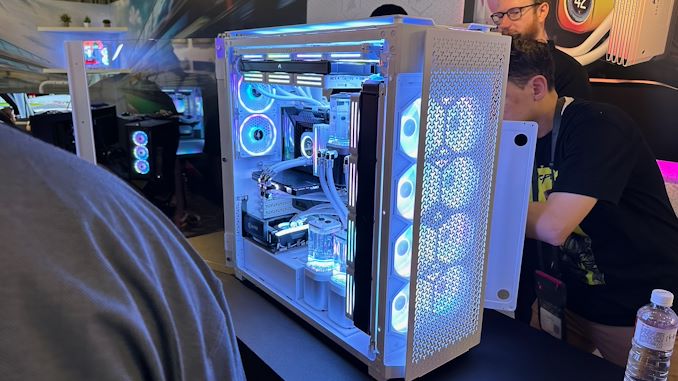
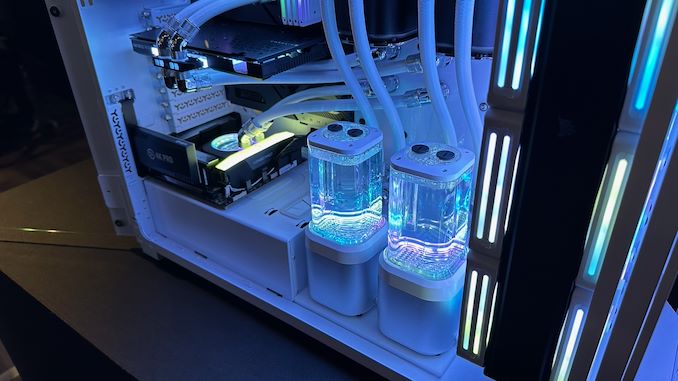


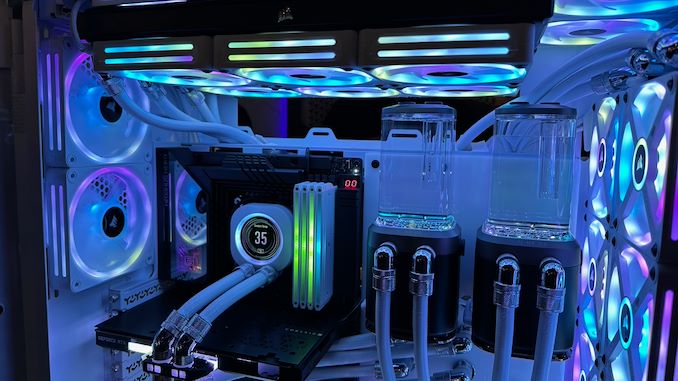
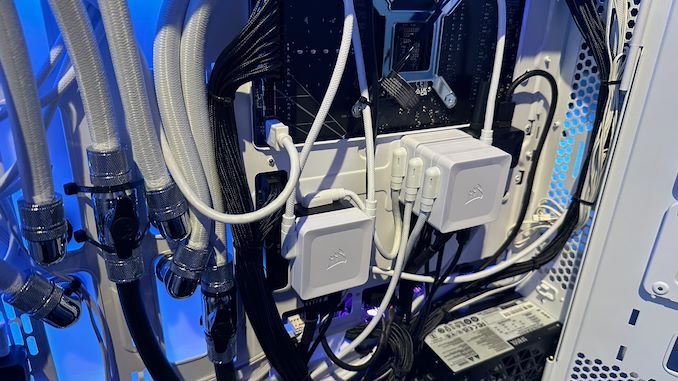

. So the technology does have some scalability limitations that makes it best-suited for lower-power devices. None the less, removing 25W of thermal energy from a modern laptop without a fan can make a huge difference in the performance of these normally passively-cooled devices.</p>
<p><a href="https://www.anandtech.com/show/21428/frore-demos-airjet-in-action-25-cpu-performance-44-ssd-performance-"><img alt="" src="https://images.anandtech.com/doci/21428/IMG_2200_575px.jpeg" /></a></p>
<p>Of course, the main goal for these Computex demos is far more than just showing off AirJets to the public; what Frore would really like to do is to land a deal for its solid-state cooling solution with a major PC vendor (e.g., Apple, Samsung, etc.). Though to do that, Frore has to pass qualification tests and ensure availability of its products, which is something the company says it's currently working on. Meanwhile, from performance point of view, especially given their dimensions, AirJets look very impressive.</p>
</p> Cases/Cooling/PSUs)
. So the technology does have some scalability limitations that makes it best-suited for lower-power devices. None the less, removing 25W of thermal energy from a modern laptop without a fan can make a huge difference in the performance of these normally passively-cooled devices.</p>
<p><a href="https://www.anandtech.com/show/21428/frore-demos-airjet-in-action-25-cpu-performance-44-ssd-performance-"><img alt="" src="https://images.anandtech.com/doci/21428/IMG_2200_575px.jpeg" /></a></p>
<p>Of course, the main goal for these Computex demos is far more than just showing off AirJets to the public; what Frore would really like to do is to land a deal for its solid-state cooling solution with a major PC vendor (e.g., Apple, Samsung, etc.). Though to do that, Frore has to pass qualification tests and ensure availability of its products, which is something the company says it's currently working on. Meanwhile, from performance point of view, especially given their dimensions, AirJets look very impressive.</p>
</p> Cases/Cooling/PSUs | https://compbuddey.blogspot.com/2024/06/frore-demos-solid-state-airjet-cooler_84.html)
. So the technology does have some scalability limitations that makes it best-suited for lower-power devices. None the less, removing 25W of thermal energy from a modern laptop without a fan can make a huge difference in the performance of these normally passively-cooled devices.</p>
<p><a href="https://www.anandtech.com/show/21428/frore-demos-airjet-in-action-25-cpu-performance-44-ssd-performance-"><img alt="" src="https://images.anandtech.com/doci/21428/IMG_2200_575px.jpeg" /></a></p>
<p>Of course, the main goal for these Computex demos is far more than just showing off AirJets to the public; what Frore would really like to do is to land a deal for its solid-state cooling solution with a major PC vendor (e.g., Apple, Samsung, etc.). Though to do that, Frore has to pass qualification tests and ensure availability of its products, which is something the company says it's currently working on. Meanwhile, from performance point of view, especially given their dimensions, AirJets look very impressive.</p>
</p> Cases/Cooling/PSUs&body=https://compbuddey.blogspot.com/2024/06/frore-demos-solid-state-airjet-cooler_84.html)


0 Comments