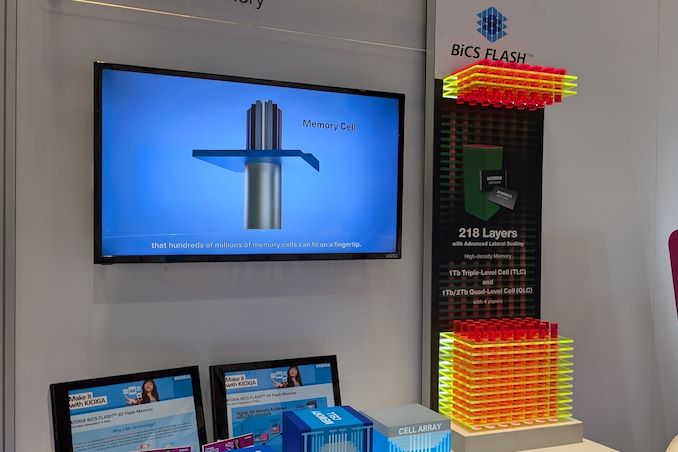

Kioxia's booth at FMS 2024 was a busy one with multiple technology demonstrations keeping visitors occupied. A walk-through of the BiCS 8 manufacturing process was the first to grab my attention. Kioxia and Western Digital announced the sampling of BiCS 8 in March 2023. We had touched briefly upon its CMOS Bonded Array (CBA) scheme in our coverage of Kioxial's 2Tb QLC NAND device and coverage of Western Digital's 128 TB QLC enterprise SSD proof-of-concept demonstration. At Kioxia's booth, we got more insights.
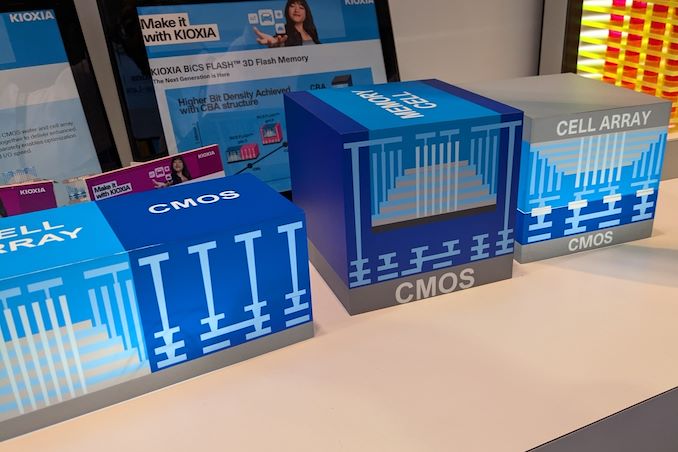
Traditionally, fabrication of flash chips involved placement of the associate logic circuitry (CMOS process) around the periphery of the flash array. The process then moved on to putting the CMOS under the cell array, but the wafer development process was serialized with the CMOS logic getting fabricated first followed by the cell array on top. However, this has some challenges because the cell array requires a high-temperature processing step to ensure higher reliability that can be detrimental to the health of the CMOS logic. Thanks to recent advancements in wafer bonding techniques, the new CBA process allows the CMOS wafer and cell array wafer to be processed independently in parallel and then pieced together, as shown in the models above.
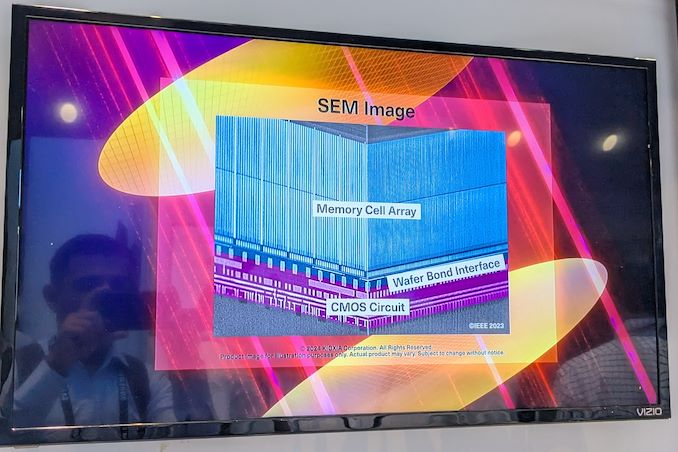
The BiCS 8 3D NAND incorporates 218 layers, compared to 112 layers in BiCS 5 and 162 layers in BiCS 6. The company decided to skip over BiCS 7 (or, rather, it was probably a short-lived generation meant as an internal test vehicle). The generation retains the four-plane charge trap structure of BiCS 6. In its TLC avatar, it is available as a 1 Tbit device. The QLC version is available in two capacities - 1 Tbit and 2 Tbit.
Kioxia also noted that while the number of layers (218) doesn't compare favorably with the latest layer counts from the competition, its lateral scaling / cell shrinkage has enabled it to be competitive in terms of bit density as well as operating speeds (3200 MT/s). For reference, the latest shipping NAND from Micron - the G9 - has 276 layers with a bit density in TLC mode of 21 Gbit/mm2, and operates at up to 3600 MT/s. However, its 232L NAND operates only up to 2400 MT/s and has a bit density of 14.6 Gbit/mm2.
It must be noted that the CBA hybrid bonding process has advantages over the current processes used by other vendors - including Micron's CMOS under array (CuA) and SK hynix's 4D PUC (periphery-under-chip) developed in the late 2010s. It is expected that other NAND vendors will also move eventually to some variant of the hybrid bonding scheme used by Kioxia.
Storage

UPDATE 5/17, 6 PM: Western Digital has confirmed that the new 2.5-inch T GB HDDs uses 6 SMR platters
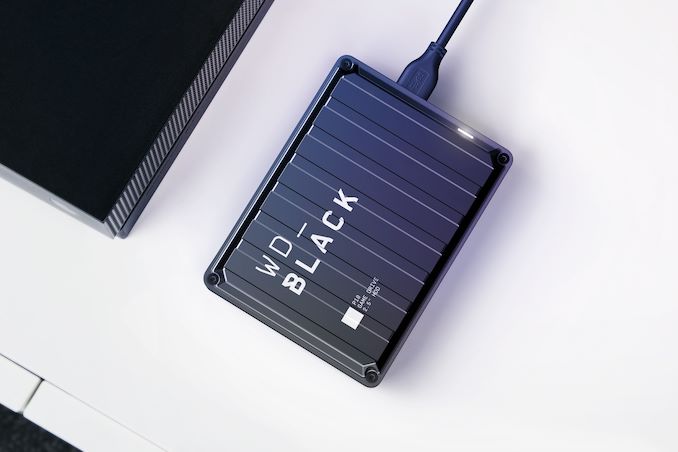
The vast majority of laptops nowadays use solid-state drives, which is why the development of new, higher-capacity 2.5-inch hard drives has all but come to a halt. Or rather, it almost has. It seems that the 2.5-inch form factor has a bit more life left in it after all, as today Western Digital has released a slate of new external storage products based on a new, high-capacity 6 TB 2.5-inch hard drive.
WD's new 6 TB spinner is being used to offer upgraded versions of the company's My Passport, Black P10, and and G-DRIVE ArmorATD portable storage products. Notably, however, WD isn't selling the bare 2.5-inch drive on a standalone basis – at least not yet – so for the time being it's entirely reserved for use in external storage.
Consequently, WD isn't publishing much about the 6 TB hard drive itself. The maximum read speed for these products is listed at 130 MB/sec – the same as WD's existing externals – and write performance goes unmentioned.
Notably, all of these 6 TB devices are thicker than their existing 5 TB counterparts, which strongly suggests that WD has increased their storage capacity not by improving their areal density, but by adding another platter to their existing drive platform (which WD has since confirmed). This, in turn, would help to explain why these new drives are being used in external storage products, as WD's 5 TB 2.5-inch drives are already 15mm thick and using 5 platters. 15mm is the highest standard thickness for a 2.5-inch form-factor, and already incompatible with a decent number of portable devices. External drives, in turn, are the only place these even thicker 2.5-inch drives would fit.
WD's specifications also gloss over whether these drives are based on shingled magnetic recording (SMR) technology. The company was already using SMR for their 5 TB drives in order to hit the necessary storage density there, and WD has since confirmed that this is exactly the case. Which is likely why the company isn't publishing write performance specifications for the drives, as we've seen device-managed SMR drives bottom out as low as 10 MB/second in our testing when the drive needs to rewrite data.
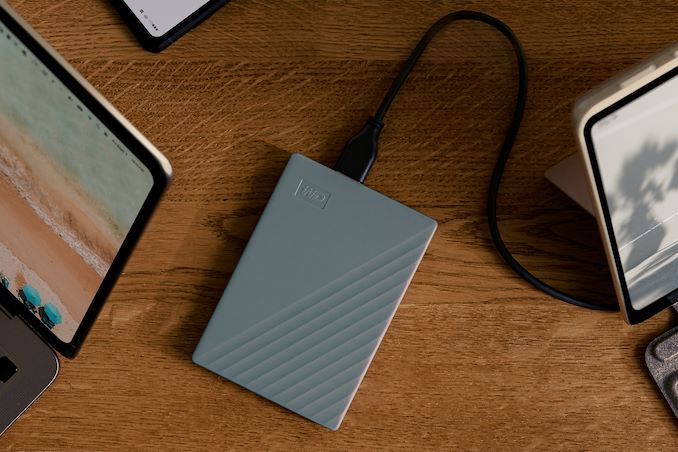
Depending on the specific drive model, all of the external storage drives use either a USB-C connector, or the very quaint USB Micro-B 3.0 connector. Though regardless of the physical connector used, all of the drives feature a USB 3.2 Gen 1 (5Gbps) electrical interface, which is more than ample given the drives' physically-limited transfer speeds.
Wrapping things up, according to WD the new drives are available at retail immediately. The WD My Passport Ultra and WD My Passport Ultra for Mac with USB-C both retail for $199.99; the WD My Passport and WD My Passport for Mac are $179.99; the WD My Passport Works With USB-C is $184.99; the gaming-focused WD_Black P10 Game Drive sells for $184.99, and the SanDisk Professional G-Drive ArmorATD is $229.99. All of Western Digital's external storage drives are backed with a three-year limited warranty.
Storage
UPDATE 5/17, 6 PM: Western Digital has confirmed that the new 2.5-inch T GB HDDs uses 6 SMR platters
The vast majority of laptops nowadays use solid-state drives, which is why the development of new, higher-capacity 2.5-inch hard drives has all but come to a halt. Or rather, it almost has. It seems that the 2.5-inch form factor has a bit more life left in it after all, as today Western Digital has released a slate of new external storage products based on a new, high-capacity 6 TB 2.5-inch hard drive.
WD's new 6 TB spinner is being used to offer upgraded versions of the company's My Passport, Black P10, and and G-DRIVE ArmorATD portable storage products. Notably, however, WD isn't selling the bare 2.5-inch drive on a standalone basis – at least not yet – so for the time being it's entirely reserved for use in external storage.
Consequently, WD isn't publishing much about the 6 TB hard drive itself. The maximum read speed for these products is listed at 130 MB/sec – the same as WD's existing externals – and write performance goes unmentioned.
Notably, all of these 6 TB devices are thicker than their existing 5 TB counterparts, which strongly suggests that WD has increased their storage capacity not by improving their areal density, but by adding another platter to their existing drive platform (which WD has since confirmed). This, in turn, would help to explain why these new drives are being used in external storage products, as WD's 5 TB 2.5-inch drives are already 15mm thick and using 5 platters. 15mm is the highest standard thickness for a 2.5-inch form-factor, and already incompatible with a decent number of portable devices. External drives, in turn, are the only place these even thicker 2.5-inch drives would fit.
WD's specifications also gloss over whether these drives are based on shingled magnetic recording (SMR) technology. The company was already using SMR for their 5 TB drives in order to hit the necessary storage density there, and WD has since confirmed that this is exactly the case. Which is likely why the company isn't publishing write performance specifications for the drives, as we've seen device-managed SMR drives bottom out as low as 10 MB/second in our testing when the drive needs to rewrite data.
Depending on the specific drive model, all of the external storage drives use either a USB-C connector, or the very quaint USB Micro-B 3.0 connector. Though regardless of the physical connector used, all of the drives feature a USB 3.2 Gen 1 (5Gbps) electrical interface, which is more than ample given the drives' physically-limited transfer speeds.
Wrapping things up, according to WD the new drives are available at retail immediately. The WD My Passport Ultra and WD My Passport Ultra for Mac with USB-C both retail for $199.99; the WD My Passport and WD My Passport for Mac are $179.99; the WD My Passport Works With USB-C is $184.99; the gaming-focused WD_Black P10 Game Drive sells for $184.99, and the SanDisk Professional G-Drive ArmorATD is $229.99. All of Western Digital's external storage drives are backed with a three-year limited warranty.
Storage
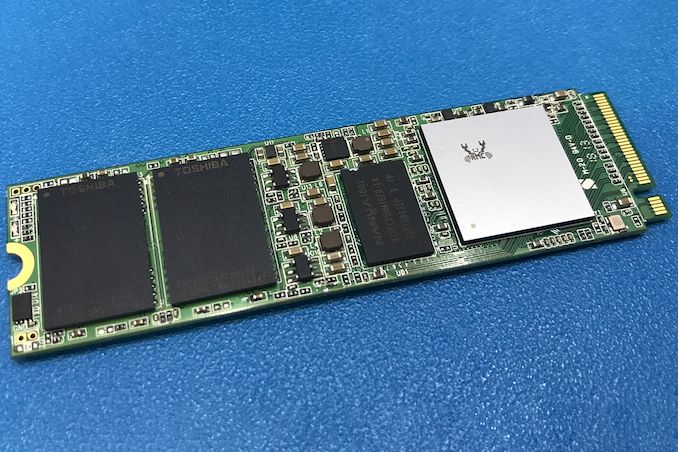
While Realtek is best known in the enthusiast space for for its peripheral controllers such as audio codecs and network controllers, the company also has a small-but-respectable SSD controller business that tends to fly under the radar due to its focus on entry-level and mainstream drives. But Realtek's stature in the SSD space is on the rise, as the company is not only planning new PCIe Gen5 SSD controllers, but also their first high-end, DRAM-equipped SSD controller.
For this year's Computex trade show, Realtek laid out a new SSD controller roadmap that calls for the company to release a trio of new SSD controllers over the next couple of years. First up is a new four-channel entry-level PCIe 4.0 controller, the RTS5776DL, which will be joined a bit later by a PCIe 5.0 variant, the RTS5781DL. But most interesting on Realtek's new roadmap is the final chip being planned: the eight-channel, DRAM-equipped RTS5782, which would be the company's first high-end SSD controller, capable of hitting sequential read rates as high as 14GB/second.
| Realtek NVMe SSD Controller Comparison | |||||||||
| RTS5782 | RTS5781DL | RTS5776DL | RTS5772DL | RTS5766DL | |||||
| Market Segment | High-End | Mainstream | Entry-Level | ||||||
| Error Correction | 4K LDPC | 2K LDPC | |||||||
| DRAM | DDR4, LPDDR4(X) | No | No | No | No | ||||
| Host Interface | PCIe 5.0 x4 | PCIe 5.0 x4 | PCIe 4.0 x4 | PCIe 4.0 x4 | PCIe 3.0 x4 | ||||
| NVMe Version | NVMe 2.0 | NVMe 2.0 | NVMe 2.0 | NVMe 1.4 | NVMe 1.4 | ||||
| NAND Channels, Interface Speed | 8 ch, 3600 MT/s |
4 ch, 3600 MT/s |
4 ch, 3600 MT/s |
8 ch, 1600 MT/s |
4 ch, 1200 MT/s |
||||
| Sequential Read | 14 GB/s | 10 GB/s | 7.4 GB/s | 6 GB/s | 3.2 GB/s | ||||
| Sequential Write | 12 GB/s | 10 GB/s | 7.4 GB/s | 6 GB/s | 2.2 GB/s | ||||
| 4KB Random Read IOPS | 2500k | 1400k | 1200k | - | - | ||||
| 4KB Random Write IOPS | 2500k | 1400k | 1200k | - | - | ||||
Diving a bit deeper into Realtek's roadmap, the RTS5776DL is traditional DRAM-less PCIe Gen4 x4 controller with four NAND chann... SSDs

Silicon Motion's SM2320 native USB 3.2 Gen 2x2 controller for USB flash drives and portable SSDs has enjoyed great market success with a large number of design wins over the last few years. Silicon Motion proudly displayed a selection of products based on the SM2320 on the show floor at FMS 2024.
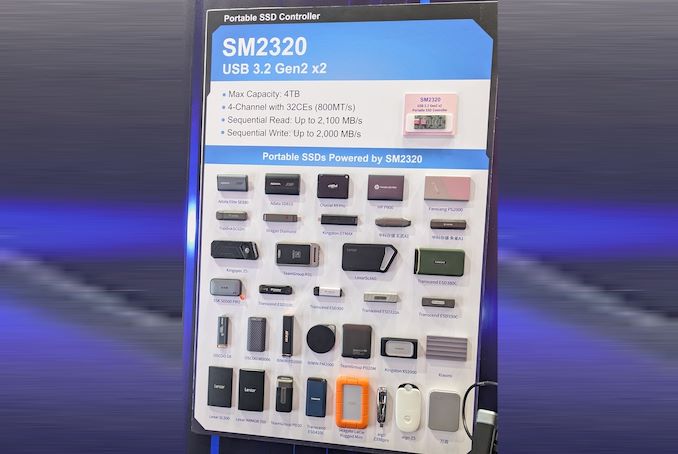
The SM2320 went into mass production in Q3 2021. Since then, the NAND flash market has seen considerable change. QLC is becoming more and more reliable and common, leading to the launch of high-capacity cost-effective 4 TB and 8 TB SSDs. Newer NAND generations with flash operating at higher speeds have also made an appearance.
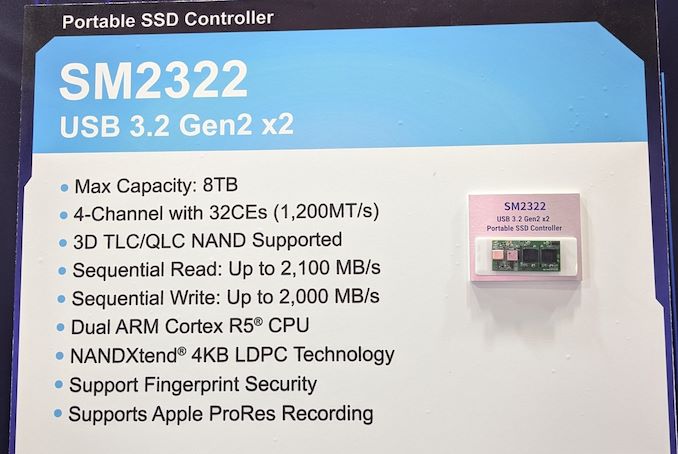
The SM2320, fabricated in TSMC's 28nm node, supported four channels of NAND flash running at up to 800 MT/s. The new SM2322 uses the same process node and retains support for the same number of flash channels and chip enables (8 CEs per channel). However, the NAND can now operate at up to 1200 MT/s.
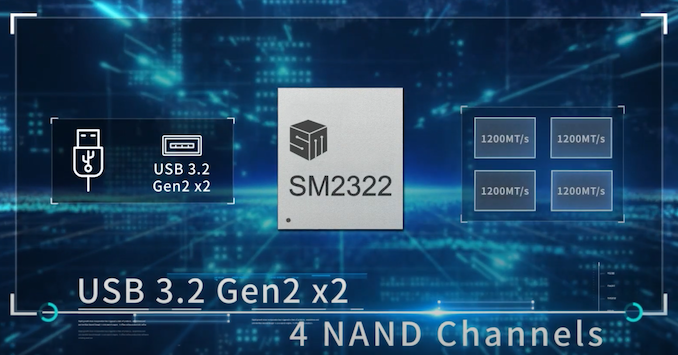
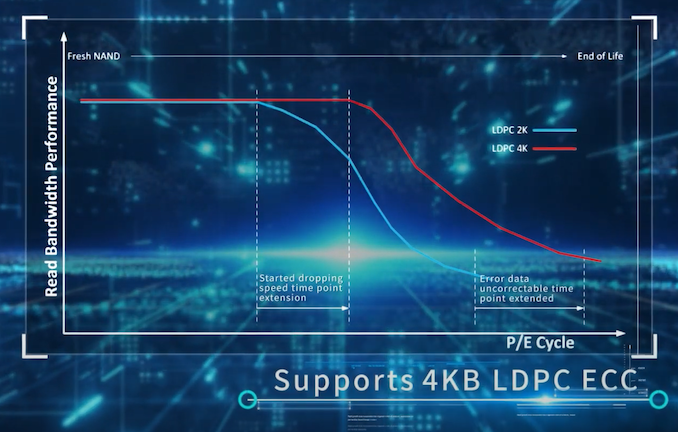
The SM2322 also improves the QLC support, thanks to the implementation of a better ECC scheme. While the SM2320 opted for a 2KB LDPC implementation, the SM2322 goes in for a 4KB LDPC solution. The use of a larger region enables extension of the NAND's useful life.
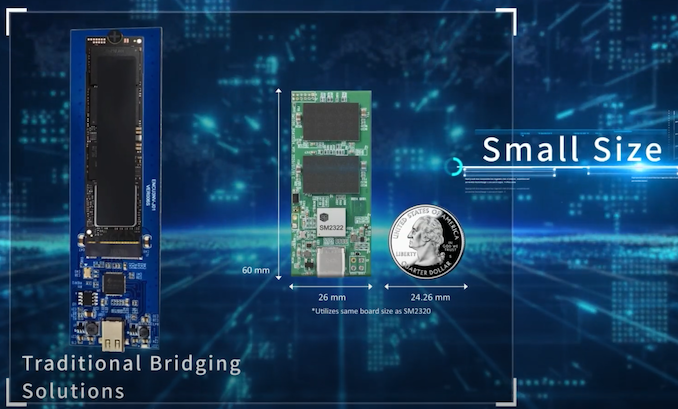
The SM2322 and SM2320 packages are similar in size, and Silicon Motion expects PSSD designs using the SM2320 to adopt the SM2322 with different NAND (higher capacity / speeds) using the same enclosure. Products based on the SM2322 are expected to appear in the market before the end of the year.
Storage
Silicon Motion's SM2320 native USB 3.2 Gen 2x2 controller for USB flash drives and portable SSDs has enjoyed great market success with a large number of design wins over the last few years. Silicon Motion proudly displayed a selection of products based on the SM2320 on the show floor at FMS 2024.
The SM2320 went into mass production in Q3 2021. Since then, the NAND flash market has seen considerable change. QLC is becoming more and more reliable and common, leading to the launch of high-capacity cost-effective 4 TB and 8 TB SSDs. Newer NAND generations with flash operating at higher speeds have also made an appearance.
The SM2320, fabricated in TSMC's 28nm node, supported four channels of NAND flash running at up to 800 MT/s. The new SM2322 uses the same process node and retains support for the same number of flash channels and chip enables (8 CEs per channel). However, the NAND can now operate at up to 1200 MT/s.
The SM2322 also improves the QLC support, thanks to the implementation of a better ECC scheme. While the SM2320 opted for a 2KB LDPC implementation, the SM2322 goes in for a 4KB LDPC solution. The use of a larger region enables extension of the NAND's useful life.
The SM2322 and SM2320 packages are similar in size, and Silicon Motion expects PSSD designs using the SM2320 to adopt the SM2322 with different NAND (higher capacity / speeds) using the same enclosure. Products based on the SM2322 are expected to appear in the market before the end of the year.
Storage
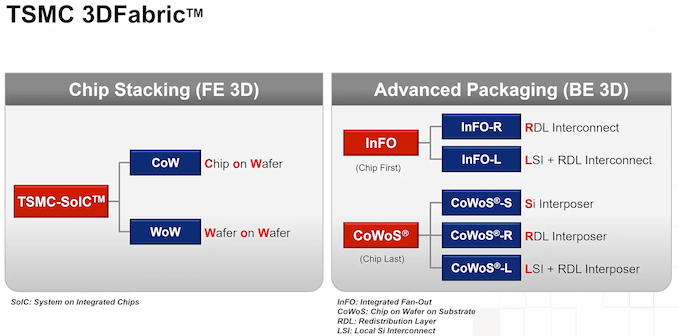
Customer demand for AI and HPC processors is driving a much greater use of advanced packaging technologies, particularly TSMC's chip-on-wafer-on-substrate (CoWoS) services. As things stand, TSMC is just barely meeting the current demand for this packaging method – never mind future demand – which is why last year the company announced plans to more than double CoWoS capacity by the end of 2024. But as it turns out, just doubling capacity once won't be enough, and the world's largest contract maker of chips is going to have to keep scaling up at a rapid pace.
At its European Technology Symposium last week TSMC announced plans to expand CoWoS capacity at a compound annual growth rate (CAGR) of over 60% till at least 2026. As a result, TSMC's CoWoS capacity will more than quadruple from 2023 levels by the end of that period. And keeping in mind that TSMC is prepping additional versions of CoWoS (namely CoWoS-L) that will enable building system-in-packages (SiPs) of up to eight reticle sizes, increasing CoWoS capacity by four-fold in three years may still not be enough. The good news is that the various third-party off-site assembly and testing (OSAT) providers are also expanding their CoWoS-like capacity, so the demand for advanced packing isn't a problem that TSMC is facing (or resolving) on their own.
And CoWoS isn't the only advanced packaging technology line whose capacity TSMC is looking to rapidly expand. The company also has its system-on-integrated chips (SoIC) 3D stacking technology which adoption is poised to grow in the coming years. To meet demand for its SoIC packaging methods TSMC will expand SoIC capacity at a 100% compound annual growth rate by the end of 2026. As a result, SoIC capacity will grow by eight-fold from 2023 levels by late 2026.
Overall, TSMC itself expects leading-edge SiPs for demanding applications like AI and HPC will adopt both CoWoS and SoIC 3D stacking technologies in the coming years, which is why it needs to increase capacity for both methods to be able to build those highly-complex processors.
Semiconductors
Lorem Ipsum is simply dummy text of the printing and typesetting industry. Lorem Ipsum has been the industry's.
UPDATE 5/17, 6 PM: Western Digital has confirmed that the new 2.5-inch T GB HDDs uses 6 SMR platters
The vast majority of laptops nowadays use solid-state drives, which is why the development of new, higher-capacity 2.5-inch hard drives has all but come to a halt. Or rather, it almost has. It seems that the 2.5-inch form factor has a bit more life left in it after all, as today Western Digital has released a slate of new external storage products based on a new, high-capacity 6 TB 2.5-inch hard drive.
WD's new 6 TB spinner is being used to offer upgraded versions of the company's My Passport, Black P10, and and G-DRIVE ArmorATD portable storage products. Notably, however, WD isn't selling the bare 2.5-inch drive on a standalone basis – at least not yet – so for the time being it's entirely reserved for use in external storage.
Consequently, WD isn't publishing much about the 6 TB hard drive itself. The maximum read speed for these products is listed at 130 MB/sec – the same as WD's existing externals – and write performance goes unmentioned.
Notably, all of these 6 TB devices are thicker than their existing 5 TB counterparts, which strongly suggests that WD has increased their storage capacity not by improving their areal density, but by adding another platter to their existing drive platform (which WD has since confirmed). This, in turn, would help to explain why these new drives are being used in external storage products, as WD's 5 TB 2.5-inch drives are already 15mm thick and using 5 platters. 15mm is the highest standard thickness for a 2.5-inch form-factor, and already incompatible with a decent number of portable devices. External drives, in turn, are the only place these even thicker 2.5-inch drives would fit.
WD's specifications also gloss over whether these drives are based on shingled magnetic recording (SMR) technology. The company was already using SMR for their 5 TB drives in order to hit the necessary storage density there, and WD has since confirmed that this is exactly the case. Which is likely why the company isn't publishing write performance specifications for the drives, as we've seen device-managed SMR drives bottom out as low as 10 MB/second in our testing when the drive needs to rewrite data.
Depending on the specific drive model, all of the external storage drives use either a USB-C connector, or the very quaint USB Micro-B 3.0 connector. Though regardless of the physical connector used, all of the drives feature a USB 3.2 Gen 1 (5Gbps) electrical interface, which is more than ample given the drives' physically-limited transfer speeds.
Wrapping things up, according to WD the new drives are available at retail immediately. The WD My Passport Ultra and WD My Passport Ultra for Mac with USB-C both retail for $199.99; the WD My Passport and WD My Passport for Mac are $179.99; the WD My Passport Works With USB-C is $184.99; the gaming-focused WD_Black P10 Game Drive sells for $184.99, and the SanDisk Professional G-Drive ArmorATD is $229.99. All of Western Digital's external storage drives are backed with a three-year limited warranty.
Storage
 scheme in our coverage of Kioxial's <a href="https://www.anandtech.com/show/21464">2Tb QLC NAND device</a> and <a href="https://www.anandtech.com/show/21505">coverage</a> of Western Digital's 128 TB QLC enterprise SSD proof-of-concept demonstration. At Kioxia's booth, we got more insights.</p>
<p align="center"><a href="https://www.anandtech.com/show/21519/kioxia-details-bics-8-at-fms-2024"><img alt="" src="https://images.anandtech.com/doci/21519/bics8-nor-cua-cba_575px.jpg" /></a></p>
<p>Traditionally, fabrication of flash chips involved placement of the associate logic circuitry (CMOS process) around the periphery of the flash array. The process then moved on to putting the CMOS under the cell array, but the wafer development process was serialized with the CMOS logic getting fabricated first followed by the cell array on top. However, this has some challenges because the cell array requires a high-temperature processing step to ensure higher reliability that can be detrimental to the health of the CMOS logic. Thanks to recent advancements in wafer bonding techniques, the new CBA process allows the CMOS wafer and cell array wafer to be processed independently in parallel and then pieced together, as shown in the models above.</p>
<p align="center"><a href="https://www.anandtech.com/show/21519/kioxia-details-bics-8-at-fms-2024"><img alt="" src="https://images.anandtech.com/doci/21519/bica8-cba-sem_575px.jpg" /></a></p>
<p>The BiCS 8 3D NAND incorporates 218 layers, compared to 112 layers in BiCS 5 and 162 layers in BiCS 6. The company decided to skip over BiCS 7 (or, rather, it was probably a short-lived generation meant as an internal test vehicle). The generation retains the four-plane charge trap structure of BiCS 6. In its TLC avatar, it is available as a 1 Tbit device. The QLC version is available in two capacities - 1 Tbit and 2 Tbit.</p>
<p>Kioxia also noted that while the number of layers (218) doesn't compare favorably with the latest layer counts from the competition, its lateral scaling / cell shrinkage has enabled it to be competitive in terms of bit density as well as operating speeds (3200 MT/s). For reference, the latest shipping NAND from Micron - the <a href="https://www.anandtech.com/show/21492">G9</a> - has 276 layers with a bit density in TLC mode of 21 Gbit/mm<sup>2</sup>, and operates at up to 3600 MT/s. However, its 232L NAND operates only up to 2400 MT/s and has a bit density of 14.6 Gbit/mm<sup>2</sup>.</p>
<p>It must be noted that the CBA hybrid bonding process has advantages over the current processes used by other vendors - including Micron's CMOS under array (CuA) and SK hynix's 4D PUC (periphery-under-chip) developed in the late 2010s. It is expected that other NAND vendors will also move eventually to some variant of the hybrid bonding scheme used by Kioxia.</p>
</p> Storage)
 scheme in our coverage of Kioxial's <a href="https://www.anandtech.com/show/21464">2Tb QLC NAND device</a> and <a href="https://www.anandtech.com/show/21505">coverage</a> of Western Digital's 128 TB QLC enterprise SSD proof-of-concept demonstration. At Kioxia's booth, we got more insights.</p>
<p align="center"><a href="https://www.anandtech.com/show/21519/kioxia-details-bics-8-at-fms-2024"><img alt="" src="https://images.anandtech.com/doci/21519/bics8-nor-cua-cba_575px.jpg" /></a></p>
<p>Traditionally, fabrication of flash chips involved placement of the associate logic circuitry (CMOS process) around the periphery of the flash array. The process then moved on to putting the CMOS under the cell array, but the wafer development process was serialized with the CMOS logic getting fabricated first followed by the cell array on top. However, this has some challenges because the cell array requires a high-temperature processing step to ensure higher reliability that can be detrimental to the health of the CMOS logic. Thanks to recent advancements in wafer bonding techniques, the new CBA process allows the CMOS wafer and cell array wafer to be processed independently in parallel and then pieced together, as shown in the models above.</p>
<p align="center"><a href="https://www.anandtech.com/show/21519/kioxia-details-bics-8-at-fms-2024"><img alt="" src="https://images.anandtech.com/doci/21519/bica8-cba-sem_575px.jpg" /></a></p>
<p>The BiCS 8 3D NAND incorporates 218 layers, compared to 112 layers in BiCS 5 and 162 layers in BiCS 6. The company decided to skip over BiCS 7 (or, rather, it was probably a short-lived generation meant as an internal test vehicle). The generation retains the four-plane charge trap structure of BiCS 6. In its TLC avatar, it is available as a 1 Tbit device. The QLC version is available in two capacities - 1 Tbit and 2 Tbit.</p>
<p>Kioxia also noted that while the number of layers (218) doesn't compare favorably with the latest layer counts from the competition, its lateral scaling / cell shrinkage has enabled it to be competitive in terms of bit density as well as operating speeds (3200 MT/s). For reference, the latest shipping NAND from Micron - the <a href="https://www.anandtech.com/show/21492">G9</a> - has 276 layers with a bit density in TLC mode of 21 Gbit/mm<sup>2</sup>, and operates at up to 3600 MT/s. However, its 232L NAND operates only up to 2400 MT/s and has a bit density of 14.6 Gbit/mm<sup>2</sup>.</p>
<p>It must be noted that the CBA hybrid bonding process has advantages over the current processes used by other vendors - including Micron's CMOS under array (CuA) and SK hynix's 4D PUC (periphery-under-chip) developed in the late 2010s. It is expected that other NAND vendors will also move eventually to some variant of the hybrid bonding scheme used by Kioxia.</p>
</p> Storage | https://compbuddey.blogspot.com/2024/08/kioxia-details-bics-8-nand-at-fms-2024_90.html)
 scheme in our coverage of Kioxial's <a href="https://www.anandtech.com/show/21464">2Tb QLC NAND device</a> and <a href="https://www.anandtech.com/show/21505">coverage</a> of Western Digital's 128 TB QLC enterprise SSD proof-of-concept demonstration. At Kioxia's booth, we got more insights.</p>
<p align="center"><a href="https://www.anandtech.com/show/21519/kioxia-details-bics-8-at-fms-2024"><img alt="" src="https://images.anandtech.com/doci/21519/bics8-nor-cua-cba_575px.jpg" /></a></p>
<p>Traditionally, fabrication of flash chips involved placement of the associate logic circuitry (CMOS process) around the periphery of the flash array. The process then moved on to putting the CMOS under the cell array, but the wafer development process was serialized with the CMOS logic getting fabricated first followed by the cell array on top. However, this has some challenges because the cell array requires a high-temperature processing step to ensure higher reliability that can be detrimental to the health of the CMOS logic. Thanks to recent advancements in wafer bonding techniques, the new CBA process allows the CMOS wafer and cell array wafer to be processed independently in parallel and then pieced together, as shown in the models above.</p>
<p align="center"><a href="https://www.anandtech.com/show/21519/kioxia-details-bics-8-at-fms-2024"><img alt="" src="https://images.anandtech.com/doci/21519/bica8-cba-sem_575px.jpg" /></a></p>
<p>The BiCS 8 3D NAND incorporates 218 layers, compared to 112 layers in BiCS 5 and 162 layers in BiCS 6. The company decided to skip over BiCS 7 (or, rather, it was probably a short-lived generation meant as an internal test vehicle). The generation retains the four-plane charge trap structure of BiCS 6. In its TLC avatar, it is available as a 1 Tbit device. The QLC version is available in two capacities - 1 Tbit and 2 Tbit.</p>
<p>Kioxia also noted that while the number of layers (218) doesn't compare favorably with the latest layer counts from the competition, its lateral scaling / cell shrinkage has enabled it to be competitive in terms of bit density as well as operating speeds (3200 MT/s). For reference, the latest shipping NAND from Micron - the <a href="https://www.anandtech.com/show/21492">G9</a> - has 276 layers with a bit density in TLC mode of 21 Gbit/mm<sup>2</sup>, and operates at up to 3600 MT/s. However, its 232L NAND operates only up to 2400 MT/s and has a bit density of 14.6 Gbit/mm<sup>2</sup>.</p>
<p>It must be noted that the CBA hybrid bonding process has advantages over the current processes used by other vendors - including Micron's CMOS under array (CuA) and SK hynix's 4D PUC (periphery-under-chip) developed in the late 2010s. It is expected that other NAND vendors will also move eventually to some variant of the hybrid bonding scheme used by Kioxia.</p>
</p> Storage&body=https://compbuddey.blogspot.com/2024/08/kioxia-details-bics-8-nand-at-fms-2024_90.html)


0 Comments