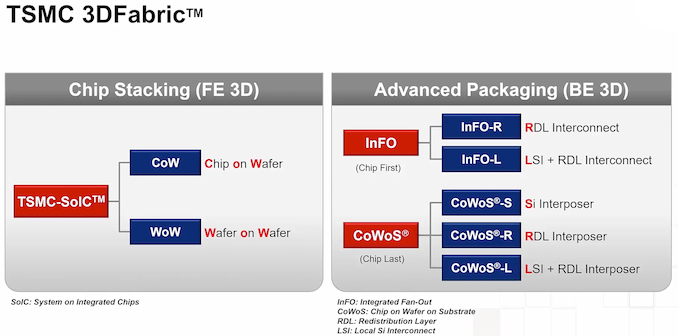

Customer demand for AI and HPC processors is driving a much greater use of advanced packaging technologies, particularly TSMC's chip-on-wafer-on-substrate (CoWoS) services. As things stand, TSMC is just barely meeting the current demand for this packaging method – never mind future demand – which is why last year the company announced plans to more than double CoWoS capacity by the end of 2024. But as it turns out, just doubling capacity once won't be enough, and the world's largest contract maker of chips is going to have to keep scaling up at a rapid pace.
At its European Technology Symposium last week TSMC announced plans to expand CoWoS capacity at a compound annual growth rate (CAGR) of over 60% till at least 2026. As a result, TSMC's CoWoS capacity will more than quadruple from 2023 levels by the end of that period. And keeping in mind that TSMC is prepping additional versions of CoWoS (namely CoWoS-L) that will enable building system-in-packages (SiPs) of up to eight reticle sizes, increasing CoWoS capacity by four-fold in three years may still not be enough. The good news is that the various third-party off-site assembly and testing (OSAT) providers are also expanding their CoWoS-like capacity, so the demand for advanced packing isn't a problem that TSMC is facing (or resolving) on their own.
And CoWoS isn't the only advanced packaging technology line whose capacity TSMC is looking to rapidly expand. The company also has its system-on-integrated chips (SoIC) 3D stacking technology which adoption is poised to grow in the coming years. To meet demand for its SoIC packaging methods TSMC will expand SoIC capacity at a 100% compound annual growth rate by the end of 2026. As a result, SoIC capacity will grow by eight-fold from 2023 levels by late 2026.
Overall, TSMC itself expects leading-edge SiPs for demanding applications like AI and HPC will adopt both CoWoS and SoIC 3D stacking technologies in the coming years, which is why it needs to increase capacity for both methods to be able to build those highly-complex processors.
Semiconductors

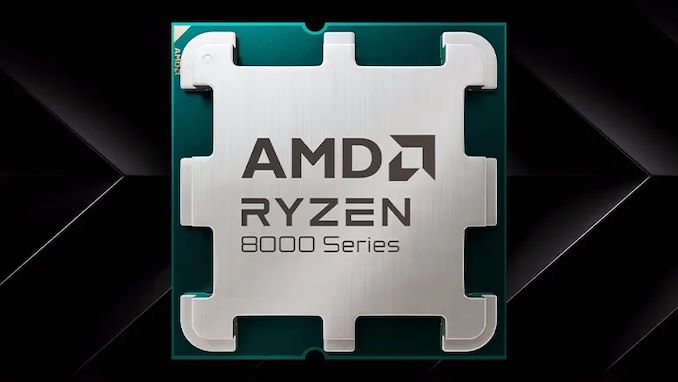
AMD has recently expanded its Ryzen 8000 series by introducing the Ryzen 7 8700F and Ryzen 5 8400F processors. Initially launched in China, these chips were added to AMD's global website, signaling they are available worldwide, apparently from April 1st. Built from the recent Zen 4-based Phoenix APUs using the TSMC 4nm node as their Zen 4 mobile chips, these new CPUs lack integrated graphics. However, the Ryzen 7 8700F does include the integrated Ryzen AI NPU for added capabilities in a world currently dominated by AI and moving it directly into the PC.
The company's decision to announce these chips in China aligns with its strategy to offer Ryzen solutions at every price point in the market. Although AMD didn't initially disclose the full specifications of these F-series models, and we did reach out to the company to ask about them, they refused to discuss them with us. Their listing on the website has now been updated with a complete list of specifications and features, with everything but the price mentioned.
| AMD Ryzen 8000G vs. Ryzen 8000F Series (Desktop) Zen 4 (Phoenix) |
|||||||||
| AnandTech | Cores/Threads | Base Freq |
Turbo Freq |
GPU | GPU Freq |
Ryzen AI (NPU) |
L3 Cache (MB) |
TDP | MSRP |
| Ryzen 7 | |||||||||
| Ryzen 7 8700G | 8/16 | 4200 | 5100 | R780M 12 CUs |
2900 | Y | 16 | 65W | $329 |
| Ryzen 7 8700F | 8/16 | 4100 | 5000 | - | - | Y | 16 | 65W | ? |
| Ryzen 5 | |||||||||
| Ryzen 5 8600G | 6/12 | 4300 | 5000 | R760M 8 CUs |
2800 | Y | 16 | 65W | $229 |
| Ryzen 5 8400F | 6/12 | 4200 | 4700 | - | - | N | 16 | 65W | ? |
The Ryzen 7 8700F features an 8C/16T design, with 16MB of L3 cache and the same 65W TDP as the Ryzen 7 8700G. Although the base clock speed is 4.1 GHz, it boosts to 5.0 GHz; this is 100 MHz less on both base/boost clocks than the 8700G. Meanwhile, the Ryzen 5 8400F is a slightly scaled-down version of the Ryzen 8600G APU, with 6C/12, 16MB of L3 cache, and again has a 100 MHz reduction to base clocks compared to the 8600G. Unlike the Ryzen 5 8400F, the Ryzen 7 8700F keeps AMD's Ryzen AI NPU, adding additional capability for generative AI.
The Ryzen 5 8400F can boost up to 4.7 GHz, 300 MHz slower than the Ryzen 5 8600G. AMD also allows overclocking for these new F-series chips, which means users could potentially boost the performance of these processors to match their G-series equivalents.
Pricing details are still pending, but to remain competitive, AMD will likely need to price these CPUs below the 8700G and 8600G, as well as the Ryzen 7 7700 and Ryzen 5 7600. These CPUs offer, albeit very limited, integrated graphics and have double the L3 cache capacity, along with higher boost clocks than the 8000F series chips, so pricing is something to consider whenever pricing becomes available.
CPUs
AMD has recently expanded its Ryzen 8000 series by introducing the Ryzen 7 8700F and Ryzen 5 8400F processors. Initially launched in China, these chips were added to AMD's global website, signaling they are available worldwide, apparently from April 1st. Built from the recent Zen 4-based Phoenix APUs using the TSMC 4nm node as their Zen 4 mobile chips, these new CPUs lack integrated graphics. However, the Ryzen 7 8700F does include the integrated Ryzen AI NPU for added capabilities in a world currently dominated by AI and moving it directly into the PC.
The company's decision to announce these chips in China aligns with its strategy to offer Ryzen solutions at every price point in the market. Although AMD didn't initially disclose the full specifications of these F-series models, and we did reach out to the company to ask about them, they refused to discuss them with us. Their listing on the website has now been updated with a complete list of specifications and features, with everything but the price mentioned.
| AMD Ryzen 8000G vs. Ryzen 8000F Series (Desktop) Zen 4 (Phoenix) |
|||||||||
| AnandTech | Cores/Threads | Base Freq |
Turbo Freq |
GPU | GPU Freq |
Ryzen AI (NPU) |
L3 Cache (MB) |
TDP | MSRP |
| Ryzen 7 | |||||||||
| Ryzen 7 8700G | 8/16 | 4200 | 5100 | R780M 12 CUs |
2900 | Y | 16 | 65W | $329 |
| Ryzen 7 8700F | 8/16 | 4100 | 5000 | - | - | Y | 16 | 65W | ? |
| Ryzen 5 | |||||||||
| Ryzen 5 8600G | 6/12 | 4300 | 5000 | R760M 8 CUs |
2800 | Y | 16 | 65W | $229 |
| Ryzen 5 8400F | 6/12 | 4200 | 4700 | - | - | N | 16 | 65W | ? |
The Ryzen 7 8700F features an 8C/16T design, with 16MB of L3 cache and the same 65W TDP as the Ryzen 7 8700G. Although the base clock speed is 4.1 GHz, it boosts to 5.0 GHz; this is 100 MHz less on both base/boost clocks than the 8700G. Meanwhile, the Ryzen 5 8400F is a slightly scaled-down version of the Ryzen 8600G APU, with 6C/12, 16MB of L3 cache, and again has a 100 MHz reduction to base clocks compared to the 8600G. Unlike the Ryzen 5 8400F, the Ryzen 7 8700F keeps AMD's Ryzen AI NPU, adding additional capability for generative AI.
The Ryzen 5 8400F can boost up to 4.7 GHz, 300 MHz slower than the Ryzen 5 8600G. AMD also allows overclocking for these new F-series chips, which means users could potentially boost the performance of these processors to match their G-series equivalents.
Pricing details are still pending, but to remain competitive, AMD will likely need to price these CPUs below the 8700G and 8600G, as well as the Ryzen 7 7700 and Ryzen 5 7600. These CPUs offer, albeit very limited, integrated graphics and have double the L3 cache capacity, along with higher boost clocks than the 8000F series chips, so pricing is something to consider whenever pricing becomes available.
CPUs
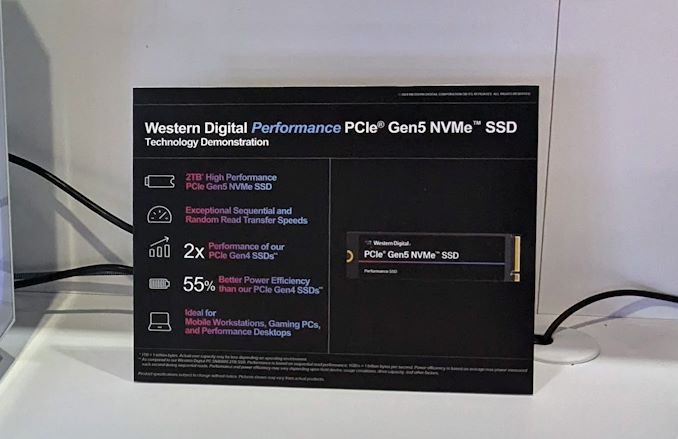
Western Digital's FMS 2024 demonstrations included a preview of their upcoming PCIe 5.0 x4 M.2 2280 NVMe SSDs for mobile workstations and consumer desktops. The Gen 5 client SSD market has been dominated by solutions based on Phison's E26 controller. The first generation products launched with slower NAND flash, while the more recent ones have exceeded the 14 GBps barrier by utilizing Micron's 2400 MT/s 232L 3D TLC. Western Digital has been conservative over the last year or so by focusing more on the mainstream / mid-range market in terms of new product introductions (such as the WD Blue SN5000, WD_BLACK SN770M, and the WD Blue SN580). Their SSD lineup is due for an update with Gen 5 drives being sorely missed. The SSDs being demonstrated at FMS 2024 will end up doing just that.
Western Digital's technology demonstrations in this segment involved two different M.2 2280 SSDs - one for the performance segment, and another for the mainstream market. They both utilize in-house controllers - while the performance segment drive uses a 8-channel controller with DRAM for the flash translation layer, the mainstream one utilizes a 4-channel DRAM-less controller. Both drives being benchmarked live were equipped with BiCS8 218-layer 3D TLC.
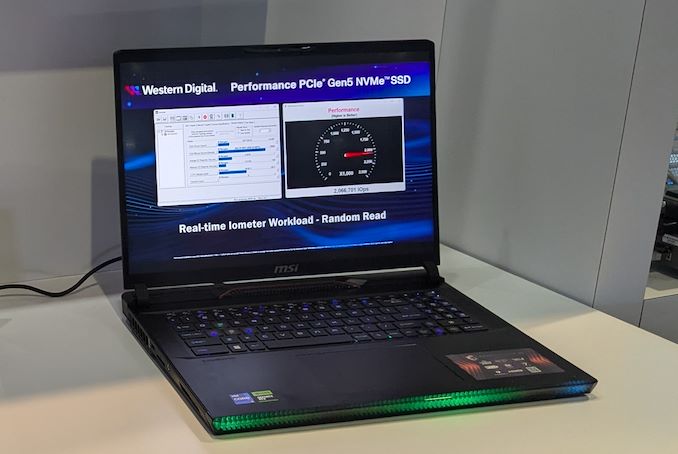
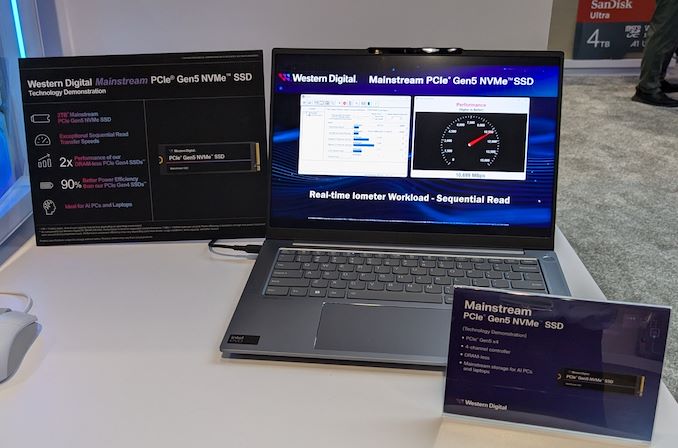
Western Digital is touting the power efficiency of their platform as a key differentiator, promising south of 7W (performance drive) and 5W (mainstream DRAM-less drive) for the complete SSD under stressful traffic. This makes it suitable for use in mobile workstations, but a good fit for desktops as well.
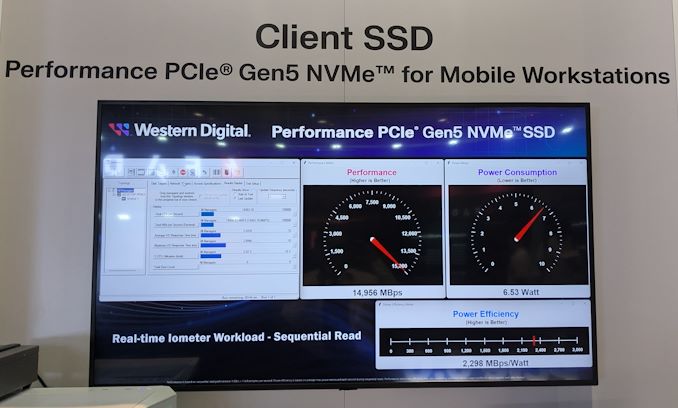
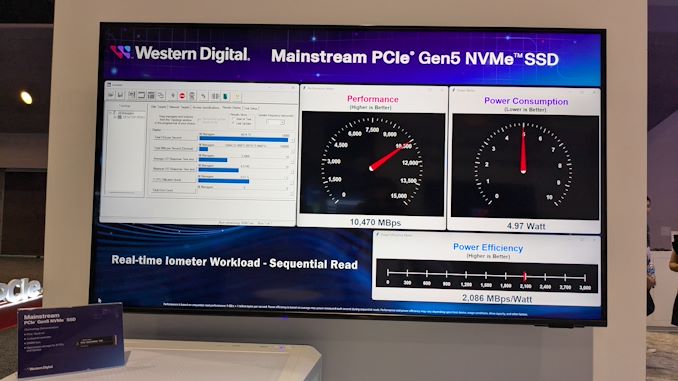
Demonstrated performance numbers indicate almost 15 GBps sequential reads and 2M+ random read IOPS for the performance drive, and 10.7 GBps sequential reads for the mainstream version. Western Digital might have missed the Gen 5 bus as it started out slowly. However, the technology demonstrations with the in-house controller and NAND indicate that WD has caught up just as the Gen 5 market is about to take off.|
Storage
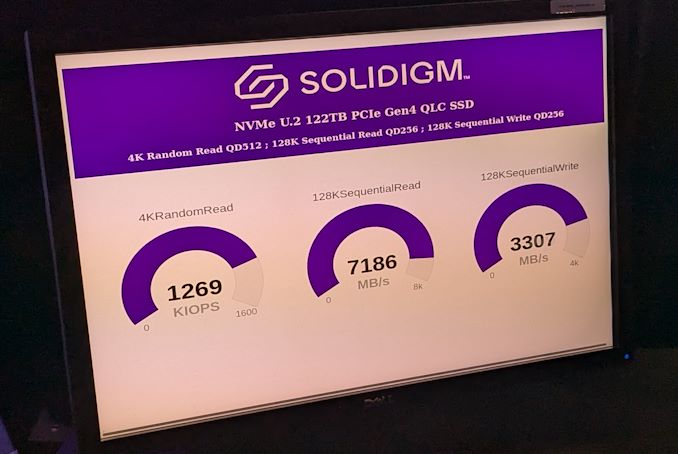
Solidigm's D5-P5336 61.44 TB enterprise QLC SSD released in mid-2023 has seen unprecedented demand over the last few quarters, driven by the insatiable demand for high-capacity storage in AI datacenters. Multiple vendors have recognized and started preparing products to service this demand, but Solidigm appears to have taken the lead in actual market availability.
At FMS 2024, Solidigm previewed a U.2 version of their upcoming 122 TB enterprise QLC SSD. The proof-of-concept Gen 4 drives were running live in a 2U server, and Solidigm is preparing them for an early 2025 release.
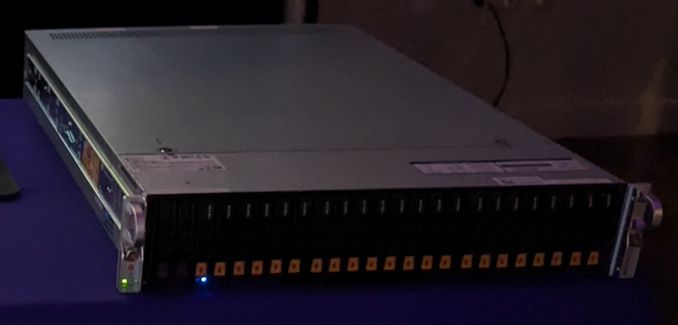
Given the capacity play, Solidigm will be relying on QLC technology. However, the company was coy about confirming the NAND generation used in the product.
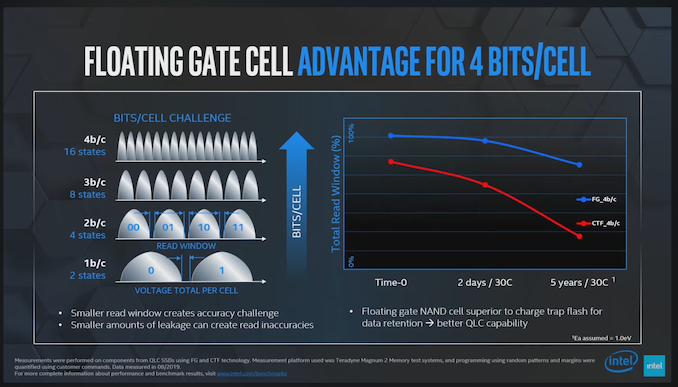
Source: The Advantages of Floating Gate Technology (YouTube)
The 61.44 TB D5-P5336 currently utilizes Solidigm's 192L 3D QLC based on the floating gate architecture. This has a distinct advantage for QLC endurance compared to the charge trap architecture also available to Solidigm from SK hynix. That said, SK hynix's 238L NAND also has a QLC avatar, which gives Solidigm the flexibility to use either NAND for the production version of the 122 TB drive. Solidigm expects to confirm this by the end of year in preparation for volume shipment in the first half of 2025.
Storage
Lorem Ipsum is simply dummy text of the printing and typesetting industry. Lorem Ipsum has been the industry's.
AMD has recently expanded its Ryzen 8000 series by introducing the Ryzen 7 8700F and Ryzen 5 8400F processors. Initially launched in China, these chips were added to AMD's global website, signaling they are available worldwide, apparently from April 1st. Built from the recent Zen 4-based Phoenix APUs using the TSMC 4nm node as their Zen 4 mobile chips, these new CPUs lack integrated graphics. However, the Ryzen 7 8700F does include the integrated Ryzen AI NPU for added capabilities in a world currently dominated by AI and moving it directly into the PC.
The company's decision to announce these chips in China aligns with its strategy to offer Ryzen solutions at every price point in the market. Although AMD didn't initially disclose the full specifications of these F-series models, and we did reach out to the company to ask about them, they refused to discuss them with us. Their listing on the website has now been updated with a complete list of specifications and features, with everything but the price mentioned.
| AMD Ryzen 8000G vs. Ryzen 8000F Series (Desktop) Zen 4 (Phoenix) |
|||||||||
| AnandTech | Cores/Threads | Base Freq |
Turbo Freq |
GPU | GPU Freq |
Ryzen AI (NPU) |
L3 Cache (MB) |
TDP | MSRP |
| Ryzen 7 | |||||||||
| Ryzen 7 8700G | 8/16 | 4200 | 5100 | R780M 12 CUs |
2900 | Y | 16 | 65W | $329 |
| Ryzen 7 8700F | 8/16 | 4100 | 5000 | - | - | Y | 16 | 65W | ? |
| Ryzen 5 | |||||||||
| Ryzen 5 8600G | 6/12 | 4300 | 5000 | R760M 8 CUs |
2800 | Y | 16 | 65W | $229 |
| Ryzen 5 8400F | 6/12 | 4200 | 4700 | - | - | N | 16 | 65W | ? |
The Ryzen 7 8700F features an 8C/16T design, with 16MB of L3 cache and the same 65W TDP as the Ryzen 7 8700G. Although the base clock speed is 4.1 GHz, it boosts to 5.0 GHz; this is 100 MHz less on both base/boost clocks than the 8700G. Meanwhile, the Ryzen 5 8400F is a slightly scaled-down version of the Ryzen 8600G APU, with 6C/12, 16MB of L3 cache, and again has a 100 MHz reduction to base clocks compared to the 8600G. Unlike the Ryzen 5 8400F, the Ryzen 7 8700F keeps AMD's Ryzen AI NPU, adding additional capability for generative AI.
The Ryzen 5 8400F can boost up to 4.7 GHz, 300 MHz slower than the Ryzen 5 8600G. AMD also allows overclocking for these new F-series chips, which means users could potentially boost the performance of these processors to match their G-series equivalents.
Pricing details are still pending, but to remain competitive, AMD will likely need to price these CPUs below the 8700G and 8600G, as well as the Ryzen 7 7700 and Ryzen 5 7600. These CPUs offer, albeit very limited, integrated graphics and have double the L3 cache capacity, along with higher boost clocks than the 8000F series chips, so pricing is something to consider whenever pricing becomes available.
CPUs

 services. As things stand, TSMC is just barely meeting the current demand for this packaging method – never mind future demand – which is why last year the company announced plans to more than double CoWoS capacity by the end of 2024. But as it turns out, just doubling capacity once won't be enough, and the world's largest contract maker of chips is going to have to keep scaling up at a rapid pace.</p>
<p>At its European Technology Symposium last week TSMC announced plans to expand CoWoS capacity at a compound annual growth rate (CAGR) of over 60% till at least 2026. As a result, TSMC's CoWoS capacity will more than quadruple from 2023 levels by the end of that period. And keeping in mind that TSMC is prepping additional versions of CoWoS (namely CoWoS-L) that will enable building <a href="https://www.anandtech.com/show/21375/tsmc-readies-8x-reticle-size-super-carrier-interposer">system-in-packages (SiPs) of up to eight reticle sizes</a>, increasing CoWoS capacity by four-fold in three years may <em>still</em> not be enough. The good news is that the various third-party off-site assembly and testing (OSAT) providers are also expanding their CoWoS-like capacity, so the demand for advanced packing isn't a problem that TSMC is facing (or resolving) on their own.</p>
<p>And CoWoS isn't the only advanced packaging technology line whose capacity TSMC is looking to rapidly expand. The company also has its system-on-integrated chips (SoIC) 3D stacking technology which adoption is poised to grow in the coming years. To meet demand for its SoIC packaging methods TSMC will expand SoIC capacity at a 100% compound annual growth rate by the end of 2026. As a result, SoIC capacity will grow by eight-fold from 2023 levels by late 2026.</p>
<p>Overall, TSMC itself expects leading-edge SiPs for demanding applications like AI and HPC will adopt both CoWoS and SoIC 3D stacking technologies in the coming years, which is why it needs to increase capacity for both methods to be able to build those highly-complex processors.</p>
</p> Semiconductors)
 services. As things stand, TSMC is just barely meeting the current demand for this packaging method – never mind future demand – which is why last year the company announced plans to more than double CoWoS capacity by the end of 2024. But as it turns out, just doubling capacity once won't be enough, and the world's largest contract maker of chips is going to have to keep scaling up at a rapid pace.</p>
<p>At its European Technology Symposium last week TSMC announced plans to expand CoWoS capacity at a compound annual growth rate (CAGR) of over 60% till at least 2026. As a result, TSMC's CoWoS capacity will more than quadruple from 2023 levels by the end of that period. And keeping in mind that TSMC is prepping additional versions of CoWoS (namely CoWoS-L) that will enable building <a href="https://www.anandtech.com/show/21375/tsmc-readies-8x-reticle-size-super-carrier-interposer">system-in-packages (SiPs) of up to eight reticle sizes</a>, increasing CoWoS capacity by four-fold in three years may <em>still</em> not be enough. The good news is that the various third-party off-site assembly and testing (OSAT) providers are also expanding their CoWoS-like capacity, so the demand for advanced packing isn't a problem that TSMC is facing (or resolving) on their own.</p>
<p>And CoWoS isn't the only advanced packaging technology line whose capacity TSMC is looking to rapidly expand. The company also has its system-on-integrated chips (SoIC) 3D stacking technology which adoption is poised to grow in the coming years. To meet demand for its SoIC packaging methods TSMC will expand SoIC capacity at a 100% compound annual growth rate by the end of 2026. As a result, SoIC capacity will grow by eight-fold from 2023 levels by late 2026.</p>
<p>Overall, TSMC itself expects leading-edge SiPs for demanding applications like AI and HPC will adopt both CoWoS and SoIC 3D stacking technologies in the coming years, which is why it needs to increase capacity for both methods to be able to build those highly-complex processors.</p>
</p> Semiconductors)
 services. As things stand, TSMC is just barely meeting the current demand for this packaging method – never mind future demand – which is why last year the company announced plans to more than double CoWoS capacity by the end of 2024. But as it turns out, just doubling capacity once won't be enough, and the world's largest contract maker of chips is going to have to keep scaling up at a rapid pace.</p>
<p>At its European Technology Symposium last week TSMC announced plans to expand CoWoS capacity at a compound annual growth rate (CAGR) of over 60% till at least 2026. As a result, TSMC's CoWoS capacity will more than quadruple from 2023 levels by the end of that period. And keeping in mind that TSMC is prepping additional versions of CoWoS (namely CoWoS-L) that will enable building <a href="https://www.anandtech.com/show/21375/tsmc-readies-8x-reticle-size-super-carrier-interposer">system-in-packages (SiPs) of up to eight reticle sizes</a>, increasing CoWoS capacity by four-fold in three years may <em>still</em> not be enough. The good news is that the various third-party off-site assembly and testing (OSAT) providers are also expanding their CoWoS-like capacity, so the demand for advanced packing isn't a problem that TSMC is facing (or resolving) on their own.</p>
<p>And CoWoS isn't the only advanced packaging technology line whose capacity TSMC is looking to rapidly expand. The company also has its system-on-integrated chips (SoIC) 3D stacking technology which adoption is poised to grow in the coming years. To meet demand for its SoIC packaging methods TSMC will expand SoIC capacity at a 100% compound annual growth rate by the end of 2026. As a result, SoIC capacity will grow by eight-fold from 2023 levels by late 2026.</p>
<p>Overall, TSMC itself expects leading-edge SiPs for demanding applications like AI and HPC will adopt both CoWoS and SoIC 3D stacking technologies in the coming years, which is why it needs to increase capacity for both methods to be able to build those highly-complex processors.</p>
</p> Semiconductors | https://compbuddey.blogspot.com/2024/06/tsmc-to-expand-cowos-capacity-by-60_18.html)
 services. As things stand, TSMC is just barely meeting the current demand for this packaging method – never mind future demand – which is why last year the company announced plans to more than double CoWoS capacity by the end of 2024. But as it turns out, just doubling capacity once won't be enough, and the world's largest contract maker of chips is going to have to keep scaling up at a rapid pace.</p>
<p>At its European Technology Symposium last week TSMC announced plans to expand CoWoS capacity at a compound annual growth rate (CAGR) of over 60% till at least 2026. As a result, TSMC's CoWoS capacity will more than quadruple from 2023 levels by the end of that period. And keeping in mind that TSMC is prepping additional versions of CoWoS (namely CoWoS-L) that will enable building <a href="https://www.anandtech.com/show/21375/tsmc-readies-8x-reticle-size-super-carrier-interposer">system-in-packages (SiPs) of up to eight reticle sizes</a>, increasing CoWoS capacity by four-fold in three years may <em>still</em> not be enough. The good news is that the various third-party off-site assembly and testing (OSAT) providers are also expanding their CoWoS-like capacity, so the demand for advanced packing isn't a problem that TSMC is facing (or resolving) on their own.</p>
<p>And CoWoS isn't the only advanced packaging technology line whose capacity TSMC is looking to rapidly expand. The company also has its system-on-integrated chips (SoIC) 3D stacking technology which adoption is poised to grow in the coming years. To meet demand for its SoIC packaging methods TSMC will expand SoIC capacity at a 100% compound annual growth rate by the end of 2026. As a result, SoIC capacity will grow by eight-fold from 2023 levels by late 2026.</p>
<p>Overall, TSMC itself expects leading-edge SiPs for demanding applications like AI and HPC will adopt both CoWoS and SoIC 3D stacking technologies in the coming years, which is why it needs to increase capacity for both methods to be able to build those highly-complex processors.</p>
</p> Semiconductors&body=https://compbuddey.blogspot.com/2024/06/tsmc-to-expand-cowos-capacity-by-60_18.html)


0 Comments