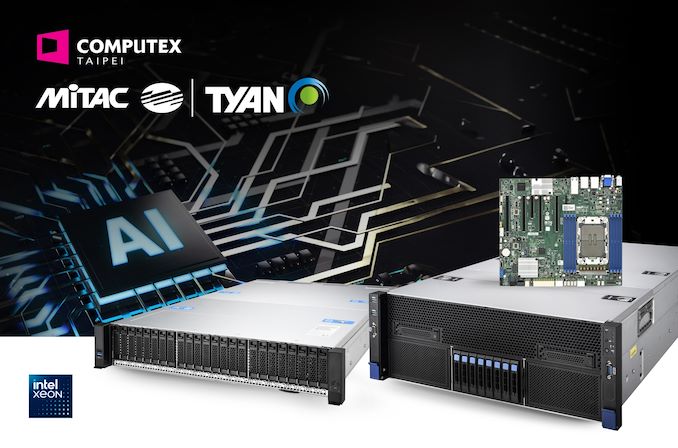

Later this year Intel is set to introduce its Xeon 6-branded processors, codenamed Granite Rapids (6x00P) and Sierra Forest (6x00E). And with it will come a new slew of server motherboards and pre-built server platforms to go with it. On the latter note, this will be the first generation where Intel won't be offering any pre-builts of its own, after selling that business off to MiTAC last year.
To that end, MiTAC and its subsidiary Tyan were at this year's event to demonstrate what they've been up to since acquiring Intel's server business unit, as well as to show off the server platforms they're developing for the Xeon 6 family. Altogether, the companies had two server platforms on display – a compact 2S system, and a larger 2S system with significant expansion capabilities – as well as a pair of single-socket designs from Tyan.
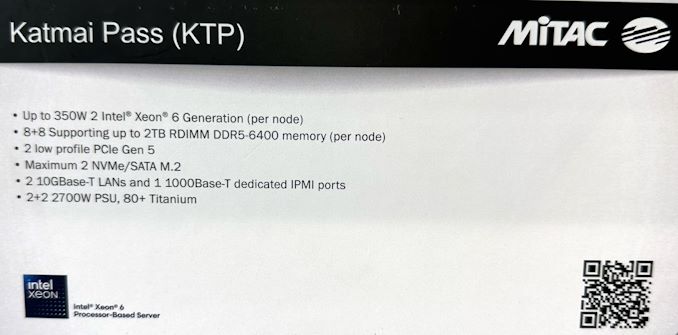
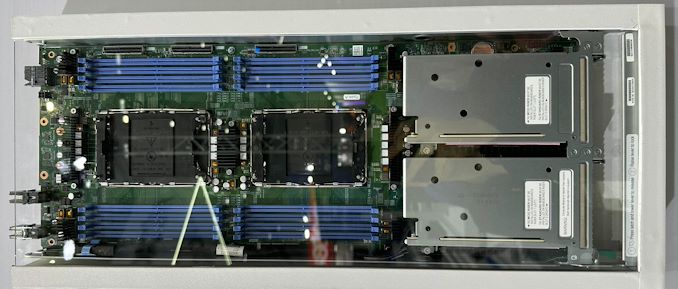
The most basic platform that MiTAC had to show is their TX86-E7148 (Katmai Pass), a half-width 1U system that's the successor to Intel's D50DNP platform. Katmai Pass has two CPU sockets, supports up to 2 TB of DDR5-6400 RDIMMs over 16 slots (8 per CPU), and has two low-profile PCIe 5.0 x16 slots. Like its predecessor, this platform is aimed at mainstream servers that do not need a lot of storage or room to house bulky add-in cards like AI accelerators.
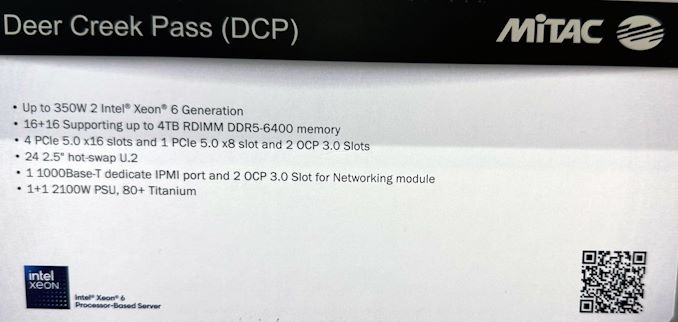
The company's other platform is TX77A-E7142 (Deer Creek Pass), a considerably more serious offering that replaces Intel's M50FCP platform. This board can house up to 4 TB of DDR5-6400 RDIMMs over 32 slots (16 per CPU with 2DPC), four PCIe 5.0 x16 slots, one PCIe 5.0 x8 slot, two OCP 3.0 slots, and 24 hot-swap U.2 bays. Deer Creek Pass can be used both for general-purpose workloads, high-performance storage, as well as workloads that require GPUs or other special-purpose accelerators.
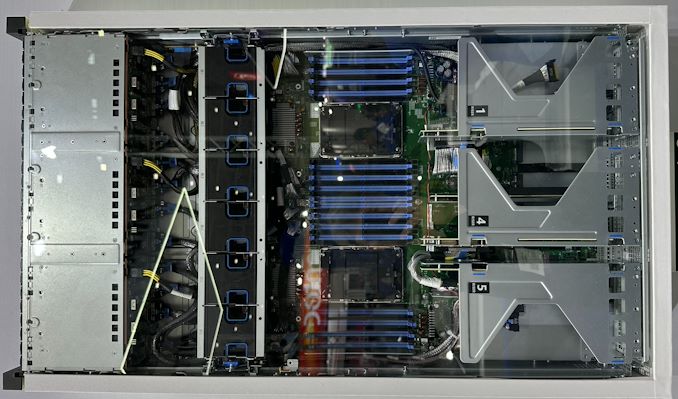
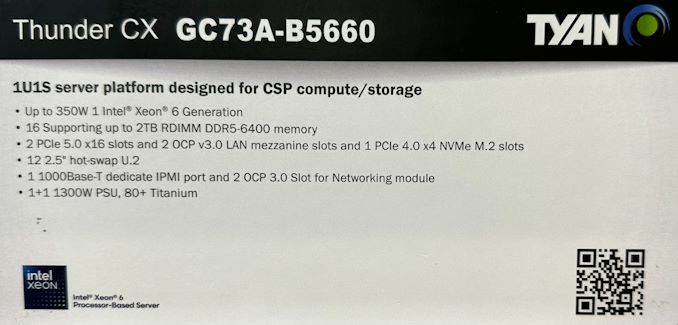
Meanwhile Tyan had the single-socket Thunder CX GC73A-B5660 on display. That system supports up to 2 TB of DDR5-6400 memory over 16 RDIMMs and offers two PCIe 5.0 x16 slots, one PCIe 4.0 x4 M.2 slot, two OCP 3.0 slots, and 12 hot-swappable U.2 drive bays.
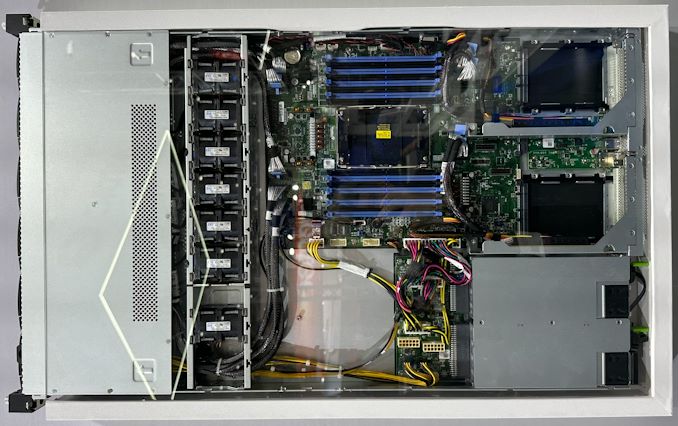
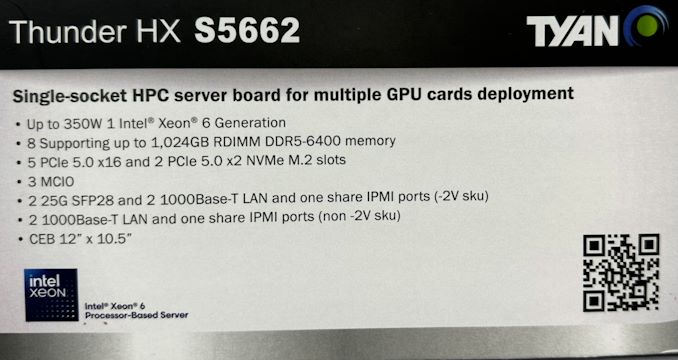
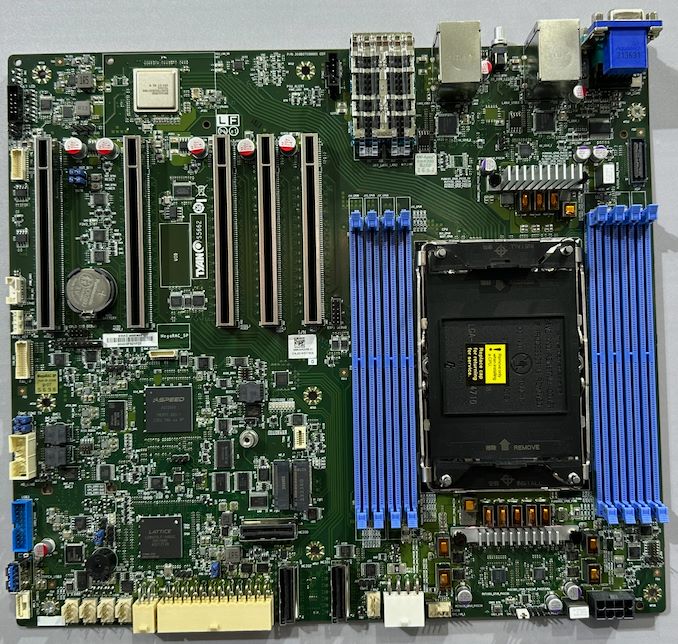
Finally, Tyan's Thunder HX S5662 is an HPC server board specifically designed to house multiple AI accelerators and other large PCIe cards. This board supports one Xeon 6 6700 processor, up to 1 TB of memory over eight DDR5-6400 RDIMMs, and has five tradiitonal PCIe 5.0 x16 slots as well as two PCIe 5.0 x2 M.2 slots for storage.
MiTAC is expected to start shipments of these new Xeon 6 motherboards in the coming months, as Intel rolls out its next-generation datacenter CPUs. Pricing of these platforms is unknown for now, but expect it to be comparable to... Servers


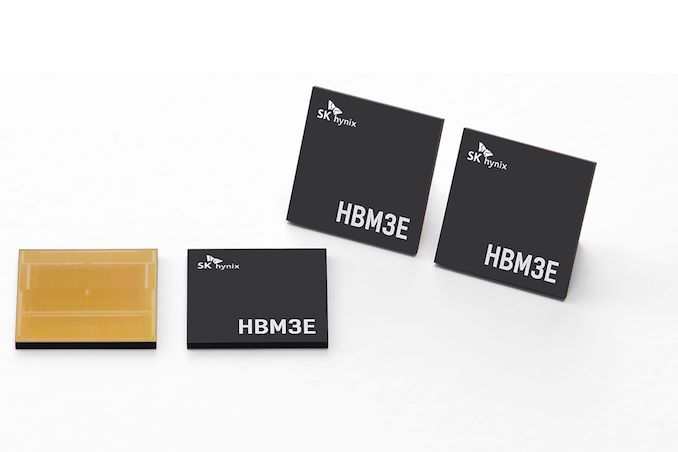
Demand for high-performance processors for AI training is skyrocketing, and consequently so is the demand for the components that go into these processors. So much so that SK hynix this week is very publicly announcing that the company's high-bandwidth memory (HBM) production capacity has already sold out for the rest of 2024, and even most of 2025 has already sold out as well.
SK hynix currently produces various types of HBM memory for customers like Amazon, AMD, Facebook, Google (Broadcom), Intel, Microsoft, and, of course, NVIDIA. The latter is an especially prolific consumer of HBM3 and HBM3E memory for its H100/H200/GH200 accelerators, as NVIDIA is also working to fill what remains an insatiable (and unmet) demand for its accelerators.
As a result, HBM memory orders, which are already placed months in advance, are now backlogging well into 2025 as chip vendors look to secure supplies of the memory stacks critical to their success.
This has made SK hynix the secnd HBM memory vendor in recent months to announce that they've sold out into 2025, following an earlier announcement from Micron regarding its HBM3E production. But of the two announcements, SK hynix's is arguably the most significant yet, as the South Korean firm's HBM production capacity is far greater than Micron's. So while things were merely "interesting" with the smallest of the Big Three memory manufacturers being sold out into 2025, things are taking a more concerning (and constrained) outlook now that SK hynix is as well.
SK hynix currently controls roughly 46% - 49% of HBM market, and its share is not expected to drop significantly in 2025, according to market tracking firm TrendForce. By contrast, Micron's share on HBM memory market is between 4% and 6%. Since HBM supply of both companies is sold out through the most of 2025, we're likely looking at a scenario where over 50% of the industry's total HBM3/HBM3E supply for the coming quarters is already sold out.
This leaves Samsung as the only member of the group not to comment on HBM demand so far. Though with memory being a highly fungible commodity product, it would be surprising if Samsung wasn't facing similar demand. And, ultimately, all of this is pointing towards the indusry entering an HBM3 memory shortage.
Separately, SK hynix said that it is sampling 12-Hi 36GB HBM3E stacks with customers and will begin volume shipments in the third quarter.
Memory
Demand for high-performance processors for AI training is skyrocketing, and consequently so is the demand for the components that go into these processors. So much so that SK hynix this week is very publicly announcing that the company's high-bandwidth memory (HBM) production capacity has already sold out for the rest of 2024, and even most of 2025 has already sold out as well.
SK hynix currently produces various types of HBM memory for customers like Amazon, AMD, Facebook, Google (Broadcom), Intel, Microsoft, and, of course, NVIDIA. The latter is an especially prolific consumer of HBM3 and HBM3E memory for its H100/H200/GH200 accelerators, as NVIDIA is also working to fill what remains an insatiable (and unmet) demand for its accelerators.
As a result, HBM memory orders, which are already placed months in advance, are now backlogging well into 2025 as chip vendors look to secure supplies of the memory stacks critical to their success.
This has made SK hynix the secnd HBM memory vendor in recent months to announce that they've sold out into 2025, following an earlier announcement from Micron regarding its HBM3E production. But of the two announcements, SK hynix's is arguably the most significant yet, as the South Korean firm's HBM production capacity is far greater than Micron's. So while things were merely "interesting" with the smallest of the Big Three memory manufacturers being sold out into 2025, things are taking a more concerning (and constrained) outlook now that SK hynix is as well.
SK hynix currently controls roughly 46% - 49% of HBM market, and its share is not expected to drop significantly in 2025, according to market tracking firm TrendForce. By contrast, Micron's share on HBM memory market is between 4% and 6%. Since HBM supply of both companies is sold out through the most of 2025, we're likely looking at a scenario where over 50% of the industry's total HBM3/HBM3E supply for the coming quarters is already sold out.
This leaves Samsung as the only member of the group not to comment on HBM demand so far. Though with memory being a highly fungible commodity product, it would be surprising if Samsung wasn't facing similar demand. And, ultimately, all of this is pointing towards the indusry entering an HBM3 memory shortage.
Separately, SK hynix said that it is sampling 12-Hi 36GB HBM3E stacks with customers and will begin volume shipments in the third quarter.
Memory
Lorem Ipsum is simply dummy text of the printing and typesetting industry. Lorem Ipsum has been the industry's.
Demand for high-performance processors for AI training is skyrocketing, and consequently so is the demand for the components that go into these processors. So much so that SK hynix this week is very publicly announcing that the company's high-bandwidth memory (HBM) production capacity has already sold out for the rest of 2024, and even most of 2025 has already sold out as well.
SK hynix currently produces various types of HBM memory for customers like Amazon, AMD, Facebook, Google (Broadcom), Intel, Microsoft, and, of course, NVIDIA. The latter is an especially prolific consumer of HBM3 and HBM3E memory for its H100/H200/GH200 accelerators, as NVIDIA is also working to fill what remains an insatiable (and unmet) demand for its accelerators.
As a result, HBM memory orders, which are already placed months in advance, are now backlogging well into 2025 as chip vendors look to secure supplies of the memory stacks critical to their success.
This has made SK hynix the secnd HBM memory vendor in recent months to announce that they've sold out into 2025, following an earlier announcement from Micron regarding its HBM3E production. But of the two announcements, SK hynix's is arguably the most significant yet, as the South Korean firm's HBM production capacity is far greater than Micron's. So while things were merely "interesting" with the smallest of the Big Three memory manufacturers being sold out into 2025, things are taking a more concerning (and constrained) outlook now that SK hynix is as well.
SK hynix currently controls roughly 46% - 49% of HBM market, and its share is not expected to drop significantly in 2025, according to market tracking firm TrendForce. By contrast, Micron's share on HBM memory market is between 4% and 6%. Since HBM supply of both companies is sold out through the most of 2025, we're likely looking at a scenario where over 50% of the industry's total HBM3/HBM3E supply for the coming quarters is already sold out.
This leaves Samsung as the only member of the group not to comment on HBM demand so far. Though with memory being a highly fungible commodity product, it would be surprising if Samsung wasn't facing similar demand. And, ultimately, all of this is pointing towards the indusry entering an HBM3 memory shortage.
Separately, SK hynix said that it is sampling 12-Hi 36GB HBM3E stacks with customers and will begin volume shipments in the third quarter.
Memory



 and Sierra Forest (6x00E). And with it will come a new slew of server motherboards and pre-built server platforms to go with it. On the latter note, this will be the first generation where Intel won't be offering any pre-builts of its own, after <a href="https://www.anandtech.com/show/18810/intel-to-exit-prebuilt-server-business-sells-to-mitac">selling that business off to MiTAC last year</a>.</p>
<p>To that end, MiTAC and its subsidiary Tyan were at this year's event to demonstrate what they've been up to since acquiring Intel's server business unit, as well as to show off the server platforms they're developing for the Xeon 6 family. Altogether, the companies had two server platforms on display – a compact 2S system, and a larger 2S system with significant expansion capabilities – as well as a pair of single-socket designs from Tyan.</p>
<p>The most basic platform that MiTAC had to show is their TX86-E7148 (Katmai Pass), a half-width 1U system that's the successor to Intel's D50DNP platform. Katmai Pass has two CPU sockets, supports up to 2 TB of DDR5-6400 RDIMMs over 16 slots (8 per CPU), and has two low-profile PCIe 5.0 x16 slots. Like its predecessor, this platform is aimed at mainstream servers that do not need a lot of storage or room to house bulky add-in cards like AI accelerators.</p>
<p style="text-align: center;"><a href="https://www.anandtech.com/show/21448/mitac-shows-off-motherboards-for-intels-xeon-6-cpus"><img alt="" src="https://images.anandtech.com/doci/21448/IMG_1280-ktp-s_575px.jpg" /></a></p>
<p style="text-align: center;"><a href="https://www.anandtech.com/show/21448/mitac-shows-off-motherboards-for-intels-xeon-6-cpus"><img alt="" src="https://images.anandtech.com/doci/21448/IMG_1281-ktp_575px.jpg" /></a></p>
<p>The company's other platform is TX77A-E7142 (Deer Creek Pass), a considerably more serious offering that replaces Intel's M50FCP platform. This board can house up to 4 TB of DDR5-6400 RDIMMs over 32 slots (16 per CPU with 2DPC), four PCIe 5.0 x16 slots, one PCIe 5.0 x8 slot, two OCP 3.0 slots, and 24 hot-swap U.2 bays. Deer Creek Pass can be used both for general-purpose workloads, high-performance storage, as well as workloads that require GPUs or other special-purpose accelerators.</p>
<p style="text-align: center;"><a href="https://www.anandtech.com/show/21448/mitac-shows-off-motherboards-for-intels-xeon-6-cpus"><img alt="" src="https://images.anandtech.com/doci/21448/IMG_1283-dcp-s_575px.jpg" /></a></p>
<p style="text-align: center;"><a href="https://www.anandtech.com/show/21448/mitac-shows-off-motherboards-for-intels-xeon-6-cpus"><img alt="" src="https://images.anandtech.com/doci/21448/IMG_1284-dcp_575px.jpg" /></a></p>
<p>Meanwhile Tyan had the single-socket Thunder CX GC73A-B5660 on display. That system supports up to 2 TB of DDR5-6400 memory over 16 RDIMMs and offers two PCIe 5.0 x16 slots, one PCIe 4.0 x4 M.2 slot, two OCP 3.0 slots, and 12 hot-swappable U.2 drive bays.</p>
<p style="text-align: center;"><a href="https://www.anandtech.com/show/21448/mitac-shows-off-motherboards-for-intels-xeon-6-cpus"><img alt="" src="https://images.anandtech.com/doci/21448/IMG_1286-thunder-cx_575px.jpg" /></a></p>
<p style="text-align: center;"><a href="https://www.anandtech.com/show/21448/mitac-shows-off-motherboards-for-intels-xeon-6-cpus"><img alt="" src="https://images.anandtech.com/doci/21448/IMG_1287-thunder-cs_575px.jpg" /></a></p>
<p>Finally, Tyan's Thunder HX S5662 is an HPC server board specifically designed to house multiple AI accelerators and other large PCIe cards. This board supports one Xeon 6 6700 processor, up to 1 TB of memory over eight DDR5-6400 RDIMMs, and has five tradiitonal PCIe 5.0 x16 slots as well as two PCIe 5.0 x2 M.2 slots for storage.</p>
<p style="text-align: center;"><a href="https://www.anandtech.com/show/21448/mitac-shows-off-motherboards-for-intels-xeon-6-cpus"><img alt="" src="https://images.anandtech.com/doci/21448/IMG_1289-thunder-hx_575px.jpg" /></a></p>
<p style="text-align: center;"><a href="https://www.anandtech.com/show/21448/mitac-shows-off-motherboards-for-intels-xeon-6-cpus"><img alt="" src="https://images.anandtech.com/doci/21448/IMG_1290-thunder-hx_575px.jpg" /></a></p>
<p>MiTAC is expected to start shipments of these new Xeon 6 motherboards in the coming months, as Intel rolls out its next-generation datacenter CPUs. Pricing of these platforms is unknown for now, but expect it to be comparable to... Servers)
 and Sierra Forest (6x00E). And with it will come a new slew of server motherboards and pre-built server platforms to go with it. On the latter note, this will be the first generation where Intel won't be offering any pre-builts of its own, after <a href="https://www.anandtech.com/show/18810/intel-to-exit-prebuilt-server-business-sells-to-mitac">selling that business off to MiTAC last year</a>.</p>
<p>To that end, MiTAC and its subsidiary Tyan were at this year's event to demonstrate what they've been up to since acquiring Intel's server business unit, as well as to show off the server platforms they're developing for the Xeon 6 family. Altogether, the companies had two server platforms on display – a compact 2S system, and a larger 2S system with significant expansion capabilities – as well as a pair of single-socket designs from Tyan.</p>
<p>The most basic platform that MiTAC had to show is their TX86-E7148 (Katmai Pass), a half-width 1U system that's the successor to Intel's D50DNP platform. Katmai Pass has two CPU sockets, supports up to 2 TB of DDR5-6400 RDIMMs over 16 slots (8 per CPU), and has two low-profile PCIe 5.0 x16 slots. Like its predecessor, this platform is aimed at mainstream servers that do not need a lot of storage or room to house bulky add-in cards like AI accelerators.</p>
<p style="text-align: center;"><a href="https://www.anandtech.com/show/21448/mitac-shows-off-motherboards-for-intels-xeon-6-cpus"><img alt="" src="https://images.anandtech.com/doci/21448/IMG_1280-ktp-s_575px.jpg" /></a></p>
<p style="text-align: center;"><a href="https://www.anandtech.com/show/21448/mitac-shows-off-motherboards-for-intels-xeon-6-cpus"><img alt="" src="https://images.anandtech.com/doci/21448/IMG_1281-ktp_575px.jpg" /></a></p>
<p>The company's other platform is TX77A-E7142 (Deer Creek Pass), a considerably more serious offering that replaces Intel's M50FCP platform. This board can house up to 4 TB of DDR5-6400 RDIMMs over 32 slots (16 per CPU with 2DPC), four PCIe 5.0 x16 slots, one PCIe 5.0 x8 slot, two OCP 3.0 slots, and 24 hot-swap U.2 bays. Deer Creek Pass can be used both for general-purpose workloads, high-performance storage, as well as workloads that require GPUs or other special-purpose accelerators.</p>
<p style="text-align: center;"><a href="https://www.anandtech.com/show/21448/mitac-shows-off-motherboards-for-intels-xeon-6-cpus"><img alt="" src="https://images.anandtech.com/doci/21448/IMG_1283-dcp-s_575px.jpg" /></a></p>
<p style="text-align: center;"><a href="https://www.anandtech.com/show/21448/mitac-shows-off-motherboards-for-intels-xeon-6-cpus"><img alt="" src="https://images.anandtech.com/doci/21448/IMG_1284-dcp_575px.jpg" /></a></p>
<p>Meanwhile Tyan had the single-socket Thunder CX GC73A-B5660 on display. That system supports up to 2 TB of DDR5-6400 memory over 16 RDIMMs and offers two PCIe 5.0 x16 slots, one PCIe 4.0 x4 M.2 slot, two OCP 3.0 slots, and 12 hot-swappable U.2 drive bays.</p>
<p style="text-align: center;"><a href="https://www.anandtech.com/show/21448/mitac-shows-off-motherboards-for-intels-xeon-6-cpus"><img alt="" src="https://images.anandtech.com/doci/21448/IMG_1286-thunder-cx_575px.jpg" /></a></p>
<p style="text-align: center;"><a href="https://www.anandtech.com/show/21448/mitac-shows-off-motherboards-for-intels-xeon-6-cpus"><img alt="" src="https://images.anandtech.com/doci/21448/IMG_1287-thunder-cs_575px.jpg" /></a></p>
<p>Finally, Tyan's Thunder HX S5662 is an HPC server board specifically designed to house multiple AI accelerators and other large PCIe cards. This board supports one Xeon 6 6700 processor, up to 1 TB of memory over eight DDR5-6400 RDIMMs, and has five tradiitonal PCIe 5.0 x16 slots as well as two PCIe 5.0 x2 M.2 slots for storage.</p>
<p style="text-align: center;"><a href="https://www.anandtech.com/show/21448/mitac-shows-off-motherboards-for-intels-xeon-6-cpus"><img alt="" src="https://images.anandtech.com/doci/21448/IMG_1289-thunder-hx_575px.jpg" /></a></p>
<p style="text-align: center;"><a href="https://www.anandtech.com/show/21448/mitac-shows-off-motherboards-for-intels-xeon-6-cpus"><img alt="" src="https://images.anandtech.com/doci/21448/IMG_1290-thunder-hx_575px.jpg" /></a></p>
<p>MiTAC is expected to start shipments of these new Xeon 6 motherboards in the coming months, as Intel rolls out its next-generation datacenter CPUs. Pricing of these platforms is unknown for now, but expect it to be comparable to... Servers)
 and Sierra Forest (6x00E). And with it will come a new slew of server motherboards and pre-built server platforms to go with it. On the latter note, this will be the first generation where Intel won't be offering any pre-builts of its own, after <a href="https://www.anandtech.com/show/18810/intel-to-exit-prebuilt-server-business-sells-to-mitac">selling that business off to MiTAC last year</a>.</p>
<p>To that end, MiTAC and its subsidiary Tyan were at this year's event to demonstrate what they've been up to since acquiring Intel's server business unit, as well as to show off the server platforms they're developing for the Xeon 6 family. Altogether, the companies had two server platforms on display – a compact 2S system, and a larger 2S system with significant expansion capabilities – as well as a pair of single-socket designs from Tyan.</p>
<p>The most basic platform that MiTAC had to show is their TX86-E7148 (Katmai Pass), a half-width 1U system that's the successor to Intel's D50DNP platform. Katmai Pass has two CPU sockets, supports up to 2 TB of DDR5-6400 RDIMMs over 16 slots (8 per CPU), and has two low-profile PCIe 5.0 x16 slots. Like its predecessor, this platform is aimed at mainstream servers that do not need a lot of storage or room to house bulky add-in cards like AI accelerators.</p>
<p style="text-align: center;"><a href="https://www.anandtech.com/show/21448/mitac-shows-off-motherboards-for-intels-xeon-6-cpus"><img alt="" src="https://images.anandtech.com/doci/21448/IMG_1280-ktp-s_575px.jpg" /></a></p>
<p style="text-align: center;"><a href="https://www.anandtech.com/show/21448/mitac-shows-off-motherboards-for-intels-xeon-6-cpus"><img alt="" src="https://images.anandtech.com/doci/21448/IMG_1281-ktp_575px.jpg" /></a></p>
<p>The company's other platform is TX77A-E7142 (Deer Creek Pass), a considerably more serious offering that replaces Intel's M50FCP platform. This board can house up to 4 TB of DDR5-6400 RDIMMs over 32 slots (16 per CPU with 2DPC), four PCIe 5.0 x16 slots, one PCIe 5.0 x8 slot, two OCP 3.0 slots, and 24 hot-swap U.2 bays. Deer Creek Pass can be used both for general-purpose workloads, high-performance storage, as well as workloads that require GPUs or other special-purpose accelerators.</p>
<p style="text-align: center;"><a href="https://www.anandtech.com/show/21448/mitac-shows-off-motherboards-for-intels-xeon-6-cpus"><img alt="" src="https://images.anandtech.com/doci/21448/IMG_1283-dcp-s_575px.jpg" /></a></p>
<p style="text-align: center;"><a href="https://www.anandtech.com/show/21448/mitac-shows-off-motherboards-for-intels-xeon-6-cpus"><img alt="" src="https://images.anandtech.com/doci/21448/IMG_1284-dcp_575px.jpg" /></a></p>
<p>Meanwhile Tyan had the single-socket Thunder CX GC73A-B5660 on display. That system supports up to 2 TB of DDR5-6400 memory over 16 RDIMMs and offers two PCIe 5.0 x16 slots, one PCIe 4.0 x4 M.2 slot, two OCP 3.0 slots, and 12 hot-swappable U.2 drive bays.</p>
<p style="text-align: center;"><a href="https://www.anandtech.com/show/21448/mitac-shows-off-motherboards-for-intels-xeon-6-cpus"><img alt="" src="https://images.anandtech.com/doci/21448/IMG_1286-thunder-cx_575px.jpg" /></a></p>
<p style="text-align: center;"><a href="https://www.anandtech.com/show/21448/mitac-shows-off-motherboards-for-intels-xeon-6-cpus"><img alt="" src="https://images.anandtech.com/doci/21448/IMG_1287-thunder-cs_575px.jpg" /></a></p>
<p>Finally, Tyan's Thunder HX S5662 is an HPC server board specifically designed to house multiple AI accelerators and other large PCIe cards. This board supports one Xeon 6 6700 processor, up to 1 TB of memory over eight DDR5-6400 RDIMMs, and has five tradiitonal PCIe 5.0 x16 slots as well as two PCIe 5.0 x2 M.2 slots for storage.</p>
<p style="text-align: center;"><a href="https://www.anandtech.com/show/21448/mitac-shows-off-motherboards-for-intels-xeon-6-cpus"><img alt="" src="https://images.anandtech.com/doci/21448/IMG_1289-thunder-hx_575px.jpg" /></a></p>
<p style="text-align: center;"><a href="https://www.anandtech.com/show/21448/mitac-shows-off-motherboards-for-intels-xeon-6-cpus"><img alt="" src="https://images.anandtech.com/doci/21448/IMG_1290-thunder-hx_575px.jpg" /></a></p>
<p>MiTAC is expected to start shipments of these new Xeon 6 motherboards in the coming months, as Intel rolls out its next-generation datacenter CPUs. Pricing of these platforms is unknown for now, but expect it to be comparable to... Servers | https://compbuddey.blogspot.com/2024/07/mitactyan-shows-off-motherboard-and_5.html)
 and Sierra Forest (6x00E). And with it will come a new slew of server motherboards and pre-built server platforms to go with it. On the latter note, this will be the first generation where Intel won't be offering any pre-builts of its own, after <a href="https://www.anandtech.com/show/18810/intel-to-exit-prebuilt-server-business-sells-to-mitac">selling that business off to MiTAC last year</a>.</p>
<p>To that end, MiTAC and its subsidiary Tyan were at this year's event to demonstrate what they've been up to since acquiring Intel's server business unit, as well as to show off the server platforms they're developing for the Xeon 6 family. Altogether, the companies had two server platforms on display – a compact 2S system, and a larger 2S system with significant expansion capabilities – as well as a pair of single-socket designs from Tyan.</p>
<p>The most basic platform that MiTAC had to show is their TX86-E7148 (Katmai Pass), a half-width 1U system that's the successor to Intel's D50DNP platform. Katmai Pass has two CPU sockets, supports up to 2 TB of DDR5-6400 RDIMMs over 16 slots (8 per CPU), and has two low-profile PCIe 5.0 x16 slots. Like its predecessor, this platform is aimed at mainstream servers that do not need a lot of storage or room to house bulky add-in cards like AI accelerators.</p>
<p style="text-align: center;"><a href="https://www.anandtech.com/show/21448/mitac-shows-off-motherboards-for-intels-xeon-6-cpus"><img alt="" src="https://images.anandtech.com/doci/21448/IMG_1280-ktp-s_575px.jpg" /></a></p>
<p style="text-align: center;"><a href="https://www.anandtech.com/show/21448/mitac-shows-off-motherboards-for-intels-xeon-6-cpus"><img alt="" src="https://images.anandtech.com/doci/21448/IMG_1281-ktp_575px.jpg" /></a></p>
<p>The company's other platform is TX77A-E7142 (Deer Creek Pass), a considerably more serious offering that replaces Intel's M50FCP platform. This board can house up to 4 TB of DDR5-6400 RDIMMs over 32 slots (16 per CPU with 2DPC), four PCIe 5.0 x16 slots, one PCIe 5.0 x8 slot, two OCP 3.0 slots, and 24 hot-swap U.2 bays. Deer Creek Pass can be used both for general-purpose workloads, high-performance storage, as well as workloads that require GPUs or other special-purpose accelerators.</p>
<p style="text-align: center;"><a href="https://www.anandtech.com/show/21448/mitac-shows-off-motherboards-for-intels-xeon-6-cpus"><img alt="" src="https://images.anandtech.com/doci/21448/IMG_1283-dcp-s_575px.jpg" /></a></p>
<p style="text-align: center;"><a href="https://www.anandtech.com/show/21448/mitac-shows-off-motherboards-for-intels-xeon-6-cpus"><img alt="" src="https://images.anandtech.com/doci/21448/IMG_1284-dcp_575px.jpg" /></a></p>
<p>Meanwhile Tyan had the single-socket Thunder CX GC73A-B5660 on display. That system supports up to 2 TB of DDR5-6400 memory over 16 RDIMMs and offers two PCIe 5.0 x16 slots, one PCIe 4.0 x4 M.2 slot, two OCP 3.0 slots, and 12 hot-swappable U.2 drive bays.</p>
<p style="text-align: center;"><a href="https://www.anandtech.com/show/21448/mitac-shows-off-motherboards-for-intels-xeon-6-cpus"><img alt="" src="https://images.anandtech.com/doci/21448/IMG_1286-thunder-cx_575px.jpg" /></a></p>
<p style="text-align: center;"><a href="https://www.anandtech.com/show/21448/mitac-shows-off-motherboards-for-intels-xeon-6-cpus"><img alt="" src="https://images.anandtech.com/doci/21448/IMG_1287-thunder-cs_575px.jpg" /></a></p>
<p>Finally, Tyan's Thunder HX S5662 is an HPC server board specifically designed to house multiple AI accelerators and other large PCIe cards. This board supports one Xeon 6 6700 processor, up to 1 TB of memory over eight DDR5-6400 RDIMMs, and has five tradiitonal PCIe 5.0 x16 slots as well as two PCIe 5.0 x2 M.2 slots for storage.</p>
<p style="text-align: center;"><a href="https://www.anandtech.com/show/21448/mitac-shows-off-motherboards-for-intels-xeon-6-cpus"><img alt="" src="https://images.anandtech.com/doci/21448/IMG_1289-thunder-hx_575px.jpg" /></a></p>
<p style="text-align: center;"><a href="https://www.anandtech.com/show/21448/mitac-shows-off-motherboards-for-intels-xeon-6-cpus"><img alt="" src="https://images.anandtech.com/doci/21448/IMG_1290-thunder-hx_575px.jpg" /></a></p>
<p>MiTAC is expected to start shipments of these new Xeon 6 motherboards in the coming months, as Intel rolls out its next-generation datacenter CPUs. Pricing of these platforms is unknown for now, but expect it to be comparable to... Servers&body=https://compbuddey.blogspot.com/2024/07/mitactyan-shows-off-motherboard-and_5.html)


0 Comments