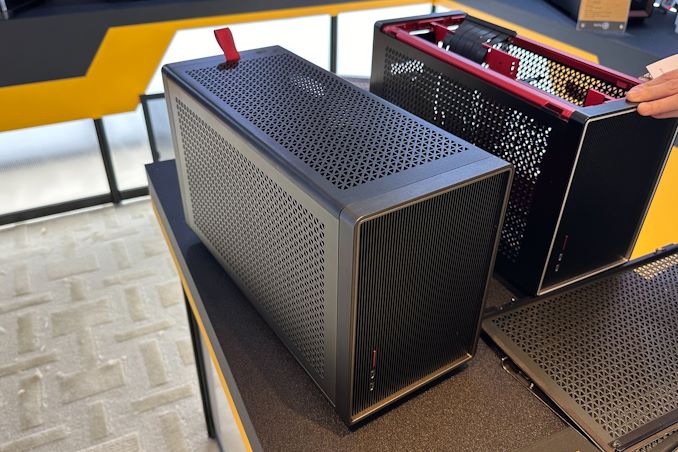

With the highly integrated nature of PCs these days, the Mini-ITX form-factor has become a very viable option for high-performance gaming system. With plenty of motherboards available for both AMD and Intel's latest platforms, equipping an ITX system with a CPU is easy enough. But the small size of the form factor means that housing an ultra-wide flagship-level graphics card remains an issue. For this year's Computex trade show, Antec was showing off their solution to the problem of giant video cards: the Performance 1M case, a Mini-ITX case with a separate chamber just for a large video card.
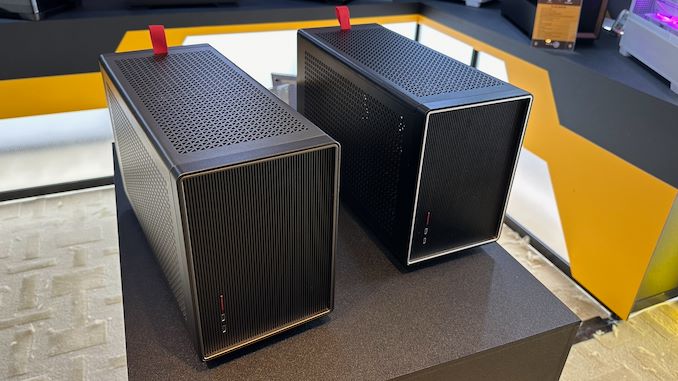
Antec's Performance 1M is a dual-chamber Mini-ITX chassis that splits off the video card from the rest of the system. The primary chamber houses a Mini-ITX motherboard and an SFX power supply, while the secondary chamber houses a huge graphics card. Notably, the two chambers are bridged using a PCIe riser cable, allowing the motherboard chamber to be far shorter than even a half-height PCIe card, while the video card chamber can hold a triple-slot video card parallel to the motherboard chamber, cutting down on wasted space. For Antec's Computex demo, the company had a triple-slot ASUS GeForce RTX 4090 installed to showcase how this worked.
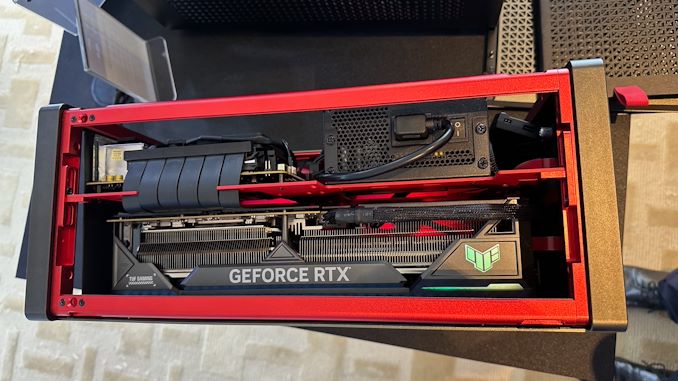
Antec's decision to allocate most of the case's volume to th video card chamber does come with a slight catch, however: it doesn't leave much space for a CPU cooler in the motherboard chamber. The short motherboard chamber means that system builders will have to use a low-profile cooler; these are readily available, but it does leave less thermal headroom overall for high-end CPUs. So there are still trade-offs for being able to accommodate a high-end video card.
Otherwise, the Performance 1M chassis from Antec look very stylish and are traditionally well built from stainless steel and aluminum. The chassis can be equipped with two 120-mm or two 140-mm coolers for extra airflow (which will help performance), one 2.5-inch SATA SSD, and even some RGB bling. To make the PC built inside a Performance 1M case more convenient to use, there are two USB Type-C ports on the front.
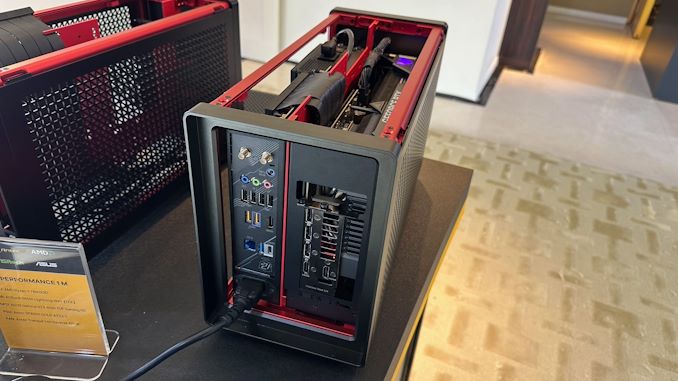
Of course, housing a GeForce RTX 4090 graphics card in a Mini-ITX chassis has its peculiarities when it comes to dimensions and Antec's Performance 1M measures 424×175×260mm, which is pretty large. On the other hand, for an ultra-high-performance gaming system, this is pretty compact.
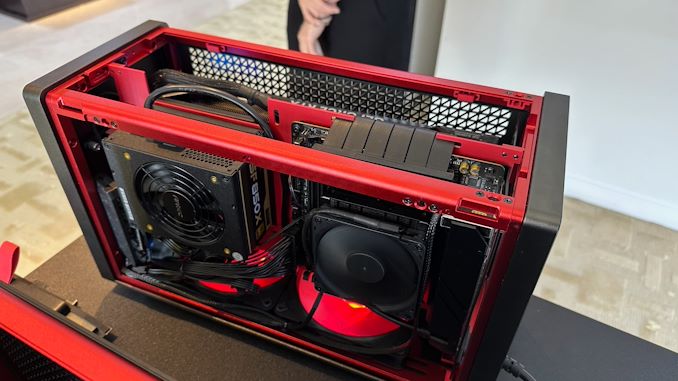
Antec's Performance 1M Mini-ITX chassis will be available in gunmetal gray and matte black colors sometimes later this year. Pricing is something that the company is thinking about now, though keep in mind that we are talking about unique premium products.
Cases/Cooling/PSUs

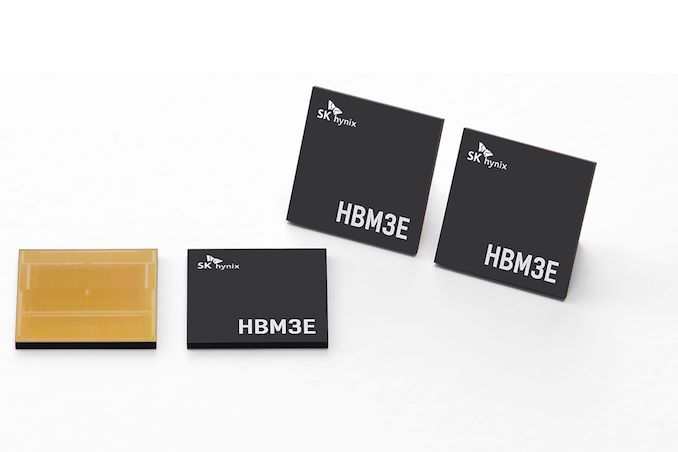
Demand for high-performance processors for AI training is skyrocketing, and consequently so is the demand for the components that go into these processors. So much so that SK hynix this week is very publicly announcing that the company's high-bandwidth memory (HBM) production capacity has already sold out for the rest of 2024, and even most of 2025 has already sold out as well.
SK hynix currently produces various types of HBM memory for customers like Amazon, AMD, Facebook, Google (Broadcom), Intel, Microsoft, and, of course, NVIDIA. The latter is an especially prolific consumer of HBM3 and HBM3E memory for its H100/H200/GH200 accelerators, as NVIDIA is also working to fill what remains an insatiable (and unmet) demand for its accelerators.
As a result, HBM memory orders, which are already placed months in advance, are now backlogging well into 2025 as chip vendors look to secure supplies of the memory stacks critical to their success.
This has made SK hynix the secnd HBM memory vendor in recent months to announce that they've sold out into 2025, following an earlier announcement from Micron regarding its HBM3E production. But of the two announcements, SK hynix's is arguably the most significant yet, as the South Korean firm's HBM production capacity is far greater than Micron's. So while things were merely "interesting" with the smallest of the Big Three memory manufacturers being sold out into 2025, things are taking a more concerning (and constrained) outlook now that SK hynix is as well.
SK hynix currently controls roughly 46% - 49% of HBM market, and its share is not expected to drop significantly in 2025, according to market tracking firm TrendForce. By contrast, Micron's share on HBM memory market is between 4% and 6%. Since HBM supply of both companies is sold out through the most of 2025, we're likely looking at a scenario where over 50% of the industry's total HBM3/HBM3E supply for the coming quarters is already sold out.
This leaves Samsung as the only member of the group not to comment on HBM demand so far. Though with memory being a highly fungible commodity product, it would be surprising if Samsung wasn't facing similar demand. And, ultimately, all of this is pointing towards the indusry entering an HBM3 memory shortage.
Separately, SK hynix said that it is sampling 12-Hi 36GB HBM3E stacks with customers and will begin volume shipments in the third quarter.
Memory
Demand for high-performance processors for AI training is skyrocketing, and consequently so is the demand for the components that go into these processors. So much so that SK hynix this week is very publicly announcing that the company's high-bandwidth memory (HBM) production capacity has already sold out for the rest of 2024, and even most of 2025 has already sold out as well.
SK hynix currently produces various types of HBM memory for customers like Amazon, AMD, Facebook, Google (Broadcom), Intel, Microsoft, and, of course, NVIDIA. The latter is an especially prolific consumer of HBM3 and HBM3E memory for its H100/H200/GH200 accelerators, as NVIDIA is also working to fill what remains an insatiable (and unmet) demand for its accelerators.
As a result, HBM memory orders, which are already placed months in advance, are now backlogging well into 2025 as chip vendors look to secure supplies of the memory stacks critical to their success.
This has made SK hynix the secnd HBM memory vendor in recent months to announce that they've sold out into 2025, following an earlier announcement from Micron regarding its HBM3E production. But of the two announcements, SK hynix's is arguably the most significant yet, as the South Korean firm's HBM production capacity is far greater than Micron's. So while things were merely "interesting" with the smallest of the Big Three memory manufacturers being sold out into 2025, things are taking a more concerning (and constrained) outlook now that SK hynix is as well.
SK hynix currently controls roughly 46% - 49% of HBM market, and its share is not expected to drop significantly in 2025, according to market tracking firm TrendForce. By contrast, Micron's share on HBM memory market is between 4% and 6%. Since HBM supply of both companies is sold out through the most of 2025, we're likely looking at a scenario where over 50% of the industry's total HBM3/HBM3E supply for the coming quarters is already sold out.
This leaves Samsung as the only member of the group not to comment on HBM demand so far. Though with memory being a highly fungible commodity product, it would be surprising if Samsung wasn't facing similar demand. And, ultimately, all of this is pointing towards the indusry entering an HBM3 memory shortage.
Separately, SK hynix said that it is sampling 12-Hi 36GB HBM3E stacks with customers and will begin volume shipments in the third quarter.
Memory
Lorem Ipsum is simply dummy text of the printing and typesetting industry. Lorem Ipsum has been the industry's.
Demand for high-performance processors for AI training is skyrocketing, and consequently so is the demand for the components that go into these processors. So much so that SK hynix this week is very publicly announcing that the company's high-bandwidth memory (HBM) production capacity has already sold out for the rest of 2024, and even most of 2025 has already sold out as well.
SK hynix currently produces various types of HBM memory for customers like Amazon, AMD, Facebook, Google (Broadcom), Intel, Microsoft, and, of course, NVIDIA. The latter is an especially prolific consumer of HBM3 and HBM3E memory for its H100/H200/GH200 accelerators, as NVIDIA is also working to fill what remains an insatiable (and unmet) demand for its accelerators.
As a result, HBM memory orders, which are already placed months in advance, are now backlogging well into 2025 as chip vendors look to secure supplies of the memory stacks critical to their success.
This has made SK hynix the secnd HBM memory vendor in recent months to announce that they've sold out into 2025, following an earlier announcement from Micron regarding its HBM3E production. But of the two announcements, SK hynix's is arguably the most significant yet, as the South Korean firm's HBM production capacity is far greater than Micron's. So while things were merely "interesting" with the smallest of the Big Three memory manufacturers being sold out into 2025, things are taking a more concerning (and constrained) outlook now that SK hynix is as well.
SK hynix currently controls roughly 46% - 49% of HBM market, and its share is not expected to drop significantly in 2025, according to market tracking firm TrendForce. By contrast, Micron's share on HBM memory market is between 4% and 6%. Since HBM supply of both companies is sold out through the most of 2025, we're likely looking at a scenario where over 50% of the industry's total HBM3/HBM3E supply for the coming quarters is already sold out.
This leaves Samsung as the only member of the group not to comment on HBM demand so far. Though with memory being a highly fungible commodity product, it would be surprising if Samsung wasn't facing similar demand. And, ultimately, all of this is pointing towards the indusry entering an HBM3 memory shortage.
Separately, SK hynix said that it is sampling 12-Hi 36GB HBM3E stacks with customers and will begin volume shipments in the third quarter.
Memory



, one 2.5-inch SATA SSD, and even some RGB bling. To make the PC built inside a Performance 1M case more convenient to use, there are two USB Type-C ports on the front.</p>
<p><a href="https://www.anandtech.com/show/21443/antecs-miniitx-chassis-can-house-a-geforce-rtx-4090"><img alt="" src="https://images.anandtech.com/doci/21443/IMG_0846_575px.jpg" /></a></p>
<p>Of course, housing a GeForce RTX 4090 graphics card in a Mini-ITX chassis has its peculiarities when it comes to dimensions and Antec's Performance 1M measures 424×175×260mm, which is pretty large. On the other hand, for an ultra-high-performance gaming system, this is pretty compact.</p>
<p style="text-align: center;"><a href="https://www.anandtech.com/show/21443/antecs-miniitx-chassis-can-house-a-geforce-rtx-4090"><img alt="" src="https://images.anandtech.com/doci/21443/IMG_0850_575px.jpg" /></a></p>
<p>Antec's Performance 1M Mini-ITX chassis will be available in gunmetal gray and matte black colors sometimes later this year. Pricing is something that the company is thinking about now, though keep in mind that we are talking about unique premium products.</p>
</p> Cases/Cooling/PSUs)
, one 2.5-inch SATA SSD, and even some RGB bling. To make the PC built inside a Performance 1M case more convenient to use, there are two USB Type-C ports on the front.</p>
<p><a href="https://www.anandtech.com/show/21443/antecs-miniitx-chassis-can-house-a-geforce-rtx-4090"><img alt="" src="https://images.anandtech.com/doci/21443/IMG_0846_575px.jpg" /></a></p>
<p>Of course, housing a GeForce RTX 4090 graphics card in a Mini-ITX chassis has its peculiarities when it comes to dimensions and Antec's Performance 1M measures 424×175×260mm, which is pretty large. On the other hand, for an ultra-high-performance gaming system, this is pretty compact.</p>
<p style="text-align: center;"><a href="https://www.anandtech.com/show/21443/antecs-miniitx-chassis-can-house-a-geforce-rtx-4090"><img alt="" src="https://images.anandtech.com/doci/21443/IMG_0850_575px.jpg" /></a></p>
<p>Antec's Performance 1M Mini-ITX chassis will be available in gunmetal gray and matte black colors sometimes later this year. Pricing is something that the company is thinking about now, though keep in mind that we are talking about unique premium products.</p>
</p> Cases/Cooling/PSUs)
, one 2.5-inch SATA SSD, and even some RGB bling. To make the PC built inside a Performance 1M case more convenient to use, there are two USB Type-C ports on the front.</p>
<p><a href="https://www.anandtech.com/show/21443/antecs-miniitx-chassis-can-house-a-geforce-rtx-4090"><img alt="" src="https://images.anandtech.com/doci/21443/IMG_0846_575px.jpg" /></a></p>
<p>Of course, housing a GeForce RTX 4090 graphics card in a Mini-ITX chassis has its peculiarities when it comes to dimensions and Antec's Performance 1M measures 424×175×260mm, which is pretty large. On the other hand, for an ultra-high-performance gaming system, this is pretty compact.</p>
<p style="text-align: center;"><a href="https://www.anandtech.com/show/21443/antecs-miniitx-chassis-can-house-a-geforce-rtx-4090"><img alt="" src="https://images.anandtech.com/doci/21443/IMG_0850_575px.jpg" /></a></p>
<p>Antec's Performance 1M Mini-ITX chassis will be available in gunmetal gray and matte black colors sometimes later this year. Pricing is something that the company is thinking about now, though keep in mind that we are talking about unique premium products.</p>
</p> Cases/Cooling/PSUs | https://compbuddey.blogspot.com/2024/07/antecs-performance-1m-mini-itx-chassis_5.html)
, one 2.5-inch SATA SSD, and even some RGB bling. To make the PC built inside a Performance 1M case more convenient to use, there are two USB Type-C ports on the front.</p>
<p><a href="https://www.anandtech.com/show/21443/antecs-miniitx-chassis-can-house-a-geforce-rtx-4090"><img alt="" src="https://images.anandtech.com/doci/21443/IMG_0846_575px.jpg" /></a></p>
<p>Of course, housing a GeForce RTX 4090 graphics card in a Mini-ITX chassis has its peculiarities when it comes to dimensions and Antec's Performance 1M measures 424×175×260mm, which is pretty large. On the other hand, for an ultra-high-performance gaming system, this is pretty compact.</p>
<p style="text-align: center;"><a href="https://www.anandtech.com/show/21443/antecs-miniitx-chassis-can-house-a-geforce-rtx-4090"><img alt="" src="https://images.anandtech.com/doci/21443/IMG_0850_575px.jpg" /></a></p>
<p>Antec's Performance 1M Mini-ITX chassis will be available in gunmetal gray and matte black colors sometimes later this year. Pricing is something that the company is thinking about now, though keep in mind that we are talking about unique premium products.</p>
</p> Cases/Cooling/PSUs&body=https://compbuddey.blogspot.com/2024/07/antecs-performance-1m-mini-itx-chassis_5.html)


0 Comments