
As Qualcomm's exclusivity for Arm-powered processors for Windows PCs is reportedly coming to its end, other chipmakers are getting ready to offer their Arm-based system-on-chips for Windows computers. And, according to a new report from Reuters, MediaTek will be among the companies jumping into the Windows-on-Arm field, with plans to launch their first PC processor late next year.
MediaTek's system-on-chip for Windows PCs will rely on Arm's 'ready-made designs,' according to Reuters. Which in turn hints that MediaTek would be using Arm's compute sub-system (CSS) for client PCs, a building block designed to significantly speed up development of SoCs.
With the vauge nature of the Reuters report, however, which version of Arm's IP MediaTek might be using remains unclear, and the answer to that will largely hinge on timing. Arm refreshes its client cores and IP offerings yearly – typically announcing them to the public in May – with finished chips rolling out as early as later in the year. So depending on just how late in the year MediaTek is planning to launch their chip, the company has a large enough window to potentially use either the current 2024 client designs, or next year's 2025 designs.
For reference, Arm's 2024 CSS for client systems is quite powerful on its own. It includes two ultra-high-performance Arm Cortex-X925 cores (each with up to 3MB L2 cache and clock speeds over 3.60 GHz, supporting SVE and SVE2), four high-performance Cortex-A725 cores, two energy-efficient Cortex-A520 cores, and an Immortalis-G925 graphics processor. And, of course, MediaTek has the expertise to skip Arm's CSS and build their own bespoke designs as well, if that's what they'd prefer.
Overall, the latest client designs from Arm can accommodate up to 14 CPU cores – Arm intentionally leaves headroom for designs to be scaled-up for laptops – which would make for quite a formidable chip. But the PC SoC market has no shortage of capable contenders with their own designs; besides Qualcomm's Snapdragon X processors, MediaTek would also be going up against the latest designs from Intel and AMD. All of whom are planning to make big plays for the mobile PC market in the next several months. So MediaTek will need to make a serious effort if their effort to jump into the PC SoC market are to succeed.
Since 2016, Microsoft has partnered with Qualcomm to bring Arm's processor architecture, which is widely used in smartphones, to Windows PCs. Qualcomm has an exclusive agreement to supply these chips for the next several months (the exact timing remains unclear), after which other designers like MediaTek can enter the market. Qualcomm, for its part, has benefited greatly from collaborating with Microsoft, so it will be interesting to see if Microsoft extends a similar hand out to other Arm chip makers.
Ultimately, the market for Arm PC SoCs has the potential to get crowded quickly. According to previous reports from Reuters, both AMD and NVIDIA are also developing Arm-based chips for Windows. So if all of those projects come to fruition, there could potentially be several Arm SoCs available to PC manufacturers around the same time. All of which would be a massive change from the past 20 years of the PC, where Intel and AMD have been the entire market.
Both MediaTek and Microsoft have declined to comment on the ongoing developments, the news agency states.
CPUs

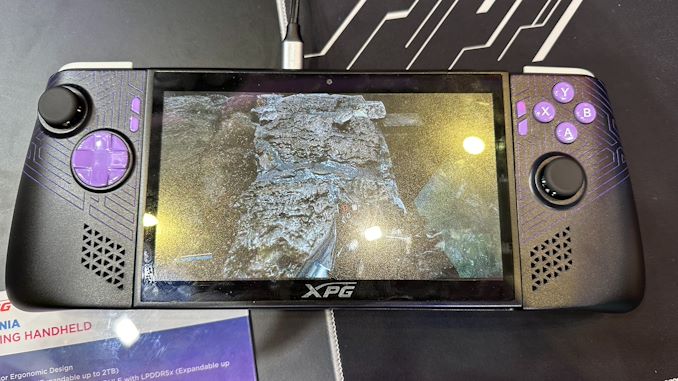
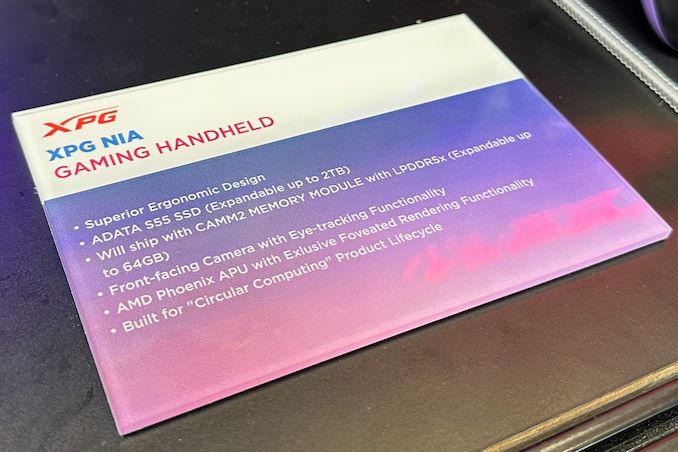
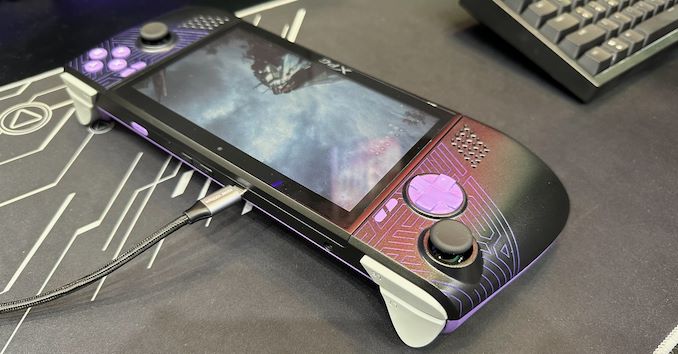
With the rise of the handheld gaming PC market, we've seen PC vendors and their partners toy with a number of tricks and tweaks to improve improve framerates in games, with some of their latest efforts on display at this year's Computex trade show. Perhaps the most interesting find thus far comes from ADATA sub-brand XPG, who is demoing their prototype "Nia" handheld PC, which uses eye tracking and dynamic foveated rendering to further improve their rendering performance.
For those unfamiliar, dynamic foveated rendering is a graphics technique that is sometimes used to boost performance in virtual reality (VR) and augmented reality (AR) applications by taking advantage of how human vision works. Typically, humans can only perceive detailed imagery in the relatively small central area of our vision called the fovea, while our peripheral vision is much less detailed. Dynamic foveated rendering, in turn, exploits this by using real-time eye tracking to determine where the user is looking, and then rendering just that area in high/full resolution, while rendering the peripheral areas in lower resolution. The net result is that only a fraction of the screen is rendered at full detail, which cuts down on the total amount of rendering work required and boosting framerates on performance-limited devices.
As stated before, this technology is sometimes used in high-end AR/VR headsets, where high resolution displays are placed mere inches from one's face. This ends up being an ideal use case for the technique, since at those distances, only a small fraction of the screen is within the fovea.
Using dynamic foveated rendering for a handheld, on the other hand, is a more novel application. All of the same visual principles apply, but the resolutions at play are lower, and the screen is farther from the users' eyes. This makes a handheld device a less ideal use case, at least on paper, as a larger portion of the screen is going to be in the fovea, and thus will need to be rendered at full resolution. None the less, it will be interesting to see how XPG's efforts pan out, and if dynamic foveated rendering is beneficial enough for handheld PCs. As we sometimes see with trade show demos, not everything makes it out of the prototype stage.
According to a press release put out by ADATA ahead of the trade show, the eye tracking technology is being provided by AMD collaborator Eyeware. Notably, their software-based approach runs on top of standard webcams, rather than requiring IR cameras. So the camera hardware itself should be pretty straight-forward.
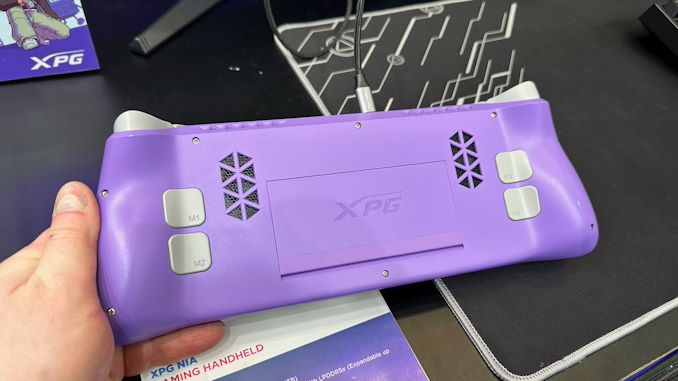
Foveated rendering aside, XPG is making sure that the Nia won't be a one-trick pony. The handheld's other major claim to fame is its hardware swappability. The prototype handheld not only features a removable M.2-2230 SSD, but the company is also taking advantage of the recently-introduced LPCAMM2 memory module standard to introduce removable DRAM. Via a hatch in the back of the handheld, device owners would be able to swap out LPCAMM2 LPDDR5X modules for higher capacity versions. This would give the handheld an additional degree of future-proofness over current handhelds, which use non-replaceable soldered-down memory.
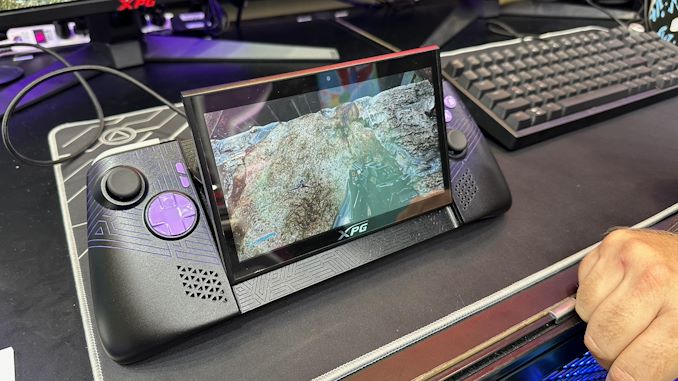
Rounding out the package, the current prototype is based on an AMD's Zen 4 Phoenix APU, which is used across both of the company's current mobile lines (Ryzen Mobile 7000/8000 and Ryzen Z1). Meanwhile, the unit's display is adjustable, allowing it to be angled away from the body of the handheld.
Assuming all goes well with the prototype, XPG aims to release a finished product in 2025.


Under the CHIPS & Science Act, the U.S. government provided tens of billions of dollars in grants and loans to the world's leading maker of chips, such as Intel, Samsung, and TSMC, which will significantly expand the country's semiconductor production industry in the coming years. However, most chips are typically tested, assembled, and packaged in Asia, which has left the American supply chain incomplete. Addressing this last gap in the government's domestic chip production plans, these past couple of weeks the U.S. government signed memorandums of understanding worth about $1.5 billion with Amkor and SK hynix to support their efforts to build chip packaging facilities in the U.S.
Amkor plans to build a $2 billion advanced packaging facility near Peoria, Arizona, to test and assemble chips produced by TSMC at its Fab 21 near Phoenix, Arizona. The company signed a MOU that offers $400 million in direct funding and access to $200 million in loans under the CHIPS & Science Act. In addition, the company plans to take advantage of a 25% investment tax credit on eligible capital expenditures.
Set to be strategically positioned near TSMC's upcoming Fab 21 complex in Arizona, Amkor's Peoria facility will occupy 55 acres and, when fully completed, will feature over 500,000 square feet (46,451 square meters) of cleanroom space, more than twice the size of Amkor's advanced packaging site in Vietnam. Although the company has not disclosed the exact capacity or the specific technologies the facility will support, it is expected to cater to a wide range of industries, including automotive, high-performance computing, and mobile technologies. This suggests the new plant will offer diverse packaging solutions, including traditional, 2.5D, and 3D technologies.
Amkor has collaborated extensively with Apple on the vision and initial setup of the Peoria facility, as Apple is slated to be the facility's first and largest customer, marking a significant commitment from the tech giant. This partnership highlights the importance of the new facility in reinforcing the U.S. semiconductor supply chain and positioning Amkor as a key partner for companies relying on TSMC's manufacturing capabilities. The project is expected to generate around 2,000 jobs and is scheduled to begin operations in 2027.
This week SK hynix also signed a preliminary agreement with the U.S. government to receive up to $450 million in direct funding and $500 million in loans to build an advanced memory packaging facility in West Lafayette, Indiana.
The proposed facility is scheduled to begin operations in 2028, which means that it will assemble HBM4 or HBM4E memory. Meanwhile, DRAM devices for high bandwidth memory (HBM) stacks will still be produced in South Korea. Nonetheless, packing finished HBM4/HBM4E in the U.S. and possibly integrating these memory modules with high-end processors is a big deal.
In addition to building its packaging plant, SK hynix plans to collaborate with Purdue University and other local research institutions to advance semiconductor technology and packaging innovations. This partnership is intended to bolster research and development in the region, positioning the facility as a hub for AI technology and skilled employment.
Semiconductors
With the rise of the handheld gaming PC market, we've seen PC vendors and their partners toy with a number of tricks and tweaks to improve improve framerates in games, with some of their latest efforts on display at this year's Computex trade show. Perhaps the most interesting find thus far comes from ADATA sub-brand XPG, who is demoing their prototype "Nia" handheld PC, which uses eye tracking and dynamic foveated rendering to further improve their rendering performance.
For those unfamiliar, dynamic foveated rendering is a graphics technique that is sometimes used to boost performance in virtual reality (VR) and augmented reality (AR) applications by taking advantage of how human vision works. Typically, humans can only perceive detailed imagery in the relatively small central area of our vision called the fovea, while our peripheral vision is much less detailed. Dynamic foveated rendering, in turn, exploits this by using real-time eye tracking to determine where the user is looking, and then rendering just that area in high/full resolution, while rendering the peripheral areas in lower resolution. The net result is that only a fraction of the screen is rendered at full detail, which cuts down on the total amount of rendering work required and boosting framerates on performance-limited devices.
As stated before, this technology is sometimes used in high-end AR/VR headsets, where high resolution displays are placed mere inches from one's face. This ends up being an ideal use case for the technique, since at those distances, only a small fraction of the screen is within the fovea.
Using dynamic foveated rendering for a handheld, on the other hand, is a more novel application. All of the same visual principles apply, but the resolutions at play are lower, and the screen is farther from the users' eyes. This makes a handheld device a less ideal use case, at least on paper, as a larger portion of the screen is going to be in the fovea, and thus will need to be rendered at full resolution. None the less, it will be interesting to see how XPG's efforts pan out, and if dynamic foveated rendering is beneficial enough for handheld PCs. As we sometimes see with trade show demos, not everything makes it out of the prototype stage.
According to a press release put out by ADATA ahead of the trade show, the eye tracking technology is being provided by AMD collaborator Eyeware. Notably, their software-based approach runs on top of standard webcams, rather than requiring IR cameras. So the camera hardware itself should be pretty straight-forward.
Foveated rendering aside, XPG is making sure that the Nia won't be a one-trick pony. The handheld's other major claim to fame is its hardware swappability. The prototype handheld not only features a removable M.2-2230 SSD, but the company is also taking advantage of the recently-introduced LPCAMM2 memory module standard to introduce removable DRAM. Via a hatch in the back of the handheld, device owners would be able to swap out LPCAMM2 LPDDR5X modules for higher capacity versions. This would give the handheld an additional degree of future-proofness over current handhelds, which use non-replaceable soldered-down memory.
Rounding out the package, the current prototype is based on an AMD's Zen 4 Phoenix APU, which is used across both of the company's current mobile lines (Ryzen Mobile 7000/8000 and Ryzen Z1). Meanwhile, the unit's display is adjustable, allowing it to be angled away from the body of the handheld.
Assuming all goes well with the prototype, XPG aims to release a finished product in 2025.
Under the CHIPS & Science Act, the U.S. government provided tens of billions of dollars in grants and loans to the world's leading maker of chips, such as Intel, Samsung, and TSMC, which will significantly expand the country's semiconductor production industry in the coming years. However, most chips are typically tested, assembled, and packaged in Asia, which has left the American supply chain incomplete. Addressing this last gap in the government's domestic chip production plans, these past couple of weeks the U.S. government signed memorandums of understanding worth about $1.5 billion with Amkor and SK hynix to support their efforts to build chip packaging facilities in the U.S.
Amkor plans to build a $2 billion advanced packaging facility near Peoria, Arizona, to test and assemble chips produced by TSMC at its Fab 21 near Phoenix, Arizona. The company signed a MOU that offers $400 million in direct funding and access to $200 million in loans under the CHIPS & Science Act. In addition, the company plans to take advantage of a 25% investment tax credit on eligible capital expenditures.
Set to be strategically positioned near TSMC's upcoming Fab 21 complex in Arizona, Amkor's Peoria facility will occupy 55 acres and, when fully completed, will feature over 500,000 square feet (46,451 square meters) of cleanroom space, more than twice the size of Amkor's advanced packaging site in Vietnam. Although the company has not disclosed the exact capacity or the specific technologies the facility will support, it is expected to cater to a wide range of industries, including automotive, high-performance computing, and mobile technologies. This suggests the new plant will offer diverse packaging solutions, including traditional, 2.5D, and 3D technologies.
Amkor has collaborated extensively with Apple on the vision and initial setup of the Peoria facility, as Apple is slated to be the facility's first and largest customer, marking a significant commitment from the tech giant. This partnership highlights the importance of the new facility in reinforcing the U.S. semiconductor supply chain and positioning Amkor as a key partner for companies relying on TSMC's manufacturing capabilities. The project is expected to generate around 2,000 jobs and is scheduled to begin operations in 2027.
This week SK hynix also signed a preliminary agreement with the U.S. government to receive up to $450 million in direct funding and $500 million in loans to build an advanced memory packaging facility in West Lafayette, Indiana.
The proposed facility is scheduled to begin operations in 2028, which means that it will assemble HBM4 or HBM4E memory. Meanwhile, DRAM devices for high bandwidth memory (HBM) stacks will still be produced in South Korea. Nonetheless, packing finished HBM4/HBM4E in the U.S. and possibly integrating these memory modules with high-end processors is a big deal.
In addition to building its packaging plant, SK hynix plans to collaborate with Purdue University and other local research institutions to advance semiconductor technology and packaging innovations. This partnership is intended to bolster research and development in the region, positioning the facility as a hub for AI technology and skilled employment.
Semiconductors
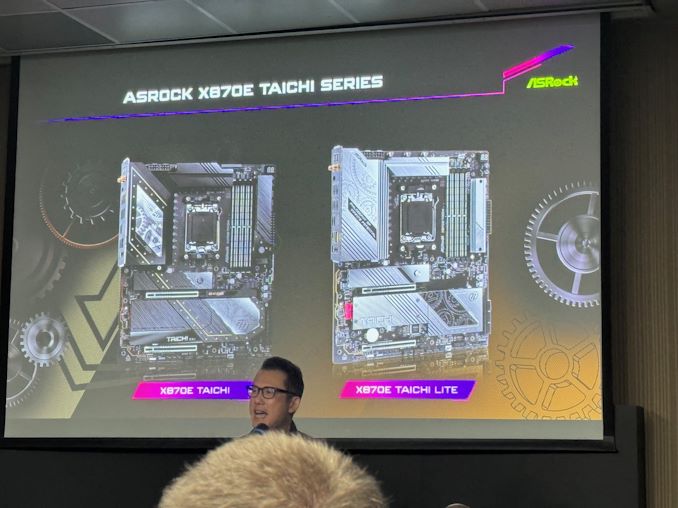
During Computex 2024, ASRock held an event to unveil some of its upcoming X870E motherboards, designed for AMD's Zen 5-based Ryzen 9000 series processors. ASRock's announcement includes a pair of Taichi-branded boards, the X870E Taichi and the lighter X870E Taichi lite, which uses AMD's X870E (Promontory 21) chipset for AM5.
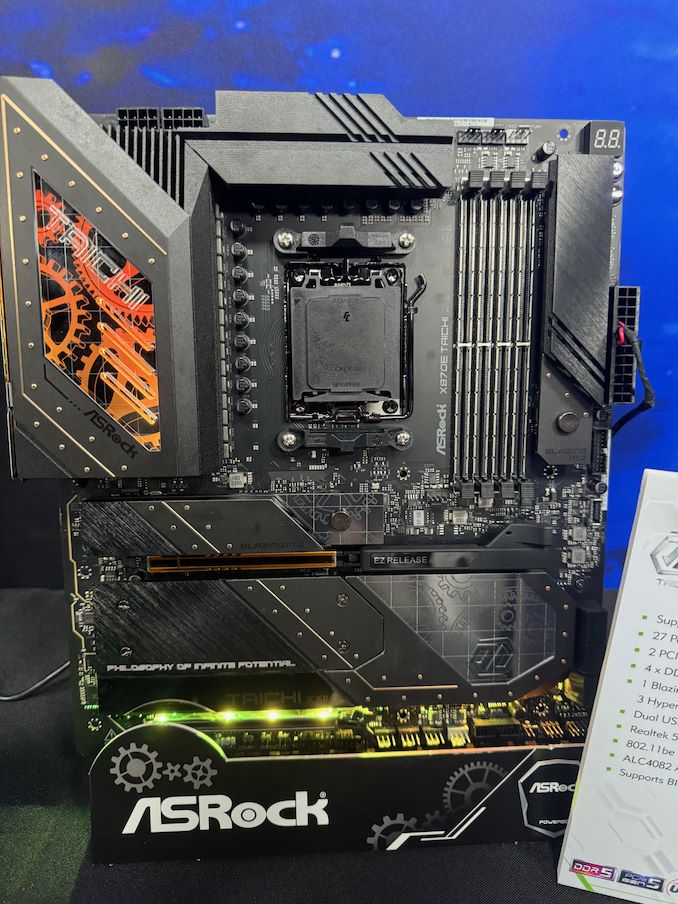
The current flagship model announced from ASRock's X870E line-up for Ryzen 9000 is the ASRock X870E Taichi. ASRock is advertising a large 27-phase power delivery through 110A SPS, suggesting this board is designed for overclockers and all-around power users. Two PCIe 5.0 x16 slots (operating in either x16/x0 or x8/x8) provide high-speed bandwidth for cutting-edge graphics cards and other devices. Meanwhile, ASRock has gone with 4 DIMM slots on this board, so system builders will be able to max out the board's memory capacity at the cost of bandwidth.
The storage offering is impressive; besides the obligatory PCIe Gen5 x4 M.2 slot (Blazing M.2), ASRock has outfit the board with another three PCIe Gen4 x4 (Hyper) M.2 slots. Also present are two USB4 Type-C ports for high-bandwidth external I/O, while networking support is a solid pairing of a discrete Wi-Fi 7 controller with a Realtek 5Gb Ethernet controller (and the first AM5 board we've come across with something faster than a 2.5GbE controller).
The audio setup includes a Realtek ALC4082 codec and ESS SABRE9218 DAC supporting high-fidelity sound. The BIOS flashback feature is also a nice touch, and we believe this should be a feature on all mid-range to high-end motherboards, which provides an easy way to update the firmware without installing a CPU. And, as no high-end board would be complete without it, ASRock has put RGB lighting on the X870E Taichi as well.
Ultimately, as ASRock's high-end X870E board, the X870E Taichi comes with pretty much every last cutting-edge technology that ASRock can fit on the board.
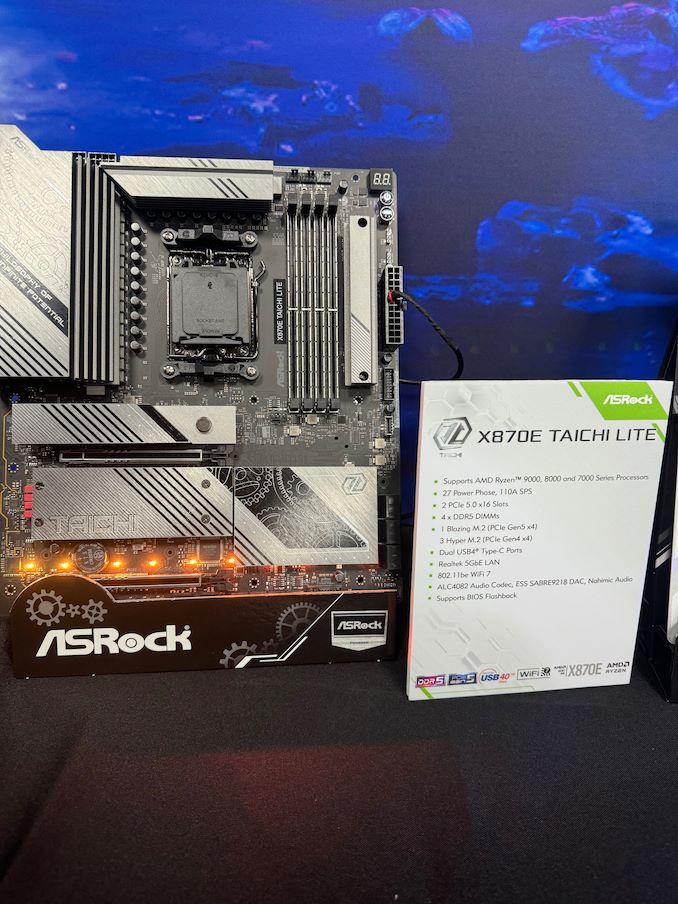
Comparatively, the ASRock X870E Taichi Lite is a more streamlined and functional version of the X870E Taichi. The Lite retaining all of the latter's key features, including the 27-phase power delivery with 110A smart power stages, dual PCIe 5.0 x16 slots operating at x16 or x8/x8, four DDR5 DIMM slots, and four M.2 slots (1x Gen5 + 3x Gen4). The only significant difference is aesthetics: the Taichi Lite features a simpler silver-themed design without the RGB lighting, while the standard Taichi has a more intricate gold-accented and fanciful aesthetics.
In terms of availability, ASRock is not disclosing a release date for the board at the show. And, checking around with other tech journalists, Andreas Schilling from HawrdwareLUXX has heard that X870E and X870 motherboards aren't expected to be available in time for the Ryzen 9000 series launch. We will investigate this and contact the motherboard vendors to confirm the situation. Though as X870E/X870 boards barely differ from the current crop of X670E/B650E boards to begin with, the Ryzen 9000 series won't be fazed by a lack of slightly newer motherboards.
Motherboards
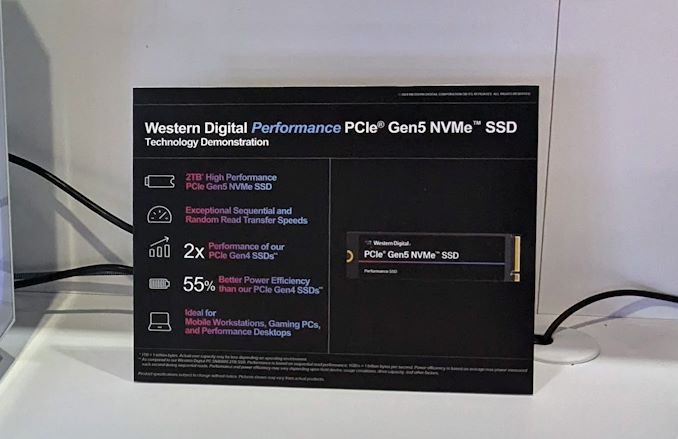
Western Digital's FMS 2024 demonstrations included a preview of their upcoming PCIe 5.0 x4 M.2 2280 NVMe SSDs for mobile workstations and consumer desktops. The Gen 5 client SSD market has been dominated by solutions based on Phison's E26 controller. The first generation products launched with slower NAND flash, while the more recent ones have exceeded the 14 GBps barrier by utilizing Micron's 2400 MT/s 232L 3D TLC. Western Digital has been conservative over the last year or so by focusing more on the mainstream / mid-range market in terms of new product introductions (such as the WD Blue SN5000, WD_BLACK SN770M, and the WD Blue SN580). Their SSD lineup is due for an update with Gen 5 drives being sorely missed. The SSDs being demonstrated at FMS 2024 will end up doing just that.
Western Digital's technology demonstrations in this segment involved two different M.2 2280 SSDs - one for the performance segment, and another for the mainstream market. They both utilize in-house controllers - while the performance segment drive uses a 8-channel controller with DRAM for the flash translation layer, the mainstream one utilizes a 4-channel DRAM-less controller. Both drives being benchmarked live were equipped with BiCS8 218-layer 3D TLC.
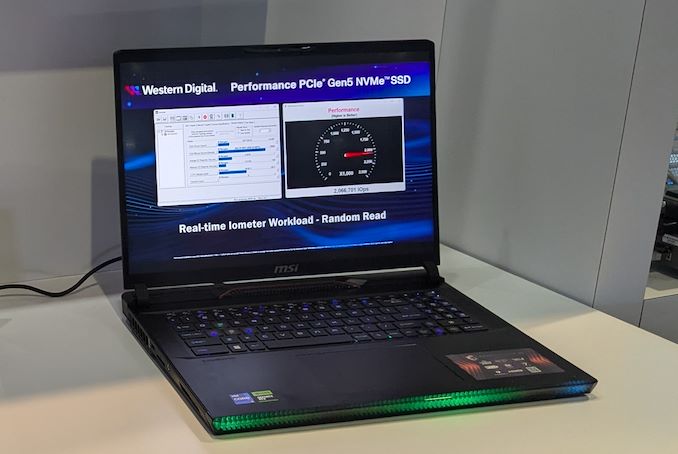
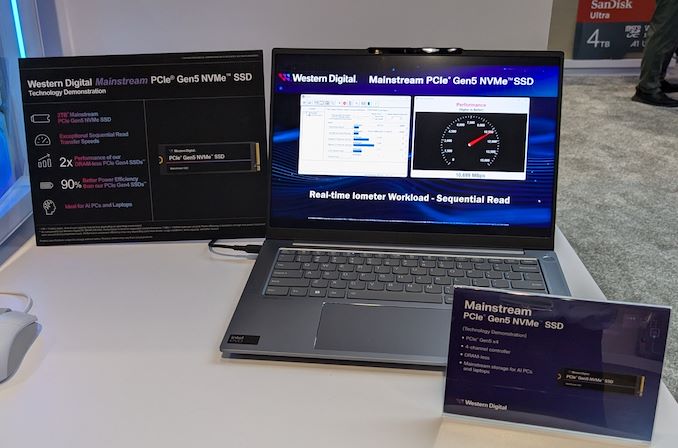
Western Digital is touting the power efficiency of their platform as a key differentiator, promising south of 7W (performance drive) and 5W (mainstream DRAM-less drive) for the complete SSD under stressful traffic. This makes it suitable for use in mobile workstations, but a good fit for desktops as well.
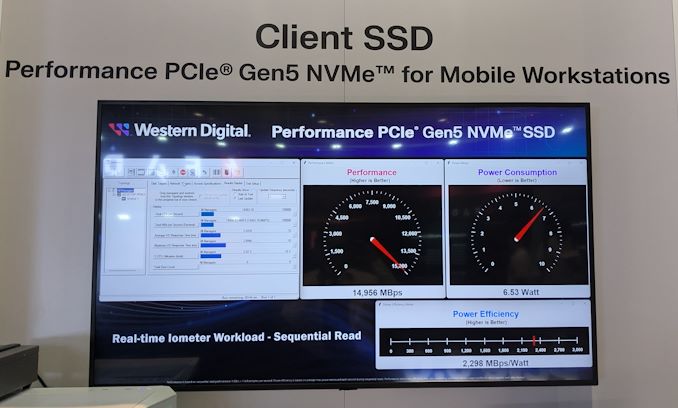
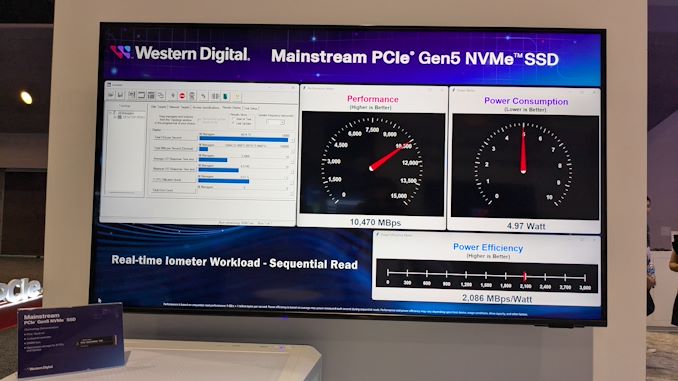
Demonstrated performance numbers indicate almost 15 GBps sequential reads and 2M+ random read IOPS for the performance drive, and 10.7 GBps sequential reads for the mainstream version. Western Digital might have missed the Gen 5 bus as it started out slowly. However, the technology demonstrations with the in-house controller and NAND indicate that WD has caught up just as the Gen 5 market is about to take off.|
Storage
Lorem Ipsum is simply dummy text of the printing and typesetting industry. Lorem Ipsum has been the industry's.
With the rise of the handheld gaming PC market, we've seen PC vendors and their partners toy with a number of tricks and tweaks to improve improve framerates in games, with some of their latest efforts on display at this year's Computex trade show. Perhaps the most interesting find thus far comes from ADATA sub-brand XPG, who is demoing their prototype "Nia" handheld PC, which uses eye tracking and dynamic foveated rendering to further improve their rendering performance.
For those unfamiliar, dynamic foveated rendering is a graphics technique that is sometimes used to boost performance in virtual reality (VR) and augmented reality (AR) applications by taking advantage of how human vision works. Typically, humans can only perceive detailed imagery in the relatively small central area of our vision called the fovea, while our peripheral vision is much less detailed. Dynamic foveated rendering, in turn, exploits this by using real-time eye tracking to determine where the user is looking, and then rendering just that area in high/full resolution, while rendering the peripheral areas in lower resolution. The net result is that only a fraction of the screen is rendered at full detail, which cuts down on the total amount of rendering work required and boosting framerates on performance-limited devices.
As stated before, this technology is sometimes used in high-end AR/VR headsets, where high resolution displays are placed mere inches from one's face. This ends up being an ideal use case for the technique, since at those distances, only a small fraction of the screen is within the fovea.
Using dynamic foveated rendering for a handheld, on the other hand, is a more novel application. All of the same visual principles apply, but the resolutions at play are lower, and the screen is farther from the users' eyes. This makes a handheld device a less ideal use case, at least on paper, as a larger portion of the screen is going to be in the fovea, and thus will need to be rendered at full resolution. None the less, it will be interesting to see how XPG's efforts pan out, and if dynamic foveated rendering is beneficial enough for handheld PCs. As we sometimes see with trade show demos, not everything makes it out of the prototype stage.
According to a press release put out by ADATA ahead of the trade show, the eye tracking technology is being provided by AMD collaborator Eyeware. Notably, their software-based approach runs on top of standard webcams, rather than requiring IR cameras. So the camera hardware itself should be pretty straight-forward.
Foveated rendering aside, XPG is making sure that the Nia won't be a one-trick pony. The handheld's other major claim to fame is its hardware swappability. The prototype handheld not only features a removable M.2-2230 SSD, but the company is also taking advantage of the recently-introduced LPCAMM2 memory module standard to introduce removable DRAM. Via a hatch in the back of the handheld, device owners would be able to swap out LPCAMM2 LPDDR5X modules for higher capacity versions. This would give the handheld an additional degree of future-proofness over current handhelds, which use non-replaceable soldered-down memory.
Rounding out the package, the current prototype is based on an AMD's Zen 4 Phoenix APU, which is used across both of the company's current mobile lines (Ryzen Mobile 7000/8000 and Ryzen Z1). Meanwhile, the unit's display is adjustable, allowing it to be angled away from the body of the handheld.
Assuming all goes well with the prototype, XPG aims to release a finished product in 2025.


 for client PCs</a>, a building block designed to significantly speed up development of SoCs.</p>
<p>With the vauge nature of the Reuters report, however, which version of Arm's IP MediaTek might be using remains unclear, and the answer to that will largely hinge on timing. Arm refreshes its client cores and IP offerings yearly – typically announcing them to the public in May – with finished chips rolling out as early as later in the year. So depending on just how late in the year MediaTek is planning to launch their chip, the company has a large enough window to potentially use either the current 2024 client designs, or next year's 2025 designs.</p>
<p>For reference, Arm's 2024 CSS for client systems is quite powerful on its own. It includes two ultra-high-performance Arm Cortex-X925 cores (each with up to 3MB L2 cache and clock speeds over 3.60 GHz, supporting SVE and SVE2), four high-performance Cortex-A725 cores, two energy-efficient Cortex-A520 cores, and an Immortalis-G925 graphics processor. And, of course, MediaTek has the expertise to skip Arm's CSS and build their own bespoke designs as well, if that's what they'd prefer.</p>
<p>Overall, the latest client designs from Arm can accommodate up to 14 CPU cores – Arm intentionally leaves headroom for designs to be scaled-up for laptops – which would make for quite a formidable chip. But the PC SoC market has no shortage of capable contenders with their own designs; besides Qualcomm's Snapdragon X processors, MediaTek would also be going up against the latest designs from Intel and AMD. All of whom are planning to make big plays for the mobile PC market in the next several months. So MediaTek will need to make a serious effort if their effort to jump into the PC SoC market are to succeed.</p>
<p>Since 2016, Microsoft has partnered with Qualcomm to bring Arm's processor architecture, which is widely used in smartphones, to Windows PCs. Qualcomm has an exclusive agreement to supply these chips for the next several months (the exact timing remains unclear), after which other designers like MediaTek can enter the market. Qualcomm, for its part, has benefited greatly from collaborating with Microsoft, so it will be interesting to see if Microsoft extends a similar hand out to other Arm chip makers.</p>
<p>Ultimately, the market for Arm PC SoCs has the potential to get crowded quickly. According to previous reports from <em>Reuters</em>, both AMD and NVIDIA are also developing Arm-based chips for Windows. So if all of those projects come to fruition, there could potentially be several Arm SoCs available to PC manufacturers around the same time. All of which would be a massive change from the past 20 years of the PC, where Intel and AMD have been the entire market.</p>
<p>Both MediaTek and Microsoft have declined to comment on the ongoing developments, the news agency states.</p>
</p> CPUs)
 for client PCs</a>, a building block designed to significantly speed up development of SoCs.</p>
<p>With the vauge nature of the Reuters report, however, which version of Arm's IP MediaTek might be using remains unclear, and the answer to that will largely hinge on timing. Arm refreshes its client cores and IP offerings yearly – typically announcing them to the public in May – with finished chips rolling out as early as later in the year. So depending on just how late in the year MediaTek is planning to launch their chip, the company has a large enough window to potentially use either the current 2024 client designs, or next year's 2025 designs.</p>
<p>For reference, Arm's 2024 CSS for client systems is quite powerful on its own. It includes two ultra-high-performance Arm Cortex-X925 cores (each with up to 3MB L2 cache and clock speeds over 3.60 GHz, supporting SVE and SVE2), four high-performance Cortex-A725 cores, two energy-efficient Cortex-A520 cores, and an Immortalis-G925 graphics processor. And, of course, MediaTek has the expertise to skip Arm's CSS and build their own bespoke designs as well, if that's what they'd prefer.</p>
<p>Overall, the latest client designs from Arm can accommodate up to 14 CPU cores – Arm intentionally leaves headroom for designs to be scaled-up for laptops – which would make for quite a formidable chip. But the PC SoC market has no shortage of capable contenders with their own designs; besides Qualcomm's Snapdragon X processors, MediaTek would also be going up against the latest designs from Intel and AMD. All of whom are planning to make big plays for the mobile PC market in the next several months. So MediaTek will need to make a serious effort if their effort to jump into the PC SoC market are to succeed.</p>
<p>Since 2016, Microsoft has partnered with Qualcomm to bring Arm's processor architecture, which is widely used in smartphones, to Windows PCs. Qualcomm has an exclusive agreement to supply these chips for the next several months (the exact timing remains unclear), after which other designers like MediaTek can enter the market. Qualcomm, for its part, has benefited greatly from collaborating with Microsoft, so it will be interesting to see if Microsoft extends a similar hand out to other Arm chip makers.</p>
<p>Ultimately, the market for Arm PC SoCs has the potential to get crowded quickly. According to previous reports from <em>Reuters</em>, both AMD and NVIDIA are also developing Arm-based chips for Windows. So if all of those projects come to fruition, there could potentially be several Arm SoCs available to PC manufacturers around the same time. All of which would be a massive change from the past 20 years of the PC, where Intel and AMD have been the entire market.</p>
<p>Both MediaTek and Microsoft have declined to comment on the ongoing developments, the news agency states.</p>
</p> CPUs)
 for client PCs</a>, a building block designed to significantly speed up development of SoCs.</p>
<p>With the vauge nature of the Reuters report, however, which version of Arm's IP MediaTek might be using remains unclear, and the answer to that will largely hinge on timing. Arm refreshes its client cores and IP offerings yearly – typically announcing them to the public in May – with finished chips rolling out as early as later in the year. So depending on just how late in the year MediaTek is planning to launch their chip, the company has a large enough window to potentially use either the current 2024 client designs, or next year's 2025 designs.</p>
<p>For reference, Arm's 2024 CSS for client systems is quite powerful on its own. It includes two ultra-high-performance Arm Cortex-X925 cores (each with up to 3MB L2 cache and clock speeds over 3.60 GHz, supporting SVE and SVE2), four high-performance Cortex-A725 cores, two energy-efficient Cortex-A520 cores, and an Immortalis-G925 graphics processor. And, of course, MediaTek has the expertise to skip Arm's CSS and build their own bespoke designs as well, if that's what they'd prefer.</p>
<p>Overall, the latest client designs from Arm can accommodate up to 14 CPU cores – Arm intentionally leaves headroom for designs to be scaled-up for laptops – which would make for quite a formidable chip. But the PC SoC market has no shortage of capable contenders with their own designs; besides Qualcomm's Snapdragon X processors, MediaTek would also be going up against the latest designs from Intel and AMD. All of whom are planning to make big plays for the mobile PC market in the next several months. So MediaTek will need to make a serious effort if their effort to jump into the PC SoC market are to succeed.</p>
<p>Since 2016, Microsoft has partnered with Qualcomm to bring Arm's processor architecture, which is widely used in smartphones, to Windows PCs. Qualcomm has an exclusive agreement to supply these chips for the next several months (the exact timing remains unclear), after which other designers like MediaTek can enter the market. Qualcomm, for its part, has benefited greatly from collaborating with Microsoft, so it will be interesting to see if Microsoft extends a similar hand out to other Arm chip makers.</p>
<p>Ultimately, the market for Arm PC SoCs has the potential to get crowded quickly. According to previous reports from <em>Reuters</em>, both AMD and NVIDIA are also developing Arm-based chips for Windows. So if all of those projects come to fruition, there could potentially be several Arm SoCs available to PC manufacturers around the same time. All of which would be a massive change from the past 20 years of the PC, where Intel and AMD have been the entire market.</p>
<p>Both MediaTek and Microsoft have declined to comment on the ongoing developments, the news agency states.</p>
</p> CPUs | https://compbuddey.blogspot.com/2024/06/report-mediatek-working-on-arm-based_17.html)
 for client PCs</a>, a building block designed to significantly speed up development of SoCs.</p>
<p>With the vauge nature of the Reuters report, however, which version of Arm's IP MediaTek might be using remains unclear, and the answer to that will largely hinge on timing. Arm refreshes its client cores and IP offerings yearly – typically announcing them to the public in May – with finished chips rolling out as early as later in the year. So depending on just how late in the year MediaTek is planning to launch their chip, the company has a large enough window to potentially use either the current 2024 client designs, or next year's 2025 designs.</p>
<p>For reference, Arm's 2024 CSS for client systems is quite powerful on its own. It includes two ultra-high-performance Arm Cortex-X925 cores (each with up to 3MB L2 cache and clock speeds over 3.60 GHz, supporting SVE and SVE2), four high-performance Cortex-A725 cores, two energy-efficient Cortex-A520 cores, and an Immortalis-G925 graphics processor. And, of course, MediaTek has the expertise to skip Arm's CSS and build their own bespoke designs as well, if that's what they'd prefer.</p>
<p>Overall, the latest client designs from Arm can accommodate up to 14 CPU cores – Arm intentionally leaves headroom for designs to be scaled-up for laptops – which would make for quite a formidable chip. But the PC SoC market has no shortage of capable contenders with their own designs; besides Qualcomm's Snapdragon X processors, MediaTek would also be going up against the latest designs from Intel and AMD. All of whom are planning to make big plays for the mobile PC market in the next several months. So MediaTek will need to make a serious effort if their effort to jump into the PC SoC market are to succeed.</p>
<p>Since 2016, Microsoft has partnered with Qualcomm to bring Arm's processor architecture, which is widely used in smartphones, to Windows PCs. Qualcomm has an exclusive agreement to supply these chips for the next several months (the exact timing remains unclear), after which other designers like MediaTek can enter the market. Qualcomm, for its part, has benefited greatly from collaborating with Microsoft, so it will be interesting to see if Microsoft extends a similar hand out to other Arm chip makers.</p>
<p>Ultimately, the market for Arm PC SoCs has the potential to get crowded quickly. According to previous reports from <em>Reuters</em>, both AMD and NVIDIA are also developing Arm-based chips for Windows. So if all of those projects come to fruition, there could potentially be several Arm SoCs available to PC manufacturers around the same time. All of which would be a massive change from the past 20 years of the PC, where Intel and AMD have been the entire market.</p>
<p>Both MediaTek and Microsoft have declined to comment on the ongoing developments, the news agency states.</p>
</p> CPUs&body=https://compbuddey.blogspot.com/2024/06/report-mediatek-working-on-arm-based_17.html)


0 Comments