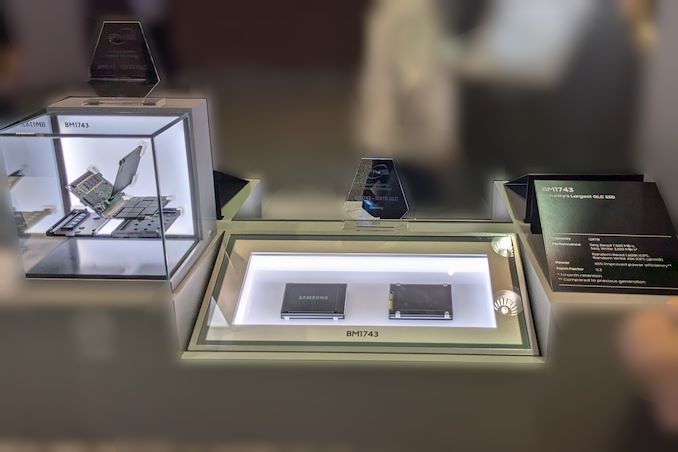

Samsung had quietly launched its BM1743 enterprise QLC SSD last month with a hefty 61.44 TB SKU. At FMS 2024, the company had the even larger 122.88 TB version of that SSD on display, alongside a few recorded benchmarking sessions. Compared to the previous generation, the BM1743 comes with a 4.1x improvement in I/O performance, improvement in data retention, and a 45% improvement in power efficiency for sequential writes.
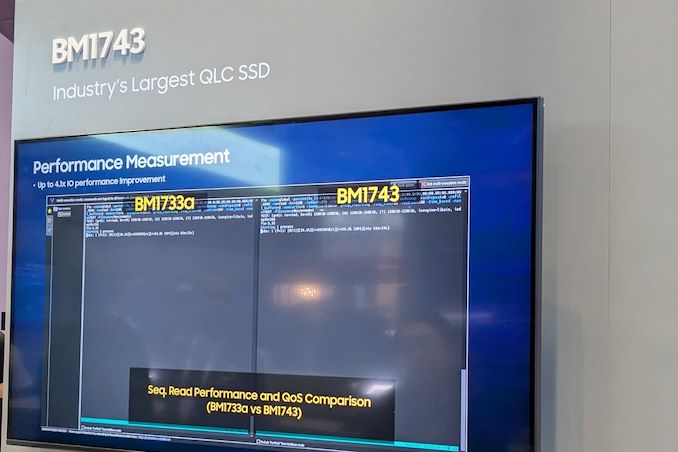
The 128 TB-class QLC SSD boasts of sequential read speeds of 7.5 GBps and write speeds of 3 GBps. Random reads come in at 1.6 M IOPS, while 16 KB random writes clock in at 45K IOPS. Based on the quoted random write access granularity, it appears that Samsung is using a 16 KB indirection unit (IU) to optimize flash management. This is similar to the strategy adopted by Solidigm with IUs larger than 4K in their high-capacity SSDs.
A recorded benchmark session on the company's PM9D3a 8-channel Gen 5 SSD was also on display.
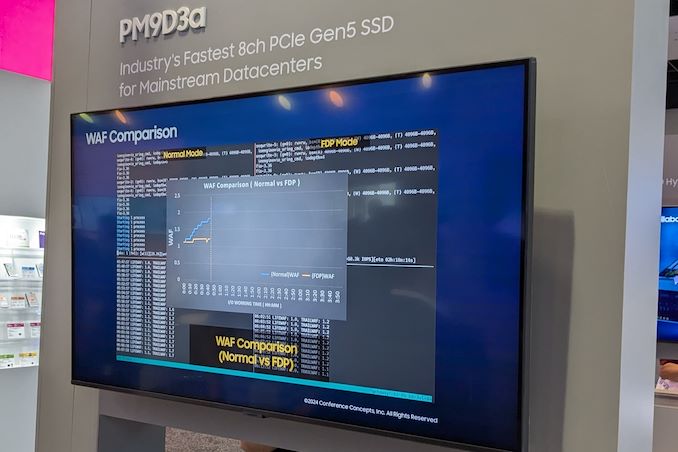
The SSD family is being promoted as a mainstream option for datacenters, and boasts of sequential reads up to 12 GBps and writes up to 6.8 GBps. Random reads clock in at 2 M IOPS, and random writes at 400 K IOPS.
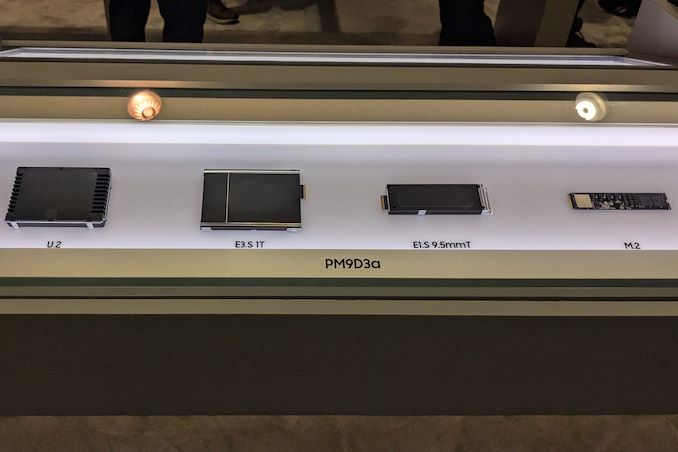
Available in multiple form-factors up to 32 TB (M.2 tops out at 2 TB), the drive's firmware includes optional support for flexible data placement (FDP) to help address the write amplification aspect.
The PM1753 is the current enterprise SSD flagship in Samsung's lineup. With support for 16 NAND channels and capacities up to 32 TB, this U.2 / E3.S SSD has advertised sequential read and write speeds of 14.8 GBps and 11 GBps respectively. Random reads and writes for 4 KB accesses are listed at 3.4 M and 600 K IOPS.
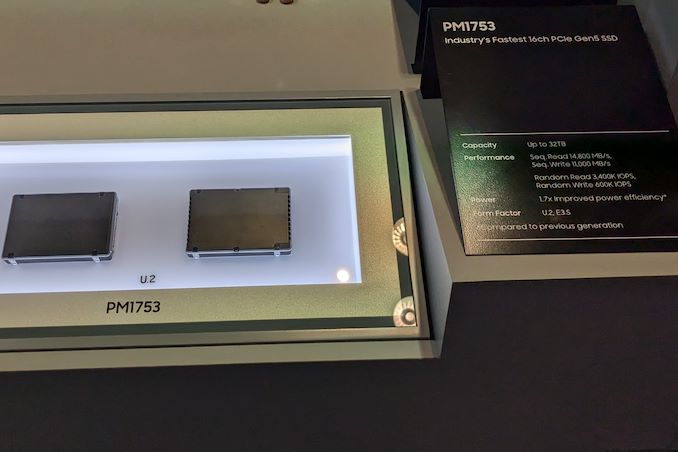
Samsung claims a 1.7x performance improvement and a 1.7x power efficiency improvement over the previous generation (PM1743), making this TLC SSD suitable for AI servers.
The 9th Gen. V-NAND wafer was also available for viewing, though photography was prohibited. Mass production of this flash memory began in April 2024.
Storage

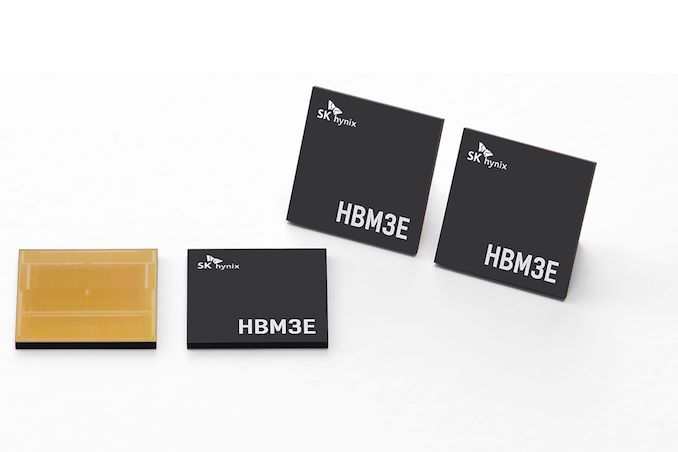
Demand for high-performance processors for AI training is skyrocketing, and consequently so is the demand for the components that go into these processors. So much so that SK hynix this week is very publicly announcing that the company's high-bandwidth memory (HBM) production capacity has already sold out for the rest of 2024, and even most of 2025 has already sold out as well.
SK hynix currently produces various types of HBM memory for customers like Amazon, AMD, Facebook, Google (Broadcom), Intel, Microsoft, and, of course, NVIDIA. The latter is an especially prolific consumer of HBM3 and HBM3E memory for its H100/H200/GH200 accelerators, as NVIDIA is also working to fill what remains an insatiable (and unmet) demand for its accelerators.
As a result, HBM memory orders, which are already placed months in advance, are now backlogging well into 2025 as chip vendors look to secure supplies of the memory stacks critical to their success.
This has made SK hynix the secnd HBM memory vendor in recent months to announce that they've sold out into 2025, following an earlier announcement from Micron regarding its HBM3E production. But of the two announcements, SK hynix's is arguably the most significant yet, as the South Korean firm's HBM production capacity is far greater than Micron's. So while things were merely "interesting" with the smallest of the Big Three memory manufacturers being sold out into 2025, things are taking a more concerning (and constrained) outlook now that SK hynix is as well.
SK hynix currently controls roughly 46% - 49% of HBM market, and its share is not expected to drop significantly in 2025, according to market tracking firm TrendForce. By contrast, Micron's share on HBM memory market is between 4% and 6%. Since HBM supply of both companies is sold out through the most of 2025, we're likely looking at a scenario where over 50% of the industry's total HBM3/HBM3E supply for the coming quarters is already sold out.
This leaves Samsung as the only member of the group not to comment on HBM demand so far. Though with memory being a highly fungible commodity product, it would be surprising if Samsung wasn't facing similar demand. And, ultimately, all of this is pointing towards the indusry entering an HBM3 memory shortage.
Separately, SK hynix said that it is sampling 12-Hi 36GB HBM3E stacks with customers and will begin volume shipments in the third quarter.
Memory
Demand for high-performance processors for AI training is skyrocketing, and consequently so is the demand for the components that go into these processors. So much so that SK hynix this week is very publicly announcing that the company's high-bandwidth memory (HBM) production capacity has already sold out for the rest of 2024, and even most of 2025 has already sold out as well.
SK hynix currently produces various types of HBM memory for customers like Amazon, AMD, Facebook, Google (Broadcom), Intel, Microsoft, and, of course, NVIDIA. The latter is an especially prolific consumer of HBM3 and HBM3E memory for its H100/H200/GH200 accelerators, as NVIDIA is also working to fill what remains an insatiable (and unmet) demand for its accelerators.
As a result, HBM memory orders, which are already placed months in advance, are now backlogging well into 2025 as chip vendors look to secure supplies of the memory stacks critical to their success.
This has made SK hynix the secnd HBM memory vendor in recent months to announce that they've sold out into 2025, following an earlier announcement from Micron regarding its HBM3E production. But of the two announcements, SK hynix's is arguably the most significant yet, as the South Korean firm's HBM production capacity is far greater than Micron's. So while things were merely "interesting" with the smallest of the Big Three memory manufacturers being sold out into 2025, things are taking a more concerning (and constrained) outlook now that SK hynix is as well.
SK hynix currently controls roughly 46% - 49% of HBM market, and its share is not expected to drop significantly in 2025, according to market tracking firm TrendForce. By contrast, Micron's share on HBM memory market is between 4% and 6%. Since HBM supply of both companies is sold out through the most of 2025, we're likely looking at a scenario where over 50% of the industry's total HBM3/HBM3E supply for the coming quarters is already sold out.
This leaves Samsung as the only member of the group not to comment on HBM demand so far. Though with memory being a highly fungible commodity product, it would be surprising if Samsung wasn't facing similar demand. And, ultimately, all of this is pointing towards the indusry entering an HBM3 memory shortage.
Separately, SK hynix said that it is sampling 12-Hi 36GB HBM3E stacks with customers and will begin volume shipments in the third quarter.
Memory
Lorem Ipsum is simply dummy text of the printing and typesetting industry. Lorem Ipsum has been the industry's.
Demand for high-performance processors for AI training is skyrocketing, and consequently so is the demand for the components that go into these processors. So much so that SK hynix this week is very publicly announcing that the company's high-bandwidth memory (HBM) production capacity has already sold out for the rest of 2024, and even most of 2025 has already sold out as well.
SK hynix currently produces various types of HBM memory for customers like Amazon, AMD, Facebook, Google (Broadcom), Intel, Microsoft, and, of course, NVIDIA. The latter is an especially prolific consumer of HBM3 and HBM3E memory for its H100/H200/GH200 accelerators, as NVIDIA is also working to fill what remains an insatiable (and unmet) demand for its accelerators.
As a result, HBM memory orders, which are already placed months in advance, are now backlogging well into 2025 as chip vendors look to secure supplies of the memory stacks critical to their success.
This has made SK hynix the secnd HBM memory vendor in recent months to announce that they've sold out into 2025, following an earlier announcement from Micron regarding its HBM3E production. But of the two announcements, SK hynix's is arguably the most significant yet, as the South Korean firm's HBM production capacity is far greater than Micron's. So while things were merely "interesting" with the smallest of the Big Three memory manufacturers being sold out into 2025, things are taking a more concerning (and constrained) outlook now that SK hynix is as well.
SK hynix currently controls roughly 46% - 49% of HBM market, and its share is not expected to drop significantly in 2025, according to market tracking firm TrendForce. By contrast, Micron's share on HBM memory market is between 4% and 6%. Since HBM supply of both companies is sold out through the most of 2025, we're likely looking at a scenario where over 50% of the industry's total HBM3/HBM3E supply for the coming quarters is already sold out.
This leaves Samsung as the only member of the group not to comment on HBM demand so far. Though with memory being a highly fungible commodity product, it would be surprising if Samsung wasn't facing similar demand. And, ultimately, all of this is pointing towards the indusry entering an HBM3 memory shortage.
Separately, SK hynix said that it is sampling 12-Hi 36GB HBM3E stacks with customers and will begin volume shipments in the third quarter.
Memory



 to optimize flash management. This is similar to the strategy adopted by Solidigm with IUs larger than 4K in their high-capacity SSDs.</p>
<p>A recorded benchmark session on the company's PM9D3a 8-channel Gen 5 SSD was also on display.</p>
<p align="center"><a href="https://www.anandtech.com/show/21526/samsungs-128-tbclass-bm1743-enterprise-ssd-displayed-at-fms-2024"><img alt="" src="https://images.anandtech.com/doci/21526/pm9d3a_575px.jpg" /></a></p>
<p>The SSD family is being promoted as a mainstream option for datacenters, and boasts of sequential reads up to 12 GBps and writes up to 6.8 GBps. Random reads clock in at 2 M IOPS, and random writes at 400 K IOPS.</p>
<p align="center"><a href="https://www.anandtech.com/show/21526/samsungs-128-tbclass-bm1743-enterprise-ssd-displayed-at-fms-2024"><img alt="" src="https://images.anandtech.com/doci/21526/pm9d3a-ff_575px.jpg" /></a></p>
<p>Available in multiple form-factors up to 32 TB (M.2 tops out at 2 TB), the drive's firmware includes optional support for flexible data placement (FDP) to help address the write amplification aspect.</p>
<p>The PM1753 is the current enterprise SSD flagship in Samsung's lineup. With support for 16 NAND channels and capacities up to 32 TB, this U.2 / E3.S SSD has advertised sequential read and write speeds of 14.8 GBps and 11 GBps respectively. Random reads and writes for 4 KB accesses are listed at 3.4 M and 600 K IOPS.</p>
<p align="center"><a href="https://www.anandtech.com/show/21526/samsungs-128-tbclass-bm1743-enterprise-ssd-displayed-at-fms-2024"><img alt="" src="https://images.anandtech.com/doci/21526/pm1753-det_575px.jpg" /></a></p>
<p>Samsung claims a 1.7x performance improvement and a 1.7x power efficiency improvement over the previous generation (PM1743), making this TLC SSD suitable for AI servers.</p>
<p>The 9<sup>th</sup> Gen. V-NAND wafer was also available for viewing, though photography was prohibited. Mass production of this flash memory began in <a href="https://semiconductor.samsung.com/news-events/news/samsung-electronics-begins-industrys-first-mass-production-of-9th-gen-v-nand/">April 2024</a>.</p>
</p> Storage)
 to optimize flash management. This is similar to the strategy adopted by Solidigm with IUs larger than 4K in their high-capacity SSDs.</p>
<p>A recorded benchmark session on the company's PM9D3a 8-channel Gen 5 SSD was also on display.</p>
<p align="center"><a href="https://www.anandtech.com/show/21526/samsungs-128-tbclass-bm1743-enterprise-ssd-displayed-at-fms-2024"><img alt="" src="https://images.anandtech.com/doci/21526/pm9d3a_575px.jpg" /></a></p>
<p>The SSD family is being promoted as a mainstream option for datacenters, and boasts of sequential reads up to 12 GBps and writes up to 6.8 GBps. Random reads clock in at 2 M IOPS, and random writes at 400 K IOPS.</p>
<p align="center"><a href="https://www.anandtech.com/show/21526/samsungs-128-tbclass-bm1743-enterprise-ssd-displayed-at-fms-2024"><img alt="" src="https://images.anandtech.com/doci/21526/pm9d3a-ff_575px.jpg" /></a></p>
<p>Available in multiple form-factors up to 32 TB (M.2 tops out at 2 TB), the drive's firmware includes optional support for flexible data placement (FDP) to help address the write amplification aspect.</p>
<p>The PM1753 is the current enterprise SSD flagship in Samsung's lineup. With support for 16 NAND channels and capacities up to 32 TB, this U.2 / E3.S SSD has advertised sequential read and write speeds of 14.8 GBps and 11 GBps respectively. Random reads and writes for 4 KB accesses are listed at 3.4 M and 600 K IOPS.</p>
<p align="center"><a href="https://www.anandtech.com/show/21526/samsungs-128-tbclass-bm1743-enterprise-ssd-displayed-at-fms-2024"><img alt="" src="https://images.anandtech.com/doci/21526/pm1753-det_575px.jpg" /></a></p>
<p>Samsung claims a 1.7x performance improvement and a 1.7x power efficiency improvement over the previous generation (PM1743), making this TLC SSD suitable for AI servers.</p>
<p>The 9<sup>th</sup> Gen. V-NAND wafer was also available for viewing, though photography was prohibited. Mass production of this flash memory began in <a href="https://semiconductor.samsung.com/news-events/news/samsung-electronics-begins-industrys-first-mass-production-of-9th-gen-v-nand/">April 2024</a>.</p>
</p> Storage)
 to optimize flash management. This is similar to the strategy adopted by Solidigm with IUs larger than 4K in their high-capacity SSDs.</p>
<p>A recorded benchmark session on the company's PM9D3a 8-channel Gen 5 SSD was also on display.</p>
<p align="center"><a href="https://www.anandtech.com/show/21526/samsungs-128-tbclass-bm1743-enterprise-ssd-displayed-at-fms-2024"><img alt="" src="https://images.anandtech.com/doci/21526/pm9d3a_575px.jpg" /></a></p>
<p>The SSD family is being promoted as a mainstream option for datacenters, and boasts of sequential reads up to 12 GBps and writes up to 6.8 GBps. Random reads clock in at 2 M IOPS, and random writes at 400 K IOPS.</p>
<p align="center"><a href="https://www.anandtech.com/show/21526/samsungs-128-tbclass-bm1743-enterprise-ssd-displayed-at-fms-2024"><img alt="" src="https://images.anandtech.com/doci/21526/pm9d3a-ff_575px.jpg" /></a></p>
<p>Available in multiple form-factors up to 32 TB (M.2 tops out at 2 TB), the drive's firmware includes optional support for flexible data placement (FDP) to help address the write amplification aspect.</p>
<p>The PM1753 is the current enterprise SSD flagship in Samsung's lineup. With support for 16 NAND channels and capacities up to 32 TB, this U.2 / E3.S SSD has advertised sequential read and write speeds of 14.8 GBps and 11 GBps respectively. Random reads and writes for 4 KB accesses are listed at 3.4 M and 600 K IOPS.</p>
<p align="center"><a href="https://www.anandtech.com/show/21526/samsungs-128-tbclass-bm1743-enterprise-ssd-displayed-at-fms-2024"><img alt="" src="https://images.anandtech.com/doci/21526/pm1753-det_575px.jpg" /></a></p>
<p>Samsung claims a 1.7x performance improvement and a 1.7x power efficiency improvement over the previous generation (PM1743), making this TLC SSD suitable for AI servers.</p>
<p>The 9<sup>th</sup> Gen. V-NAND wafer was also available for viewing, though photography was prohibited. Mass production of this flash memory began in <a href="https://semiconductor.samsung.com/news-events/news/samsung-electronics-begins-industrys-first-mass-production-of-9th-gen-v-nand/">April 2024</a>.</p>
</p> Storage | https://compbuddey.blogspot.com/2025/01/samsungs-128-tb-class-bm1743-enterprise_26.html)
 to optimize flash management. This is similar to the strategy adopted by Solidigm with IUs larger than 4K in their high-capacity SSDs.</p>
<p>A recorded benchmark session on the company's PM9D3a 8-channel Gen 5 SSD was also on display.</p>
<p align="center"><a href="https://www.anandtech.com/show/21526/samsungs-128-tbclass-bm1743-enterprise-ssd-displayed-at-fms-2024"><img alt="" src="https://images.anandtech.com/doci/21526/pm9d3a_575px.jpg" /></a></p>
<p>The SSD family is being promoted as a mainstream option for datacenters, and boasts of sequential reads up to 12 GBps and writes up to 6.8 GBps. Random reads clock in at 2 M IOPS, and random writes at 400 K IOPS.</p>
<p align="center"><a href="https://www.anandtech.com/show/21526/samsungs-128-tbclass-bm1743-enterprise-ssd-displayed-at-fms-2024"><img alt="" src="https://images.anandtech.com/doci/21526/pm9d3a-ff_575px.jpg" /></a></p>
<p>Available in multiple form-factors up to 32 TB (M.2 tops out at 2 TB), the drive's firmware includes optional support for flexible data placement (FDP) to help address the write amplification aspect.</p>
<p>The PM1753 is the current enterprise SSD flagship in Samsung's lineup. With support for 16 NAND channels and capacities up to 32 TB, this U.2 / E3.S SSD has advertised sequential read and write speeds of 14.8 GBps and 11 GBps respectively. Random reads and writes for 4 KB accesses are listed at 3.4 M and 600 K IOPS.</p>
<p align="center"><a href="https://www.anandtech.com/show/21526/samsungs-128-tbclass-bm1743-enterprise-ssd-displayed-at-fms-2024"><img alt="" src="https://images.anandtech.com/doci/21526/pm1753-det_575px.jpg" /></a></p>
<p>Samsung claims a 1.7x performance improvement and a 1.7x power efficiency improvement over the previous generation (PM1743), making this TLC SSD suitable for AI servers.</p>
<p>The 9<sup>th</sup> Gen. V-NAND wafer was also available for viewing, though photography was prohibited. Mass production of this flash memory began in <a href="https://semiconductor.samsung.com/news-events/news/samsung-electronics-begins-industrys-first-mass-production-of-9th-gen-v-nand/">April 2024</a>.</p>
</p> Storage&body=https://compbuddey.blogspot.com/2025/01/samsungs-128-tb-class-bm1743-enterprise_26.html)


0 Comments