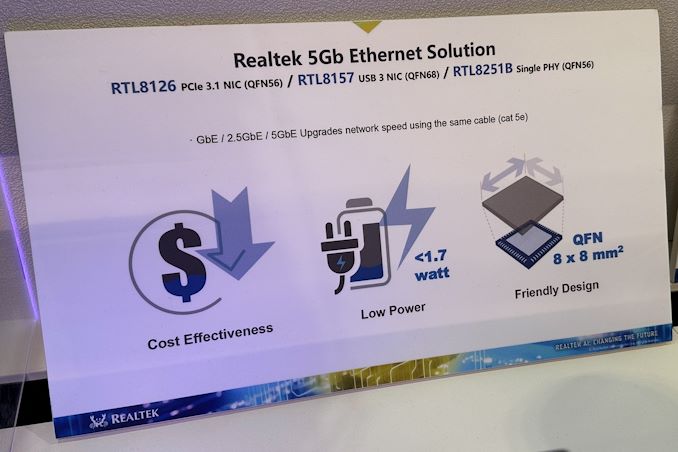

One of the more subtle trends at this year's Computex was that the majority of high-end motherboards now come equipped with a 5GbE network controller. At present, this might be considered a limited benefit as 5GbE and 10GbE switches and routers are still pretty expensive. But Realtek is planning on tackling the issue from both ends, as the company is preparing a hardware platform for sub-$100 5GbE switches.
Realtek’s quad-port 5GbE switch platform consists of five key chips: one RTL9303 switch system-on-chip, and four RTL8251B 5GbE physical interfaces (PHYs). The chips are accompanied by various other components, such as power management ICs, but in general it relies solely on in-house developed components, which is why it can be made so cheap.
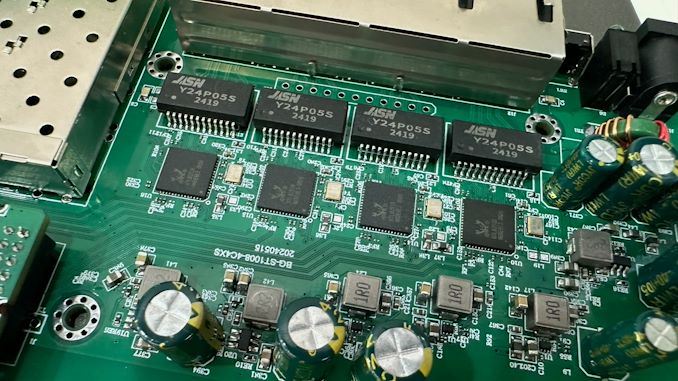
RealTek's platform is meant for home and small offices, which is reflected in the switch's feature set. This is a simple, unmanaged switch with a handful of ports, making it ideal for linking up a few systems, while enterprise users will likely find it a bit too basic.
Segmenting the market like this is ultimately critical for bringing down the price of hardware. The bulk of 5GbE/10GbE switches on the market today are more enterprise-focused managed switches, which carry more features and a price premium to match. So developing a stripped-down platform for cheaper consumer switches is a huge development that should finally make it economical for consumers to adopt faster networking hardware, similar to 2.5GbE a few years ago.
At present, 2.5GbE switches are running at around $20/port, so RealTek's sub-$100 target for a 4-port switch aims to bring 5GbE in at just a slightly higher price tag of $25/port. Or, compared to the handful of unmanaged 10GbE switches on the market, which average $60/port, this will be less than half the price (though at half the bandwidth).
The proliferation of cheap 5GbE network switches will also mark a notable inflection point in Ethernet hardware design, as it's the fastest standard that is rated to work the ubiquitous Cat 5e cable. The NBASE-T standard was penned almost a decade ago in order to cover the missing-middle between 1GbE and 10GbE, while getting more bandwidth out of existing, widely-deployed Cat 5e cabling. So with the release of consumer 5GbE gear, the standard's goals are finally coming to fruition – though it does mean we're finally reaching the end of the road for the oldest network cabling still widely in use.
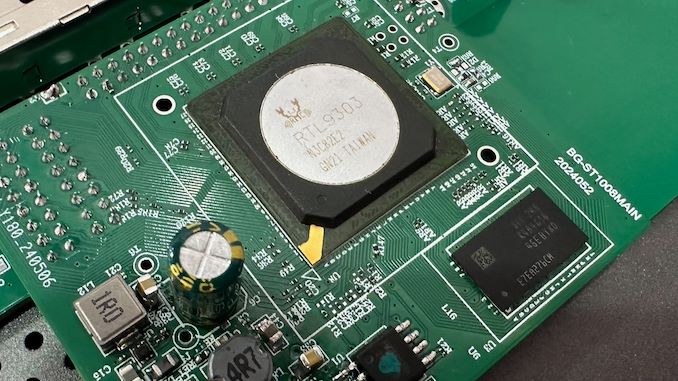
For now, Realtek is only talking about one customer offering a sub-$100 5GbE switch this September, but something tells me that other partners of the company will come up with similar devices soon enough. As a result of the competition, prices could get even lower, which is always good for buyers.
These benefits should also funnel into Wi-Fi 7 routers, to a limited extent. Wired backhaul speeds need to keep pace with ever-faster Wi-Fi standards in order to keep those newer radios fed, so it's not a coincidence that cheaper 5GbE is finally coming right as Wi-Fi 7 is taking off.
Overall, the company's 5GbE switch platform is part of a larger ecosystem of 5GbE hardware that Realtek was showing off at Computex. In addition to RTL8251B 5GbE PHYs and RTL9303 switch SoC, the company is also preparing their RTL8126 PCIe 3.1 network controller, and RTL8157 NIC for USB dongles.
Networking


In addition to revealing its roadmap and plans concerning its current leading-edge process technologies, TSMC also shared progress of its N2 node as part of its Symposiums 2024. The company's first 2nm-class fabrication node, and predominantly featuring gate-all-around transistors, according to TSMC N2 has almost achieved its target performance and yield goals, which places it on track to enter high-volume manufacturing in the second half of 2025.
TSMC states that 'N2 development is well on track and N2P is next.' In particular, gate-all-around nanosheet devices currently achieve over 90% of their expected performance, whereas yields of 256 Mb SRAM (32 MB) devices already exceeds 80%, depending on the batch. All of this for a node that is over a year away from mass production.
Meanwhile, average yield of a 256 Mb SRAM was around 70% as of March, 2024, up from around 35% in April, 2023. Device performance has also been improving with higher frequencies being achieved while keeping power consumption in check.
Chip designer interest towards TSMC's first 2nm-class gate-all-around nanosheet transistor-based technology is significant, too. The number of new tape-outs (NTOs) in the first year of N2 is over two-times higher than it was for N5. Though with that said, given TSMC's close working relationship with a handful of high-volume vendors – most notably Appe – NTOs can be a very misleading figure since the first year of a new node at TSMC is capacity constrained, and consequently the bulk of that capacity goes to TSMC's priority partners.
Meanwhile, there were considerably more N5 tapeouts in its second year (some where N5P, of course) and N2 promises to have 2.6X more NTOs in its second year. So the node indeed looks quite promising. In fact, based on TSMC's slides (which we're unfortunately not able to republish), N2 is more popular than N3 in terms of NTOs both in the first and the second years of existence.
When it comes to the second year of N2, in the second half of 2026 TSMC plans to roll out its N2P technology, which promises additional performance and power benefits. N2P is expected to improve frequency by 15% - 20%, reduce power consumption by 30% - 40%, and increase chip density by over 1.15 times compared to N3E, significant benefits to move to all-new GAA nanosheet transistors.
Finally, for those companies that need the best in performance, power, and density, TSMC is poised to offer their A16 process in 2026. That node will also bring in backside power delivery, which will add costs, but is expected to greatly improve performance efficiency and scaling.
Semiconductors
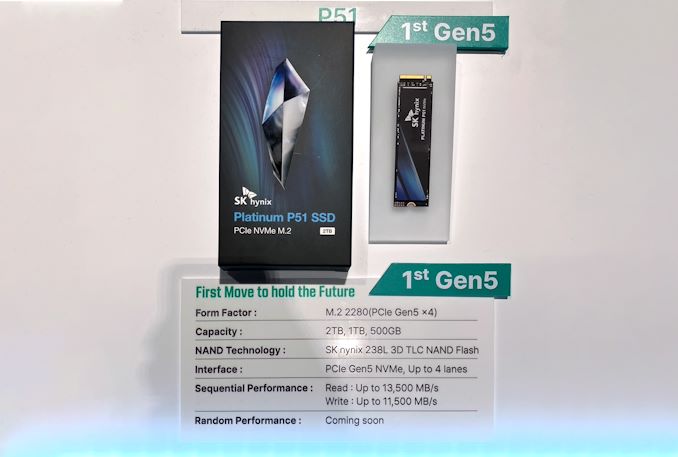
SK hynix is set to unveil their first Gen5 consumer NVMe SSD lineup shortly, based on the products at display in their GTC 2024 booth. The Platinum P51 M.2 2280 NVMe SSD will take over flagship duties from the Platinum P41 that has been serving the market for more than a year.
Similar to the Gold P31 and the Platinum P41, the Platinum P51 also uses an in-house SSD controller. The key updates are the move to PCIe Gen5 and the use of SK hynix's 238L TLC NAND. Other details are scarce, and we have reached out for additional information.
| SK hynix Platinum P51 Gen5 NVMe SSD Specifications | ||||
| Capacity | 500 GB | 1 TB | 2 TB | |
| Controller | SK hynix In-House (Alistar) | |||
| NAND Flash | SK hynix 238L 3D TLC NAND at ?? MT/s ('4D' with CMOS circuitry under the NAND as per SK hynix marketing) | |||
| Form-Factor, Interface | M.2-2280, PCIe 5.0 x4, NVMe 2.0 | |||
| Sequential Read | 13500 MB/s | |||
| Sequential Write | 11500 MB/s | |||
| Random Read IOPS | TBD | |||
| Random Write IOPS | TBD | |||
| SLC Caching | Yes | |||
| TCG Opal Encryption | TBD | |||
| Warranty | TBD | |||
| Write Endurance | TBD | TBD | TBD | |
Only the peak sequential access numbers were available at the GTC booth, indicating that the drive's firmware is still undergoing tweaks. It is also unclear how these numbers are going to vary based on capacity. Availability and pricing are also not public yet.
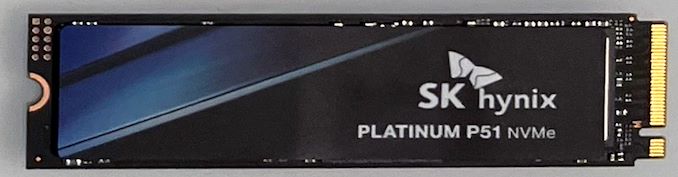
This is a significant launch for the Gen5 consumer SSD market, where the number of available options are quite limited. The Phison E26 controller and Micron's B58R NAND combination is already in its second generation (with the NAND operating at 2400 MT/s in the newest avatar), but other vertically integrated vendors such as Samsung, Western Digital / Kioxia, and SK hynix (till now) are focusing more on the Gen4 market which has much higher adoption.
We will update the piece with additional information once the specifications are officially available.
Storage
As announced last week by TSMC, later this year the company is set to start high-volume manufacturing on its N3P fabrication process, and this will be the company's most advanced node for a while. Next year things will get a bit more interesting as TSMC will have two process technologies that could actually compete against each other when they enter high-volume manufacturing (HVM) in the second half of 2025.
| Advertised PPA Improvements of New Process Technologies Data announced during conference calls, events, press briefings and press releases |
|||||||||
| Compiled by AnandTech |
TSMC | ||||||||
| N3 vs N5 |
N3E vs N5 |
N3P vs N3E |
N3X vs N3P |
N2 vs N3E |
N2P vs N3E |
N2P vs N2 |
A16 vs N2P |
||
| Power | -25% -30% |
-34% | -5% -10% |
-7%*** | -25% -30% |
-30% -40% |
-5% -10% |
-15% -20% |
|
| Performance | +10% +15% |
+18% | +5% | +5% Fmax @1.2V** |
+10% +15% |
+15% +20% |
+5 +10% |
+8% +10% |
|
| Density* | ? | 1.3x | 1.04x | 1.10x*** | 1.15x | 1.15x | ? | 1.07x 1.10x |
|
| HVM | Q4 2022 |
Q4 2023 |
H2 2024 |
H2 2025 |
H2 2025 |
H2 2026 |
H2 2026 |
H2 2026 |
|
*Chip density published by TSMC reflects 'mixed' chip density consisting of 50% logic, 30% SRAM, and 20% analog.
**At the same area.
***At the same speed.
The production nodes are N3X (3nm-class, extreme performance-focused) as well as N2 (2nm-class). TSMC says that when compared to N3P, chips made on N3X can either lower power consumption by 7% at the same frequency by lowering Vdd from 1.0V to 0.9V, increase performance by 5% at the same area, or increase transistor density by around 10% at the same frequency. Meanwhile, the key advantage of N3X compared to predecessors is its maximum voltage of 1.2V, which is important for ultra-high-performance applications, such as desktop or datacenter GPUs.
TSMC's N2 will be TSMC's first production node to use gate-all-around (GAA) nanosheet transistors and this will significantly enhance its performance, power, and are... Semiconductors
In addition to revealing its roadmap and plans concerning its current leading-edge process technologies, TSMC also shared progress of its N2 node as part of its Symposiums 2024. The company's first 2nm-class fabrication node, and predominantly featuring gate-all-around transistors, according to TSMC N2 has almost achieved its target performance and yield goals, which places it on track to enter high-volume manufacturing in the second half of 2025.
TSMC states that 'N2 development is well on track and N2P is next.' In particular, gate-all-around nanosheet devices currently achieve over 90% of their expected performance, whereas yields of 256 Mb SRAM (32 MB) devices already exceeds 80%, depending on the batch. All of this for a node that is over a year away from mass production.
Meanwhile, average yield of a 256 Mb SRAM was around 70% as of March, 2024, up from around 35% in April, 2023. Device performance has also been improving with higher frequencies being achieved while keeping power consumption in check.
Chip designer interest towards TSMC's first 2nm-class gate-all-around nanosheet transistor-based technology is significant, too. The number of new tape-outs (NTOs) in the first year of N2 is over two-times higher than it was for N5. Though with that said, given TSMC's close working relationship with a handful of high-volume vendors – most notably Appe – NTOs can be a very misleading figure since the first year of a new node at TSMC is capacity constrained, and consequently the bulk of that capacity goes to TSMC's priority partners.
Meanwhile, there were considerably more N5 tapeouts in its second year (some where N5P, of course) and N2 promises to have 2.6X more NTOs in its second year. So the node indeed looks quite promising. In fact, based on TSMC's slides (which we're unfortunately not able to republish), N2 is more popular than N3 in terms of NTOs both in the first and the second years of existence.
When it comes to the second year of N2, in the second half of 2026 TSMC plans to roll out its N2P technology, which promises additional performance and power benefits. N2P is expected to improve frequency by 15% - 20%, reduce power consumption by 30% - 40%, and increase chip density by over 1.15 times compared to N3E, significant benefits to move to all-new GAA nanosheet transistors.
Finally, for those companies that need the best in performance, power, and density, TSMC is poised to offer their A16 process in 2026. That node will also bring in backside power delivery, which will add costs, but is expected to greatly improve performance efficiency and scaling.
Semiconductors
SK hynix is set to unveil their first Gen5 consumer NVMe SSD lineup shortly, based on the products at display in their GTC 2024 booth. The Platinum P51 M.2 2280 NVMe SSD will take over flagship duties from the Platinum P41 that has been serving the market for more than a year.
Similar to the Gold P31 and the Platinum P41, the Platinum P51 also uses an in-house SSD controller. The key updates are the move to PCIe Gen5 and the use of SK hynix's 238L TLC NAND. Other details are scarce, and we have reached out for additional information.
| SK hynix Platinum P51 Gen5 NVMe SSD Specifications | ||||
| Capacity | 500 GB | 1 TB | 2 TB | |
| Controller | SK hynix In-House (Alistar) | |||
| NAND Flash | SK hynix 238L 3D TLC NAND at ?? MT/s ('4D' with CMOS circuitry under the NAND as per SK hynix marketing) | |||
| Form-Factor, Interface | M.2-2280, PCIe 5.0 x4, NVMe 2.0 | |||
| Sequential Read | 13500 MB/s | |||
| Sequential Write | 11500 MB/s | |||
| Random Read IOPS | TBD | |||
| Random Write IOPS | TBD | |||
| SLC Caching | Yes | |||
| TCG Opal Encryption | TBD | |||
| Warranty | TBD | |||
| Write Endurance | TBD | TBD | TBD | |
Only the peak sequential access numbers were available at the GTC booth, indicating that the drive's firmware is still undergoing tweaks. It is also unclear how these numbers are going to vary based on capacity. Availability and pricing are also not public yet.
This is a significant launch for the Gen5 consumer SSD market, where the number of available options are quite limited. The Phison E26 controller and Micron's B58R NAND combination is already in its second generation (with the NAND operating at 2400 MT/s in the newest avatar), but other vertically integrated vendors such as Samsung, Western Digital / Kioxia, and SK hynix (till now) are focusing more on the Gen4 market which has much higher adoption.
We will update the piece with additional information once the specifications are officially available.
Storage
As announced last week by TSMC, later this year the company is set to start high-volume manufacturing on its N3P fabrication process, and this will be the company's most advanced node for a while. Next year things will get a bit more interesting as TSMC will have two process technologies that could actually compete against each other when they enter high-volume manufacturing (HVM) in the second half of 2025.
| Advertised PPA Improvements of New Process Technologies Data announced during conference calls, events, press briefings and press releases |
|||||||||
| Compiled by AnandTech |
TSMC | ||||||||
| N3 vs N5 |
N3E vs N5 |
N3P vs N3E |
N3X vs N3P |
N2 vs N3E |
N2P vs N3E |
N2P vs N2 |
A16 vs N2P |
||
| Power | -25% -30% |
-34% | -5% -10% |
-7%*** | -25% -30% |
-30% -40% |
-5% -10% |
-15% -20% |
|
| Performance | +10% +15% |
+18% | +5% | +5% Fmax @1.2V** |
+10% +15% |
+15% +20% |
+5 +10% |
+8% +10% |
|
| Density* | ? | 1.3x | 1.04x | 1.10x*** | 1.15x | 1.15x | ? | 1.07x 1.10x |
|
| HVM | Q4 2022 |
Q4 2023 |
H2 2024 |
H2 2025 |
H2 2025 |
H2 2026 |
H2 2026 |
H2 2026 |
|
*Chip density published by TSMC reflects 'mixed' chip density consisting of 50% logic, 30% SRAM, and 20% analog.
**At the same area.
***At the same speed.
The production nodes are N3X (3nm-class, extreme performance-focused) as well as N2 (2nm-class). TSMC says that when compared to N3P, chips made on N3X can either lower power consumption by 7% at the same frequency by lowering Vdd from 1.0V to 0.9V, increase performance by 5% at the same area, or increase transistor density by around 10% at the same frequency. Meanwhile, the key advantage of N3X compared to predecessors is its maximum voltage of 1.2V, which is important for ultra-high-performance applications, such as desktop or datacenter GPUs.
TSMC's N2 will be TSMC's first production node to use gate-all-around (GAA) nanosheet transistors and this will significantly enhance its performance, power, and are... Semiconductors

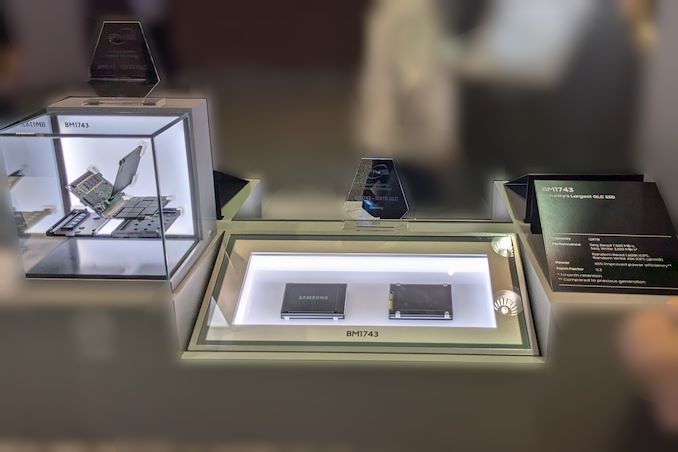
Samsung had quietly launched its BM1743 enterprise QLC SSD last month with a hefty 61.44 TB SKU. At FMS 2024, the company had the even larger 122.88 TB version of that SSD on display, alongside a few recorded benchmarking sessions. Compared to the previous generation, the BM1743 comes with a 4.1x improvement in I/O performance, improvement in data retention, and a 45% improvement in power efficiency for sequential writes.
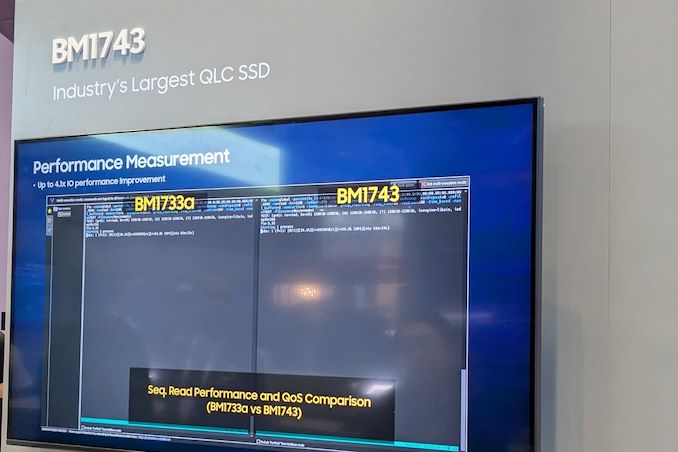
The 128 TB-class QLC SSD boasts of sequential read speeds of 7.5 GBps and write speeds of 3 GBps. Random reads come in at 1.6 M IOPS, while 16 KB random writes clock in at 45K IOPS. Based on the quoted random write access granularity, it appears that Samsung is using a 16 KB indirection unit (IU) to optimize flash management. This is similar to the strategy adopted by Solidigm with IUs larger than 4K in their high-capacity SSDs.
A recorded benchmark session on the company's PM9D3a 8-channel Gen 5 SSD was also on display.
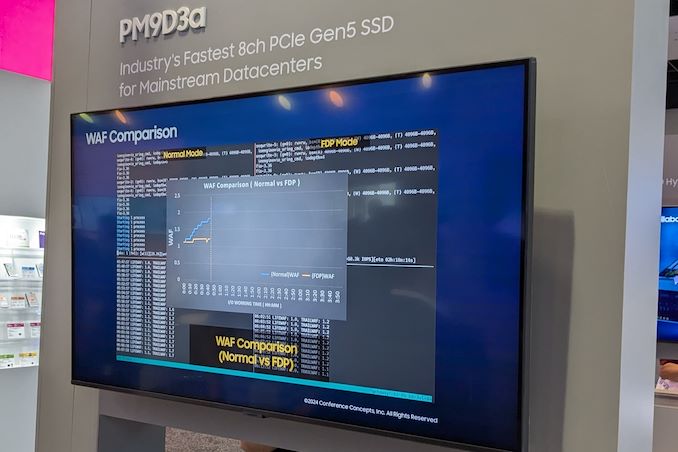
The SSD family is being promoted as a mainstream option for datacenters, and boasts of sequential reads up to 12 GBps and writes up to 6.8 GBps. Random reads clock in at 2 M IOPS, and random writes at 400 K IOPS.
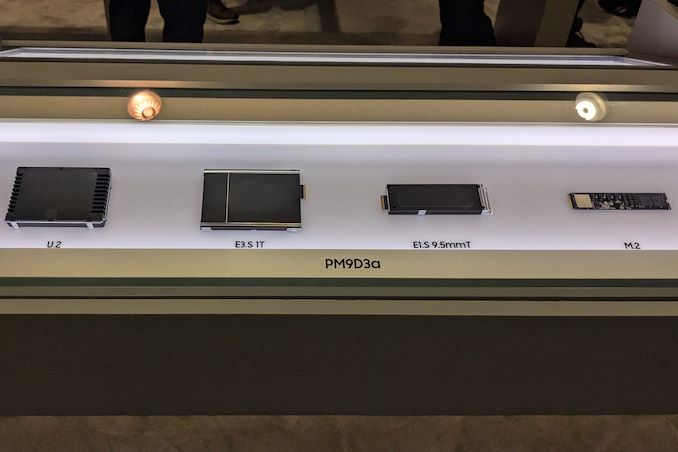
Available in multiple form-factors up to 32 TB (M.2 tops out at 2 TB), the drive's firmware includes optional support for flexible data placement (FDP) to help address the write amplification aspect.
The PM1753 is the current enterprise SSD flagship in Samsung's lineup. With support for 16 NAND channels and capacities up to 32 TB, this U.2 / E3.S SSD has advertised sequential read and write speeds of 14.8 GBps and 11 GBps respectively. Random reads and writes for 4 KB accesses are listed at 3.4 M and 600 K IOPS.
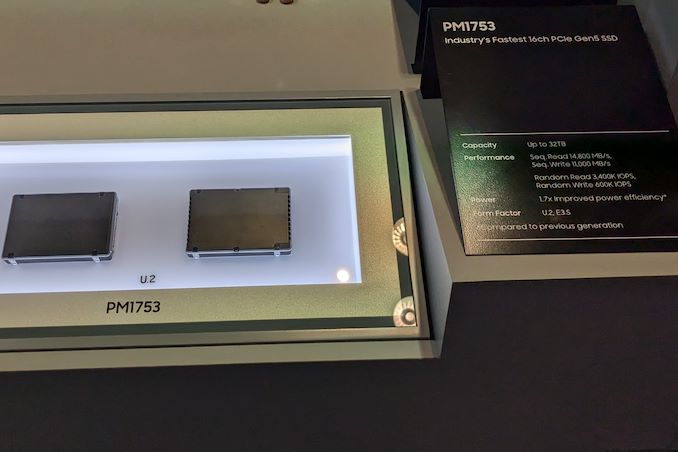
Samsung claims a 1.7x performance improvement and a 1.7x power efficiency improvement over the previous generation (PM1743), making this TLC SSD suitable for AI servers.
The 9th Gen. V-NAND wafer was also available for viewing, though photography was prohibited. Mass production of this flash memory began in April 2024.
Storage
Lorem Ipsum is simply dummy text of the printing and typesetting industry. Lorem Ipsum has been the industry's.
In addition to revealing its roadmap and plans concerning its current leading-edge process technologies, TSMC also shared progress of its N2 node as part of its Symposiums 2024. The company's first 2nm-class fabrication node, and predominantly featuring gate-all-around transistors, according to TSMC N2 has almost achieved its target performance and yield goals, which places it on track to enter high-volume manufacturing in the second half of 2025.
TSMC states that 'N2 development is well on track and N2P is next.' In particular, gate-all-around nanosheet devices currently achieve over 90% of their expected performance, whereas yields of 256 Mb SRAM (32 MB) devices already exceeds 80%, depending on the batch. All of this for a node that is over a year away from mass production.
Meanwhile, average yield of a 256 Mb SRAM was around 70% as of March, 2024, up from around 35% in April, 2023. Device performance has also been improving with higher frequencies being achieved while keeping power consumption in check.
Chip designer interest towards TSMC's first 2nm-class gate-all-around nanosheet transistor-based technology is significant, too. The number of new tape-outs (NTOs) in the first year of N2 is over two-times higher than it was for N5. Though with that said, given TSMC's close working relationship with a handful of high-volume vendors – most notably Appe – NTOs can be a very misleading figure since the first year of a new node at TSMC is capacity constrained, and consequently the bulk of that capacity goes to TSMC's priority partners.
Meanwhile, there were considerably more N5 tapeouts in its second year (some where N5P, of course) and N2 promises to have 2.6X more NTOs in its second year. So the node indeed looks quite promising. In fact, based on TSMC's slides (which we're unfortunately not able to republish), N2 is more popular than N3 in terms of NTOs both in the first and the second years of existence.
When it comes to the second year of N2, in the second half of 2026 TSMC plans to roll out its N2P technology, which promises additional performance and power benefits. N2P is expected to improve frequency by 15% - 20%, reduce power consumption by 30% - 40%, and increase chip density by over 1.15 times compared to N3E, significant benefits to move to all-new GAA nanosheet transistors.
Finally, for those companies that need the best in performance, power, and density, TSMC is poised to offer their A16 process in 2026. That node will also bring in backside power delivery, which will add costs, but is expected to greatly improve performance efficiency and scaling.
Semiconductors
SK hynix is set to unveil their first Gen5 consumer NVMe SSD lineup shortly, based on the products at display in their GTC 2024 booth. The Platinum P51 M.2 2280 NVMe SSD will take over flagship duties from the Platinum P41 that has been serving the market for more than a year.
Similar to the Gold P31 and the Platinum P41, the Platinum P51 also uses an in-house SSD controller. The key updates are the move to PCIe Gen5 and the use of SK hynix's 238L TLC NAND. Other details are scarce, and we have reached out for additional information.
| SK hynix Platinum P51 Gen5 NVMe SSD Specifications | ||||
| Capacity | 500 GB | 1 TB | 2 TB | |
| Controller | SK hynix In-House (Alistar) | |||
| NAND Flash | SK hynix 238L 3D TLC NAND at ?? MT/s ('4D' with CMOS circuitry under the NAND as per SK hynix marketing) | |||
| Form-Factor, Interface | M.2-2280, PCIe 5.0 x4, NVMe 2.0 | |||
| Sequential Read | 13500 MB/s | |||
| Sequential Write | 11500 MB/s | |||
| Random Read IOPS | TBD | |||
| Random Write IOPS | TBD | |||
| SLC Caching | Yes | |||
| TCG Opal Encryption | TBD | |||
| Warranty | TBD | |||
| Write Endurance | TBD | TBD | TBD | |
Only the peak sequential access numbers were available at the GTC booth, indicating that the drive's firmware is still undergoing tweaks. It is also unclear how these numbers are going to vary based on capacity. Availability and pricing are also not public yet.
This is a significant launch for the Gen5 consumer SSD market, where the number of available options are quite limited. The Phison E26 controller and Micron's B58R NAND combination is already in its second generation (with the NAND operating at 2400 MT/s in the newest avatar), but other vertically integrated vendors such as Samsung, Western Digital / Kioxia, and SK hynix (till now) are focusing more on the Gen4 market which has much higher adoption.
We will update the piece with additional information once the specifications are officially available.
Storage
As announced last week by TSMC, later this year the company is set to start high-volume manufacturing on its N3P fabrication process, and this will be the company's most advanced node for a while. Next year things will get a bit more interesting as TSMC will have two process technologies that could actually compete against each other when they enter high-volume manufacturing (HVM) in the second half of 2025.
| Advertised PPA Improvements of New Process Technologies Data announced during conference calls, events, press briefings and press releases |
|||||||||
| Compiled by AnandTech |
TSMC | ||||||||
| N3 vs N5 |
N3E vs N5 |
N3P vs N3E |
N3X vs N3P |
N2 vs N3E |
N2P vs N3E |
N2P vs N2 |
A16 vs N2P |
||
| Power | -25% -30% |
-34% | -5% -10% |
-7%*** | -25% -30% |
-30% -40% |
-5% -10% |
-15% -20% |
|
| Performance | +10% +15% |
+18% | +5% | +5% Fmax @1.2V** |
+10% +15% |
+15% +20% |
+5 +10% |
+8% +10% |
|
| Density* | ? | 1.3x | 1.04x | 1.10x*** | 1.15x | 1.15x | ? | 1.07x 1.10x |
|
| HVM | Q4 2022 |
Q4 2023 |
H2 2024 |
H2 2025 |
H2 2025 |
H2 2026 |
H2 2026 |
H2 2026 |
|
*Chip density published by TSMC reflects 'mixed' chip density consisting of 50% logic, 30% SRAM, and 20% analog.
**At the same area.
***At the same speed.
The production nodes are N3X (3nm-class, extreme performance-focused) as well as N2 (2nm-class). TSMC says that when compared to N3P, chips made on N3X can either lower power consumption by 7% at the same frequency by lowering Vdd from 1.0V to 0.9V, increase performance by 5% at the same area, or increase transistor density by around 10% at the same frequency. Meanwhile, the key advantage of N3X compared to predecessors is its maximum voltage of 1.2V, which is important for ultra-high-performance applications, such as desktop or datacenter GPUs.
TSMC's N2 will be TSMC's first production node to use gate-all-around (GAA) nanosheet transistors and this will significantly enhance its performance, power, and are... Semiconductors







. The chips are accompanied by various other components, such as power management ICs, but in general it relies solely on in-house developed components, which is why it can be made so cheap. </p>
<p style="text-align: center;"><a href="https://www.anandtech.com/show/21449/realtek-has-a-platform-for-sub100-5gbe-switch"><img alt="" src="https://images.anandtech.com/doci/21449/IMG_0075-phy_575px.jpg" /></a></p>
<p>RealTek's platform is meant for home and small offices, which is reflected in the switch's feature set. This is a simple, unmanaged switch with a handful of ports, making it ideal for linking up a few systems, while enterprise users will likely find it a bit too basic.</p>
<p>Segmenting the market like this is ultimately critical for bringing down the price of hardware. The bulk of 5GbE/10GbE switches on the market today are more enterprise-focused managed switches, which carry more features and a price premium to match. So developing a stripped-down platform for cheaper consumer switches is a huge development that should finally make it economical for consumers to adopt faster networking hardware, similar to 2.5GbE a few years ago.</p>
<p>At present, 2.5GbE switches are running at around $20/port, so RealTek's sub-$100 target for a 4-port switch aims to bring 5GbE in at just a slightly higher price tag of $25/port. Or, compared to the handful of unmanaged 10GbE switches on the market, which average $60/port, this will be less than half the price (though at half the bandwidth).</p>
<p>The proliferation of cheap 5GbE network switches will also mark a notable inflection point in Ethernet hardware design, as it's the fastest standard that is rated to work the ubiquitous Cat 5e cable. The NBASE-T standard was penned almost a decade ago in order to cover the missing-middle between 1GbE and 10GbE, while getting more bandwidth out of existing, widely-deployed Cat 5e cabling. So with the release of consumer 5GbE gear, the standard's goals are finally coming to fruition – though it does mean we're finally reaching the end of the road for the oldest network cabling still widely in use.</p>
<p style="text-align: center;"><a href="https://www.anandtech.com/show/21449/realtek-has-a-platform-for-sub100-5gbe-switch"><img alt="" src="https://images.anandtech.com/doci/21449/IMG_0074-realtek-chip_575px.jpg" /></a></p>
<p>For now, Realtek is only talking about one customer offering a sub-$100 5GbE switch this September, but something tells me that other partners of the company will come up with similar devices soon enough. As a result of the competition, prices could get even lower, which is always good for buyers.</p>
<p>These benefits should also funnel into Wi-Fi 7 routers, to a limited extent. Wired backhaul speeds need to keep pace with ever-faster Wi-Fi standards in order to keep those newer radios fed, so it's not a coincidence that cheaper 5GbE is finally coming right as Wi-Fi 7 is taking off.</p>
<p>Overall, the company's 5GbE switch platform is part of a larger ecosystem of 5GbE hardware that Realtek was showing off at Computex. In addition to RTL8251B 5GbE PHYs and RTL9303 switch SoC, the company is also preparing their RTL8126 PCIe 3.1 network controller, and RTL8157 NIC for USB dongles.</p>
</p> Networking)
. The chips are accompanied by various other components, such as power management ICs, but in general it relies solely on in-house developed components, which is why it can be made so cheap. </p>
<p style="text-align: center;"><a href="https://www.anandtech.com/show/21449/realtek-has-a-platform-for-sub100-5gbe-switch"><img alt="" src="https://images.anandtech.com/doci/21449/IMG_0075-phy_575px.jpg" /></a></p>
<p>RealTek's platform is meant for home and small offices, which is reflected in the switch's feature set. This is a simple, unmanaged switch with a handful of ports, making it ideal for linking up a few systems, while enterprise users will likely find it a bit too basic.</p>
<p>Segmenting the market like this is ultimately critical for bringing down the price of hardware. The bulk of 5GbE/10GbE switches on the market today are more enterprise-focused managed switches, which carry more features and a price premium to match. So developing a stripped-down platform for cheaper consumer switches is a huge development that should finally make it economical for consumers to adopt faster networking hardware, similar to 2.5GbE a few years ago.</p>
<p>At present, 2.5GbE switches are running at around $20/port, so RealTek's sub-$100 target for a 4-port switch aims to bring 5GbE in at just a slightly higher price tag of $25/port. Or, compared to the handful of unmanaged 10GbE switches on the market, which average $60/port, this will be less than half the price (though at half the bandwidth).</p>
<p>The proliferation of cheap 5GbE network switches will also mark a notable inflection point in Ethernet hardware design, as it's the fastest standard that is rated to work the ubiquitous Cat 5e cable. The NBASE-T standard was penned almost a decade ago in order to cover the missing-middle between 1GbE and 10GbE, while getting more bandwidth out of existing, widely-deployed Cat 5e cabling. So with the release of consumer 5GbE gear, the standard's goals are finally coming to fruition – though it does mean we're finally reaching the end of the road for the oldest network cabling still widely in use.</p>
<p style="text-align: center;"><a href="https://www.anandtech.com/show/21449/realtek-has-a-platform-for-sub100-5gbe-switch"><img alt="" src="https://images.anandtech.com/doci/21449/IMG_0074-realtek-chip_575px.jpg" /></a></p>
<p>For now, Realtek is only talking about one customer offering a sub-$100 5GbE switch this September, but something tells me that other partners of the company will come up with similar devices soon enough. As a result of the competition, prices could get even lower, which is always good for buyers.</p>
<p>These benefits should also funnel into Wi-Fi 7 routers, to a limited extent. Wired backhaul speeds need to keep pace with ever-faster Wi-Fi standards in order to keep those newer radios fed, so it's not a coincidence that cheaper 5GbE is finally coming right as Wi-Fi 7 is taking off.</p>
<p>Overall, the company's 5GbE switch platform is part of a larger ecosystem of 5GbE hardware that Realtek was showing off at Computex. In addition to RTL8251B 5GbE PHYs and RTL9303 switch SoC, the company is also preparing their RTL8126 PCIe 3.1 network controller, and RTL8157 NIC for USB dongles.</p>
</p> Networking)
. The chips are accompanied by various other components, such as power management ICs, but in general it relies solely on in-house developed components, which is why it can be made so cheap. </p>
<p style="text-align: center;"><a href="https://www.anandtech.com/show/21449/realtek-has-a-platform-for-sub100-5gbe-switch"><img alt="" src="https://images.anandtech.com/doci/21449/IMG_0075-phy_575px.jpg" /></a></p>
<p>RealTek's platform is meant for home and small offices, which is reflected in the switch's feature set. This is a simple, unmanaged switch with a handful of ports, making it ideal for linking up a few systems, while enterprise users will likely find it a bit too basic.</p>
<p>Segmenting the market like this is ultimately critical for bringing down the price of hardware. The bulk of 5GbE/10GbE switches on the market today are more enterprise-focused managed switches, which carry more features and a price premium to match. So developing a stripped-down platform for cheaper consumer switches is a huge development that should finally make it economical for consumers to adopt faster networking hardware, similar to 2.5GbE a few years ago.</p>
<p>At present, 2.5GbE switches are running at around $20/port, so RealTek's sub-$100 target for a 4-port switch aims to bring 5GbE in at just a slightly higher price tag of $25/port. Or, compared to the handful of unmanaged 10GbE switches on the market, which average $60/port, this will be less than half the price (though at half the bandwidth).</p>
<p>The proliferation of cheap 5GbE network switches will also mark a notable inflection point in Ethernet hardware design, as it's the fastest standard that is rated to work the ubiquitous Cat 5e cable. The NBASE-T standard was penned almost a decade ago in order to cover the missing-middle between 1GbE and 10GbE, while getting more bandwidth out of existing, widely-deployed Cat 5e cabling. So with the release of consumer 5GbE gear, the standard's goals are finally coming to fruition – though it does mean we're finally reaching the end of the road for the oldest network cabling still widely in use.</p>
<p style="text-align: center;"><a href="https://www.anandtech.com/show/21449/realtek-has-a-platform-for-sub100-5gbe-switch"><img alt="" src="https://images.anandtech.com/doci/21449/IMG_0074-realtek-chip_575px.jpg" /></a></p>
<p>For now, Realtek is only talking about one customer offering a sub-$100 5GbE switch this September, but something tells me that other partners of the company will come up with similar devices soon enough. As a result of the competition, prices could get even lower, which is always good for buyers.</p>
<p>These benefits should also funnel into Wi-Fi 7 routers, to a limited extent. Wired backhaul speeds need to keep pace with ever-faster Wi-Fi standards in order to keep those newer radios fed, so it's not a coincidence that cheaper 5GbE is finally coming right as Wi-Fi 7 is taking off.</p>
<p>Overall, the company's 5GbE switch platform is part of a larger ecosystem of 5GbE hardware that Realtek was showing off at Computex. In addition to RTL8251B 5GbE PHYs and RTL9303 switch SoC, the company is also preparing their RTL8126 PCIe 3.1 network controller, and RTL8157 NIC for USB dongles.</p>
</p> Networking | https://compbuddey.blogspot.com/2024/07/realtek-previews-platform-for-sub-100_29.html)
. The chips are accompanied by various other components, such as power management ICs, but in general it relies solely on in-house developed components, which is why it can be made so cheap. </p>
<p style="text-align: center;"><a href="https://www.anandtech.com/show/21449/realtek-has-a-platform-for-sub100-5gbe-switch"><img alt="" src="https://images.anandtech.com/doci/21449/IMG_0075-phy_575px.jpg" /></a></p>
<p>RealTek's platform is meant for home and small offices, which is reflected in the switch's feature set. This is a simple, unmanaged switch with a handful of ports, making it ideal for linking up a few systems, while enterprise users will likely find it a bit too basic.</p>
<p>Segmenting the market like this is ultimately critical for bringing down the price of hardware. The bulk of 5GbE/10GbE switches on the market today are more enterprise-focused managed switches, which carry more features and a price premium to match. So developing a stripped-down platform for cheaper consumer switches is a huge development that should finally make it economical for consumers to adopt faster networking hardware, similar to 2.5GbE a few years ago.</p>
<p>At present, 2.5GbE switches are running at around $20/port, so RealTek's sub-$100 target for a 4-port switch aims to bring 5GbE in at just a slightly higher price tag of $25/port. Or, compared to the handful of unmanaged 10GbE switches on the market, which average $60/port, this will be less than half the price (though at half the bandwidth).</p>
<p>The proliferation of cheap 5GbE network switches will also mark a notable inflection point in Ethernet hardware design, as it's the fastest standard that is rated to work the ubiquitous Cat 5e cable. The NBASE-T standard was penned almost a decade ago in order to cover the missing-middle between 1GbE and 10GbE, while getting more bandwidth out of existing, widely-deployed Cat 5e cabling. So with the release of consumer 5GbE gear, the standard's goals are finally coming to fruition – though it does mean we're finally reaching the end of the road for the oldest network cabling still widely in use.</p>
<p style="text-align: center;"><a href="https://www.anandtech.com/show/21449/realtek-has-a-platform-for-sub100-5gbe-switch"><img alt="" src="https://images.anandtech.com/doci/21449/IMG_0074-realtek-chip_575px.jpg" /></a></p>
<p>For now, Realtek is only talking about one customer offering a sub-$100 5GbE switch this September, but something tells me that other partners of the company will come up with similar devices soon enough. As a result of the competition, prices could get even lower, which is always good for buyers.</p>
<p>These benefits should also funnel into Wi-Fi 7 routers, to a limited extent. Wired backhaul speeds need to keep pace with ever-faster Wi-Fi standards in order to keep those newer radios fed, so it's not a coincidence that cheaper 5GbE is finally coming right as Wi-Fi 7 is taking off.</p>
<p>Overall, the company's 5GbE switch platform is part of a larger ecosystem of 5GbE hardware that Realtek was showing off at Computex. In addition to RTL8251B 5GbE PHYs and RTL9303 switch SoC, the company is also preparing their RTL8126 PCIe 3.1 network controller, and RTL8157 NIC for USB dongles.</p>
</p> Networking&body=https://compbuddey.blogspot.com/2024/07/realtek-previews-platform-for-sub-100_29.html)


0 Comments