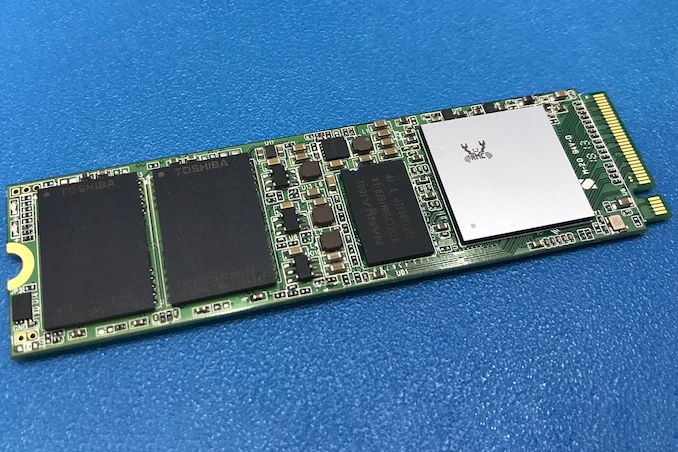

While Realtek is best known in the enthusiast space for for its peripheral controllers such as audio codecs and network controllers, the company also has a small-but-respectable SSD controller business that tends to fly under the radar due to its focus on entry-level and mainstream drives. But Realtek's stature in the SSD space is on the rise, as the company is not only planning new PCIe Gen5 SSD controllers, but also their first high-end, DRAM-equipped SSD controller.
For this year's Computex trade show, Realtek laid out a new SSD controller roadmap that calls for the company to release a trio of new SSD controllers over the next couple of years. First up is a new four-channel entry-level PCIe 4.0 controller, the RTS5776DL, which will be joined a bit later by a PCIe 5.0 variant, the RTS5781DL. But most interesting on Realtek's new roadmap is the final chip being planned: the eight-channel, DRAM-equipped RTS5782, which would be the company's first high-end SSD controller, capable of hitting sequential read rates as high as 14GB/second.
| Realtek NVMe SSD Controller Comparison | |||||||||
| RTS5782 | RTS5781DL | RTS5776DL | RTS5772DL | RTS5766DL | |||||
| Market Segment | High-End | Mainstream | Entry-Level | ||||||
| Error Correction | 4K LDPC | 2K LDPC | |||||||
| DRAM | DDR4, LPDDR4(X) | No | No | No | No | ||||
| Host Interface | PCIe 5.0 x4 | PCIe 5.0 x4 | PCIe 4.0 x4 | PCIe 4.0 x4 | PCIe 3.0 x4 | ||||
| NVMe Version | NVMe 2.0 | NVMe 2.0 | NVMe 2.0 | NVMe 1.4 | NVMe 1.4 | ||||
| NAND Channels, Interface Speed | 8 ch, 3600 MT/s |
4 ch, 3600 MT/s |
4 ch, 3600 MT/s |
8 ch, 1600 MT/s |
4 ch, 1200 MT/s |
||||
| Sequential Read | 14 GB/s | 10 GB/s | 7.4 GB/s | 6 GB/s | 3.2 GB/s | ||||
| Sequential Write | 12 GB/s | 10 GB/s | 7.4 GB/s | 6 GB/s | 2.2 GB/s | ||||
| 4KB Random Read IOPS | 2500k | 1400k | 1200k | - | - | ||||
| 4KB Random Write IOPS | 2500k | 1400k | 1200k | - | - | ||||
Diving a bit deeper into Realtek's roadmap, the RTS5776DL is traditional DRAM-less PCIe Gen4 x4 controller with four NAND chann... SSDs


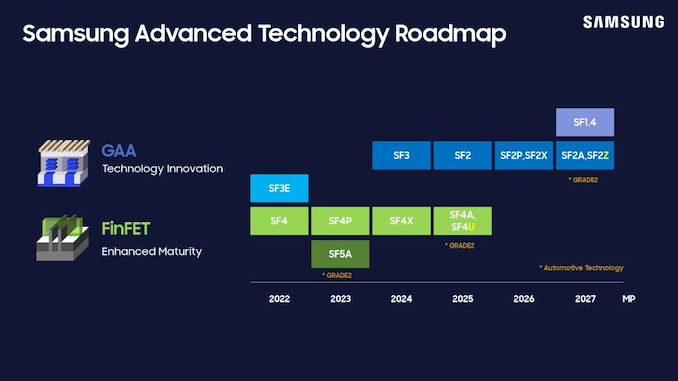
Samsung this week has unveiled its latest process technologies roadmap at the company's Samsung Foundry Forum (SFF) U.S. The new plan covers the evolution of Samsung's 2nm-class production nodes through 2027, including a process technology with a backside power delivery, re-emphasizing plans to bring out a 1.4nm-class node in 2027, and the introduction of a 'high value' 4nm-class manufacturing tech.
Samsung Foundry's key announcements for today are clearly focused on the its 2nm-class process technologies, which are set to enter production in 2025 and will span to 2027, when the company's 1.4-nm class production node is set to enter the scene. Samsung is also adding (or rather, renaming) another 2nm-class node to their roadmap with SF2, which was previously disclosed by Samsung as SF3P and aimed at high-performance devices.
"We have refined and improved the SF3P, resulting in what we now refer to as SF2," a Samsung spokesperson told AnandTech. "This enhanced node incorporates various process design improvements, delivering notable power, performance, and area (PPA) benefits."
| Samsung Foundry for Leading-Edge Nodes Announced on June 12, 2024 Compiled by AnandTech |
||||||||
| HVM Start | 2023 | 2024 | 2025 | 2026 | 2027 | 2027 | ||
| Process | SF3E | SF3 | SF2 (aka SF3P) |
SF2P/SF2X | SF2Z | SF1.4 | ||
| FET | GAAFET | |||||||
| Power Delivery | Frontside | Backside (BSPDN) | ? | |||||
| EUV | 0.33 NA EUV | ? | ? | ? | ? | |||
This is another example of a rebranding of leading-edge fabrication nodes in the recent years by a major chipmaker. Samsung Foundry is not disclosing any specific PPA improvements SF3P has over SF2, and for now is only stating in high-level terms that it will be a better-performing node than the planned SF3P.
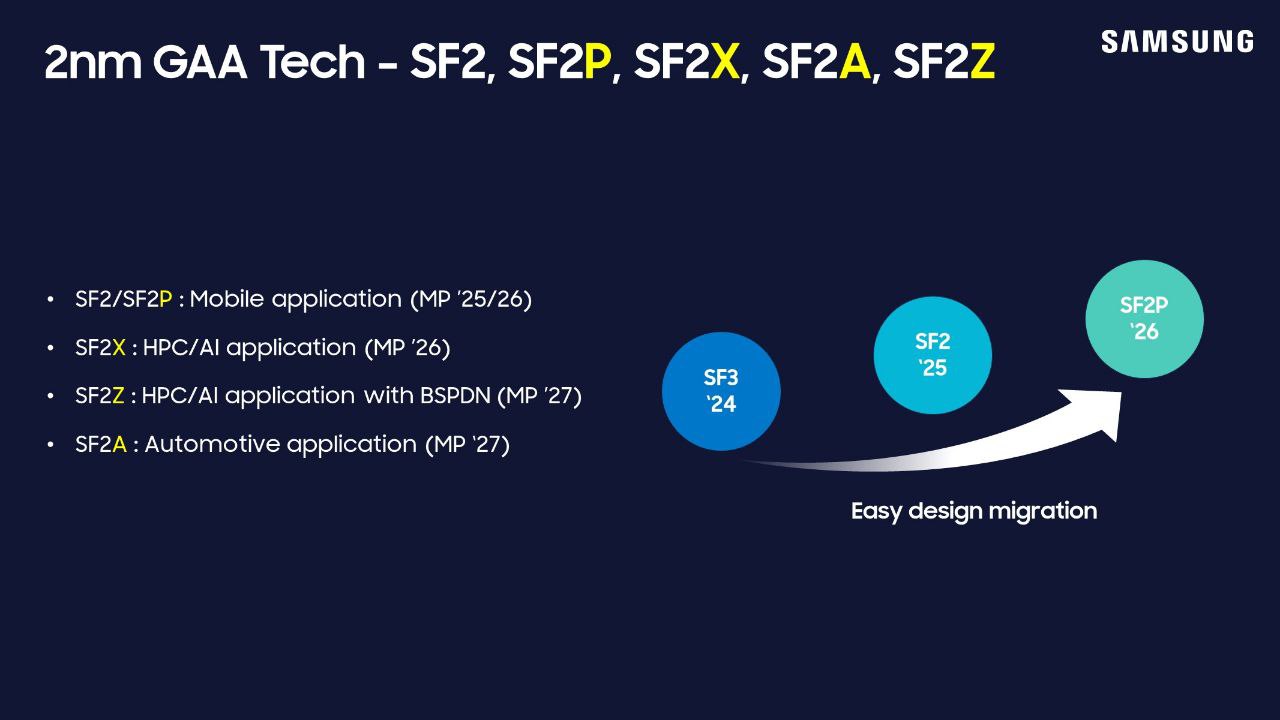
Meanwhile, this week's announcement also includes new information on Samsung's next batch of process nodes, which are planned for 2026 and 2027. In 2026 Samsung will have SF2P, a further refinement of SF2 which incorporates 'faster' yet less dense transistors. That will be followed up in 2027 with SF2Z, which adds backside power delivery to the mix for better and higher quality power delivery. In particular, Samsung is targetting voltate drop (aka IR drop) here, which is an ongoing concern in chip design.
Finally, SF1.4, a 1.4nm-class node, is on track for 2027 as well. Interestingly, however, it looks like it does not feature a backside power delivery. Which, per current roadmaps, would have Samsung as the only foundry not using BSPDN for their first 1.4nm/14Å-class node.
"We have optimized BSPDN and incorporated it for the first time in the SF2Z node we announced today," the spokesperso... Semiconductors

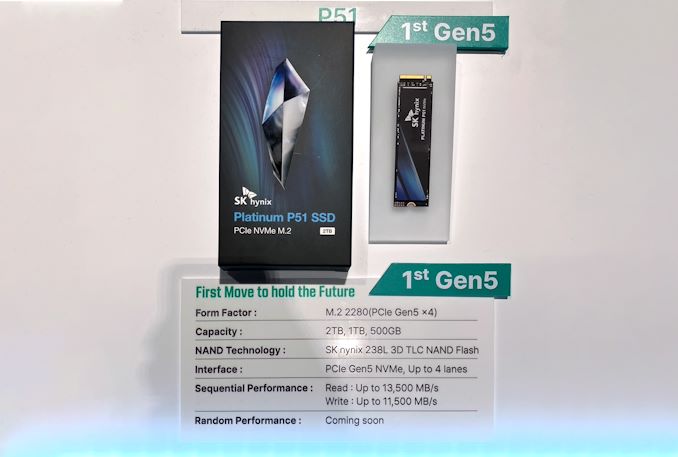
SK hynix is set to unveil their first Gen5 consumer NVMe SSD lineup shortly, based on the products at display in their GTC 2024 booth. The Platinum P51 M.2 2280 NVMe SSD will take over flagship duties from the Platinum P41 that has been serving the market for more than a year.
Similar to the Gold P31 and the Platinum P41, the Platinum P51 also uses an in-house SSD controller. The key updates are the move to PCIe Gen5 and the use of SK hynix's 238L TLC NAND. Other details are scarce, and we have reached out for additional information.
| SK hynix Platinum P51 Gen5 NVMe SSD Specifications | ||||
| Capacity | 500 GB | 1 TB | 2 TB | |
| Controller | SK hynix In-House (Alistar) | |||
| NAND Flash | SK hynix 238L 3D TLC NAND at ?? MT/s ('4D' with CMOS circuitry under the NAND as per SK hynix marketing) | |||
| Form-Factor, Interface | M.2-2280, PCIe 5.0 x4, NVMe 2.0 | |||
| Sequential Read | 13500 MB/s | |||
| Sequential Write | 11500 MB/s | |||
| Random Read IOPS | TBD | |||
| Random Write IOPS | TBD | |||
| SLC Caching | Yes | |||
| TCG Opal Encryption | TBD | |||
| Warranty | TBD | |||
| Write Endurance | TBD | TBD | TBD | |
Only the peak sequential access numbers were available at the GTC booth, indicating that the drive's firmware is still undergoing tweaks. It is also unclear how these numbers are going to vary based on capacity. Availability and pricing are also not public yet.
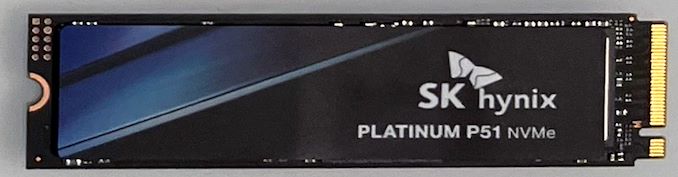
This is a significant launch for the Gen5 consumer SSD market, where the number of available options are quite limited. The Phison E26 controller and Micron's B58R NAND combination is already in its second generation (with the NAND operating at 2400 MT/s in the newest avatar), but other vertically integrated vendors such as Samsung, Western Digital / Kioxia, and SK hynix (till now) are focusing more on the Gen4 market which has much higher adoption.
We will update the piece with additional information once the specifications are officially available.
Storage
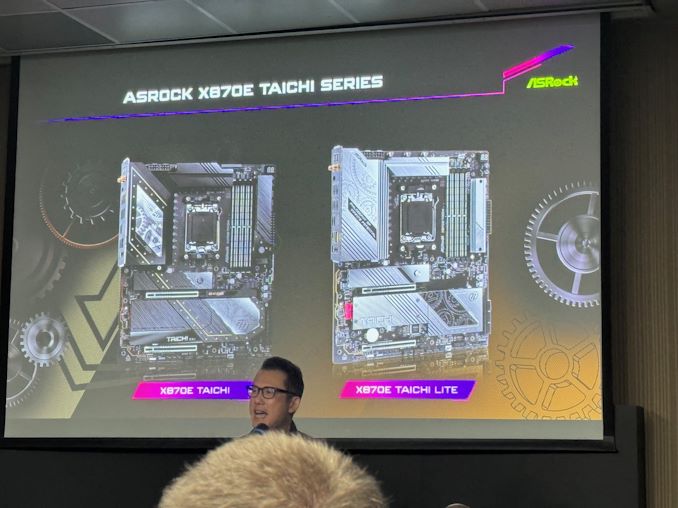
During Computex 2024, ASRock held an event to unveil some of its upcoming X870E motherboards, designed for AMD's Zen 5-based Ryzen 9000 series processors. ASRock's announcement includes a pair of Taichi-branded boards, the X870E Taichi and the lighter X870E Taichi lite, which uses AMD's X870E (Promontory 21) chipset for AM5.
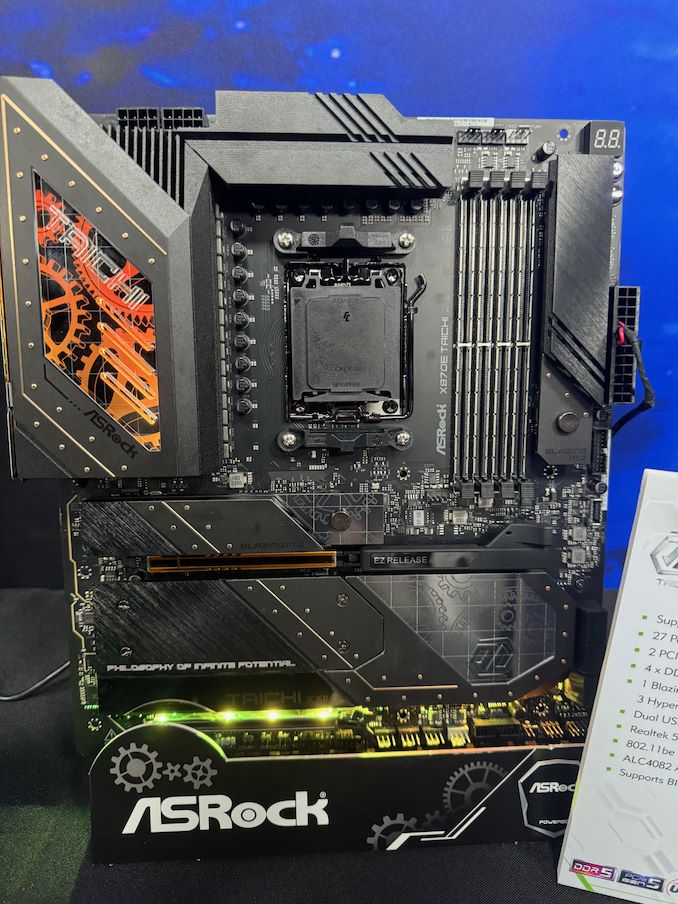
The current flagship model announced from ASRock's X870E line-up for Ryzen 9000 is the ASRock X870E Taichi. ASRock is advertising a large 27-phase power delivery through 110A SPS, suggesting this board is designed for overclockers and all-around power users. Two PCIe 5.0 x16 slots (operating in either x16/x0 or x8/x8) provide high-speed bandwidth for cutting-edge graphics cards and other devices. Meanwhile, ASRock has gone with 4 DIMM slots on this board, so system builders will be able to max out the board's memory capacity at the cost of bandwidth.
The storage offering is impressive; besides the obligatory PCIe Gen5 x4 M.2 slot (Blazing M.2), ASRock has outfit the board with another three PCIe Gen4 x4 (Hyper) M.2 slots. Also present are two USB4 Type-C ports for high-bandwidth external I/O, while networking support is a solid pairing of a discrete Wi-Fi 7 controller with a Realtek 5Gb Ethernet controller (and the first AM5 board we've come across with something faster than a 2.5GbE controller).
The audio setup includes a Realtek ALC4082 codec and ESS SABRE9218 DAC supporting high-fidelity sound. The BIOS flashback feature is also a nice touch, and we believe this should be a feature on all mid-range to high-end motherboards, which provides an easy way to update the firmware without installing a CPU. And, as no high-end board would be complete without it, ASRock has put RGB lighting on the X870E Taichi as well.
Ultimately, as ASRock's high-end X870E board, the X870E Taichi comes with pretty much every last cutting-edge technology that ASRock can fit on the board.
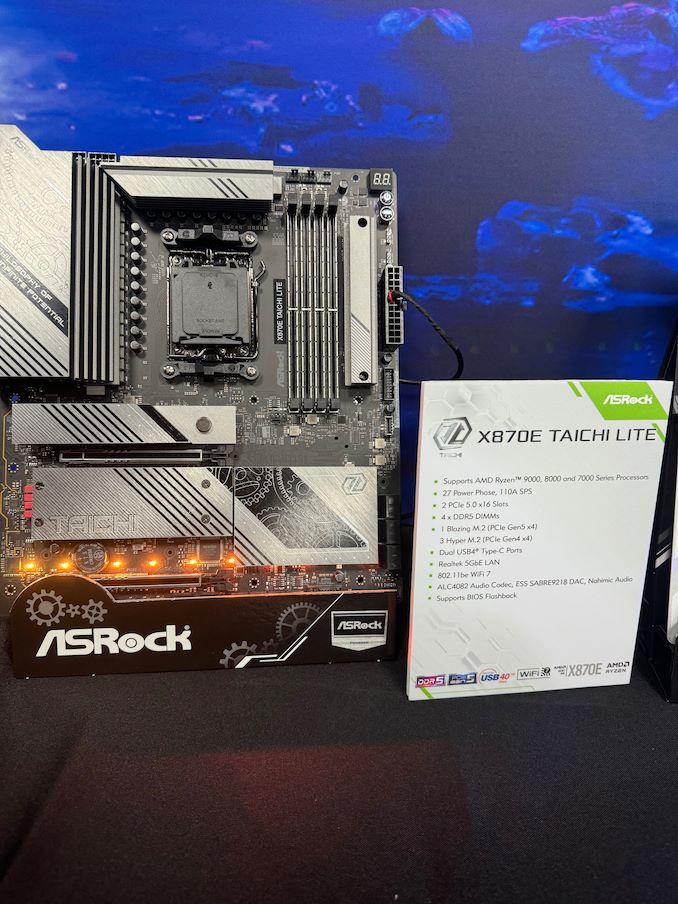
Comparatively, the ASRock X870E Taichi Lite is a more streamlined and functional version of the X870E Taichi. The Lite retaining all of the latter's key features, including the 27-phase power delivery with 110A smart power stages, dual PCIe 5.0 x16 slots operating at x16 or x8/x8, four DDR5 DIMM slots, and four M.2 slots (1x Gen5 + 3x Gen4). The only significant difference is aesthetics: the Taichi Lite features a simpler silver-themed design without the RGB lighting, while the standard Taichi has a more intricate gold-accented and fanciful aesthetics.
In terms of availability, ASRock is not disclosing a release date for the board at the show. And, checking around with other tech journalists, Andreas Schilling from HawrdwareLUXX has heard that X870E and X870 motherboards aren't expected to be available in time for the Ryzen 9000 series launch. We will investigate this and contact the motherboard vendors to confirm the situation. Though as X870E/X870 boards barely differ from the current crop of X670E/B650E boards to begin with, the Ryzen 9000 series won't be fazed by a lack of slightly newer motherboards.
Motherboards
Samsung this week has unveiled its latest process technologies roadmap at the company's Samsung Foundry Forum (SFF) U.S. The new plan covers the evolution of Samsung's 2nm-class production nodes through 2027, including a process technology with a backside power delivery, re-emphasizing plans to bring out a 1.4nm-class node in 2027, and the introduction of a 'high value' 4nm-class manufacturing tech.
Samsung Foundry's key announcements for today are clearly focused on the its 2nm-class process technologies, which are set to enter production in 2025 and will span to 2027, when the company's 1.4-nm class production node is set to enter the scene. Samsung is also adding (or rather, renaming) another 2nm-class node to their roadmap with SF2, which was previously disclosed by Samsung as SF3P and aimed at high-performance devices.
"We have refined and improved the SF3P, resulting in what we now refer to as SF2," a Samsung spokesperson told AnandTech. "This enhanced node incorporates various process design improvements, delivering notable power, performance, and area (PPA) benefits."
| Samsung Foundry for Leading-Edge Nodes Announced on June 12, 2024 Compiled by AnandTech |
||||||||
| HVM Start | 2023 | 2024 | 2025 | 2026 | 2027 | 2027 | ||
| Process | SF3E | SF3 | SF2 (aka SF3P) |
SF2P/SF2X | SF2Z | SF1.4 | ||
| FET | GAAFET | |||||||
| Power Delivery | Frontside | Backside (BSPDN) | ? | |||||
| EUV | 0.33 NA EUV | ? | ? | ? | ? | |||
This is another example of a rebranding of leading-edge fabrication nodes in the recent years by a major chipmaker. Samsung Foundry is not disclosing any specific PPA improvements SF3P has over SF2, and for now is only stating in high-level terms that it will be a better-performing node than the planned SF3P.
Meanwhile, this week's announcement also includes new information on Samsung's next batch of process nodes, which are planned for 2026 and 2027. In 2026 Samsung will have SF2P, a further refinement of SF2 which incorporates 'faster' yet less dense transistors. That will be followed up in 2027 with SF2Z, which adds backside power delivery to the mix for better and higher quality power delivery. In particular, Samsung is targetting voltate drop (aka IR drop) here, which is an ongoing concern in chip design.
Finally, SF1.4, a 1.4nm-class node, is on track for 2027 as well. Interestingly, however, it looks like it does not feature a backside power delivery. Which, per current roadmaps, would have Samsung as the only foundry not using BSPDN for their first 1.4nm/14Å-class node.
"We have optimized BSPDN and incorporated it for the first time in the SF2Z node we announced today," the spokesperso... Semiconductors
SK hynix is set to unveil their first Gen5 consumer NVMe SSD lineup shortly, based on the products at display in their GTC 2024 booth. The Platinum P51 M.2 2280 NVMe SSD will take over flagship duties from the Platinum P41 that has been serving the market for more than a year.
Similar to the Gold P31 and the Platinum P41, the Platinum P51 also uses an in-house SSD controller. The key updates are the move to PCIe Gen5 and the use of SK hynix's 238L TLC NAND. Other details are scarce, and we have reached out for additional information.
| SK hynix Platinum P51 Gen5 NVMe SSD Specifications | ||||
| Capacity | 500 GB | 1 TB | 2 TB | |
| Controller | SK hynix In-House (Alistar) | |||
| NAND Flash | SK hynix 238L 3D TLC NAND at ?? MT/s ('4D' with CMOS circuitry under the NAND as per SK hynix marketing) | |||
| Form-Factor, Interface | M.2-2280, PCIe 5.0 x4, NVMe 2.0 | |||
| Sequential Read | 13500 MB/s | |||
| Sequential Write | 11500 MB/s | |||
| Random Read IOPS | TBD | |||
| Random Write IOPS | TBD | |||
| SLC Caching | Yes | |||
| TCG Opal Encryption | TBD | |||
| Warranty | TBD | |||
| Write Endurance | TBD | TBD | TBD | |
Only the peak sequential access numbers were available at the GTC booth, indicating that the drive's firmware is still undergoing tweaks. It is also unclear how these numbers are going to vary based on capacity. Availability and pricing are also not public yet.
This is a significant launch for the Gen5 consumer SSD market, where the number of available options are quite limited. The Phison E26 controller and Micron's B58R NAND combination is already in its second generation (with the NAND operating at 2400 MT/s in the newest avatar), but other vertically integrated vendors such as Samsung, Western Digital / Kioxia, and SK hynix (till now) are focusing more on the Gen4 market which has much higher adoption.
We will update the piece with additional information once the specifications are officially available.
Storage
During Computex 2024, ASRock held an event to unveil some of its upcoming X870E motherboards, designed for AMD's Zen 5-based Ryzen 9000 series processors. ASRock's announcement includes a pair of Taichi-branded boards, the X870E Taichi and the lighter X870E Taichi lite, which uses AMD's X870E (Promontory 21) chipset for AM5.
The current flagship model announced from ASRock's X870E line-up for Ryzen 9000 is the ASRock X870E Taichi. ASRock is advertising a large 27-phase power delivery through 110A SPS, suggesting this board is designed for overclockers and all-around power users. Two PCIe 5.0 x16 slots (operating in either x16/x0 or x8/x8) provide high-speed bandwidth for cutting-edge graphics cards and other devices. Meanwhile, ASRock has gone with 4 DIMM slots on this board, so system builders will be able to max out the board's memory capacity at the cost of bandwidth.
The storage offering is impressive; besides the obligatory PCIe Gen5 x4 M.2 slot (Blazing M.2), ASRock has outfit the board with another three PCIe Gen4 x4 (Hyper) M.2 slots. Also present are two USB4 Type-C ports for high-bandwidth external I/O, while networking support is a solid pairing of a discrete Wi-Fi 7 controller with a Realtek 5Gb Ethernet controller (and the first AM5 board we've come across with something faster than a 2.5GbE controller).
The audio setup includes a Realtek ALC4082 codec and ESS SABRE9218 DAC supporting high-fidelity sound. The BIOS flashback feature is also a nice touch, and we believe this should be a feature on all mid-range to high-end motherboards, which provides an easy way to update the firmware without installing a CPU. And, as no high-end board would be complete without it, ASRock has put RGB lighting on the X870E Taichi as well.
Ultimately, as ASRock's high-end X870E board, the X870E Taichi comes with pretty much every last cutting-edge technology that ASRock can fit on the board.
Comparatively, the ASRock X870E Taichi Lite is a more streamlined and functional version of the X870E Taichi. The Lite retaining all of the latter's key features, including the 27-phase power delivery with 110A smart power stages, dual PCIe 5.0 x16 slots operating at x16 or x8/x8, four DDR5 DIMM slots, and four M.2 slots (1x Gen5 + 3x Gen4). The only significant difference is aesthetics: the Taichi Lite features a simpler silver-themed design without the RGB lighting, while the standard Taichi has a more intricate gold-accented and fanciful aesthetics.
In terms of availability, ASRock is not disclosing a release date for the board at the show. And, checking around with other tech journalists, Andreas Schilling from HawrdwareLUXX has heard that X870E and X870 motherboards aren't expected to be available in time for the Ryzen 9000 series launch. We will investigate this and contact the motherboard vendors to confirm the situation. Though as X870E/X870 boards barely differ from the current crop of X670E/B650E boards to begin with, the Ryzen 9000 series won't be fazed by a lack of slightly newer motherboards.
Motherboards
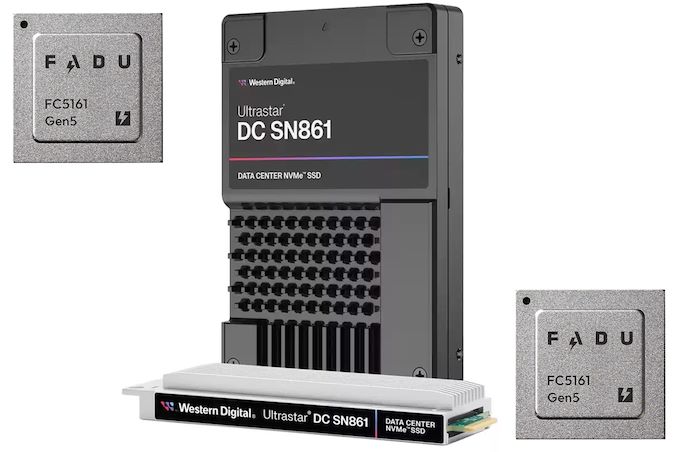
When Western Digital introduced its Ultrastar DC SN861 SSDs earlier this year, the company did not disclose which controller it used for these drives, which made many observers presume that WD was using an in-house controller. But a recent teardown of the drive shows that is not the case; instead, the company is using a controller from Fadu, a South Korean company founded in 2015 that specializes on enterprise-grade turnkey SSD solutions.
The Western Digital Ultrastar DC SN861 SSD is aimed at performance-hungry hyperscale datacenters and enterprise customers which are adopting PCIe Gen5 storage devices these days. And, as uncovered in photos from a recent Storage Review article, the drive is based on Fadu's FC5161 NVMe 2.0-compliant controller. The FC5161 utilizes 16 NAND channels supporting an ONFi 5.0 2400 MT/s interface, and features a combination of enterprise-grade capabilities (OCP Cloud Spec 2.0, SR-IOV, up to 512 name spaces for ZNS support, flexible data placement, NVMe-MI 1.2, advanced security, telemetry, power loss protection) not available on other off-the-shelf controllers – or on any previous Western Digital controllers.
The Ultrastar DC SN861 SSD offers sequential read speeds up to 13.7 GB/s as well as sequential write speeds up to 7.5 GB/s. As for random performance, it boasts with an up to 3.3 million random 4K read IOPS and up to 0.8 million random 4K write IOPS. The drives are available in capacities between 1.6 TB and 7.68 TB with one or three drive writes per day (DWPD) over five years rating as well as in U.2 and E1.S form-factors.
While the two form factors of the SN861 share a similar technical design, Western Digital has tailored each version for distinct workloads: the E1.S supports FDP and performance enhancements specifically for cloud environments. By contrast, the U.2 model is geared towards high-performance enterprise tasks and emerging applications like AI.
Without any doubts, Western Digital's Ultrastar DC SN861 is a feature-rich high-performance enterprise-grade SSD. It has another distinctive feature: a 5W idle power consumption, which is rather low by the standards of enterprise-grade drives (e.g., it is 1W lower compared to the SN840). While the difference with predecessors may be just 1W, hyperscalers deploy thousands of drives and for their TCO every watt counts.
Western Digital's Ultrastar DC SN861 SSDs are now available for purchase to select customers (such as Meta) and to interested parties. Prices are unknown, but they will depend on such factors as volumes.
Sources: Fadu, Storage Review
Storage
Lorem Ipsum is simply dummy text of the printing and typesetting industry. Lorem Ipsum has been the industry's.
Samsung this week has unveiled its latest process technologies roadmap at the company's Samsung Foundry Forum (SFF) U.S. The new plan covers the evolution of Samsung's 2nm-class production nodes through 2027, including a process technology with a backside power delivery, re-emphasizing plans to bring out a 1.4nm-class node in 2027, and the introduction of a 'high value' 4nm-class manufacturing tech.
Samsung Foundry's key announcements for today are clearly focused on the its 2nm-class process technologies, which are set to enter production in 2025 and will span to 2027, when the company's 1.4-nm class production node is set to enter the scene. Samsung is also adding (or rather, renaming) another 2nm-class node to their roadmap with SF2, which was previously disclosed by Samsung as SF3P and aimed at high-performance devices.
"We have refined and improved the SF3P, resulting in what we now refer to as SF2," a Samsung spokesperson told AnandTech. "This enhanced node incorporates various process design improvements, delivering notable power, performance, and area (PPA) benefits."
| Samsung Foundry for Leading-Edge Nodes Announced on June 12, 2024 Compiled by AnandTech |
||||||||
| HVM Start | 2023 | 2024 | 2025 | 2026 | 2027 | 2027 | ||
| Process | SF3E | SF3 | SF2 (aka SF3P) |
SF2P/SF2X | SF2Z | SF1.4 | ||
| FET | GAAFET | |||||||
| Power Delivery | Frontside | Backside (BSPDN) | ? | |||||
| EUV | 0.33 NA EUV | ? | ? | ? | ? | |||
This is another example of a rebranding of leading-edge fabrication nodes in the recent years by a major chipmaker. Samsung Foundry is not disclosing any specific PPA improvements SF3P has over SF2, and for now is only stating in high-level terms that it will be a better-performing node than the planned SF3P.
Meanwhile, this week's announcement also includes new information on Samsung's next batch of process nodes, which are planned for 2026 and 2027. In 2026 Samsung will have SF2P, a further refinement of SF2 which incorporates 'faster' yet less dense transistors. That will be followed up in 2027 with SF2Z, which adds backside power delivery to the mix for better and higher quality power delivery. In particular, Samsung is targetting voltate drop (aka IR drop) here, which is an ongoing concern in chip design.
Finally, SF1.4, a 1.4nm-class node, is on track for 2027 as well. Interestingly, however, it looks like it does not feature a backside power delivery. Which, per current roadmaps, would have Samsung as the only foundry not using BSPDN for their first 1.4nm/14Å-class node.
"We have optimized BSPDN and incorporated it for the first time in the SF2Z node we announced today," the spokesperso... Semiconductors
SK hynix is set to unveil their first Gen5 consumer NVMe SSD lineup shortly, based on the products at display in their GTC 2024 booth. The Platinum P51 M.2 2280 NVMe SSD will take over flagship duties from the Platinum P41 that has been serving the market for more than a year.
Similar to the Gold P31 and the Platinum P41, the Platinum P51 also uses an in-house SSD controller. The key updates are the move to PCIe Gen5 and the use of SK hynix's 238L TLC NAND. Other details are scarce, and we have reached out for additional information.
| SK hynix Platinum P51 Gen5 NVMe SSD Specifications | ||||
| Capacity | 500 GB | 1 TB | 2 TB | |
| Controller | SK hynix In-House (Alistar) | |||
| NAND Flash | SK hynix 238L 3D TLC NAND at ?? MT/s ('4D' with CMOS circuitry under the NAND as per SK hynix marketing) | |||
| Form-Factor, Interface | M.2-2280, PCIe 5.0 x4, NVMe 2.0 | |||
| Sequential Read | 13500 MB/s | |||
| Sequential Write | 11500 MB/s | |||
| Random Read IOPS | TBD | |||
| Random Write IOPS | TBD | |||
| SLC Caching | Yes | |||
| TCG Opal Encryption | TBD | |||
| Warranty | TBD | |||
| Write Endurance | TBD | TBD | TBD | |
Only the peak sequential access numbers were available at the GTC booth, indicating that the drive's firmware is still undergoing tweaks. It is also unclear how these numbers are going to vary based on capacity. Availability and pricing are also not public yet.
This is a significant launch for the Gen5 consumer SSD market, where the number of available options are quite limited. The Phison E26 controller and Micron's B58R NAND combination is already in its second generation (with the NAND operating at 2400 MT/s in the newest avatar), but other vertically integrated vendors such as Samsung, Western Digital / Kioxia, and SK hynix (till now) are focusing more on the Gen4 market which has much higher adoption.
We will update the piece with additional information once the specifications are officially available.
Storage
During Computex 2024, ASRock held an event to unveil some of its upcoming X870E motherboards, designed for AMD's Zen 5-based Ryzen 9000 series processors. ASRock's announcement includes a pair of Taichi-branded boards, the X870E Taichi and the lighter X870E Taichi lite, which uses AMD's X870E (Promontory 21) chipset for AM5.
The current flagship model announced from ASRock's X870E line-up for Ryzen 9000 is the ASRock X870E Taichi. ASRock is advertising a large 27-phase power delivery through 110A SPS, suggesting this board is designed for overclockers and all-around power users. Two PCIe 5.0 x16 slots (operating in either x16/x0 or x8/x8) provide high-speed bandwidth for cutting-edge graphics cards and other devices. Meanwhile, ASRock has gone with 4 DIMM slots on this board, so system builders will be able to max out the board's memory capacity at the cost of bandwidth.
The storage offering is impressive; besides the obligatory PCIe Gen5 x4 M.2 slot (Blazing M.2), ASRock has outfit the board with another three PCIe Gen4 x4 (Hyper) M.2 slots. Also present are two USB4 Type-C ports for high-bandwidth external I/O, while networking support is a solid pairing of a discrete Wi-Fi 7 controller with a Realtek 5Gb Ethernet controller (and the first AM5 board we've come across with something faster than a 2.5GbE controller).
The audio setup includes a Realtek ALC4082 codec and ESS SABRE9218 DAC supporting high-fidelity sound. The BIOS flashback feature is also a nice touch, and we believe this should be a feature on all mid-range to high-end motherboards, which provides an easy way to update the firmware without installing a CPU. And, as no high-end board would be complete without it, ASRock has put RGB lighting on the X870E Taichi as well.
Ultimately, as ASRock's high-end X870E board, the X870E Taichi comes with pretty much every last cutting-edge technology that ASRock can fit on the board.
Comparatively, the ASRock X870E Taichi Lite is a more streamlined and functional version of the X870E Taichi. The Lite retaining all of the latter's key features, including the 27-phase power delivery with 110A smart power stages, dual PCIe 5.0 x16 slots operating at x16 or x8/x8, four DDR5 DIMM slots, and four M.2 slots (1x Gen5 + 3x Gen4). The only significant difference is aesthetics: the Taichi Lite features a simpler silver-themed design without the RGB lighting, while the standard Taichi has a more intricate gold-accented and fanciful aesthetics.
In terms of availability, ASRock is not disclosing a release date for the board at the show. And, checking around with other tech journalists, Andreas Schilling from HawrdwareLUXX has heard that X870E and X870 motherboards aren't expected to be available in time for the Ryzen 9000 series launch. We will investigate this and contact the motherboard vendors to confirm the situation. Though as X870E/X870 boards barely differ from the current crop of X670E/B650E boards to begin with, the Ryzen 9000 series won't be fazed by a lack of slightly newer motherboards.
Motherboards
</td>
<td rowspan="1" style="text-align: center;">No</td>
<td rowspan="1" style="text-align: center;">No</td>
<td rowspan="1" style="text-align: center;">No</td>
<td rowspan="1" style="text-align: center;">No</td>
</tr>
<tr>
<td class="tlgrey">Host Interface</td>
<td style="text-align: center;">PCIe 5.0 x4</td>
<td style="text-align: center;">PCIe 5.0 x4</td>
<td style="text-align: center;">PCIe 4.0 x4</td>
<td rowspan="1" style="text-align: center;">PCIe 4.0 x4</td>
<td rowspan="1" style="text-align: center;">PCIe 3.0 x4</td>
</tr>
<tr>
<td class="tlgrey">NVMe Version</td>
<td style="text-align: center;">NVMe 2.0</td>
<td style="text-align: center;">NVMe 2.0</td>
<td style="text-align: center;">NVMe 2.0</td>
<td style="text-align: center;">NVMe 1.4</td>
<td style="text-align: center;">NVMe 1.4</td>
</tr>
<tr>
<td class="tlgrey" rowspan="1">NAND Channels, Interface Speed</td>
<td rowspan="1" style="text-align: center;">8 ch,<br />
3600 MT/s</td>
<td rowspan="1" style="text-align: center;">4 ch,<br />
3600 MT/s</td>
<td rowspan="1" style="text-align: center;">4 ch,<br />
3600 MT/s</td>
<td rowspan="1" style="text-align: center;">8 ch,<br />
1600 MT/s</td>
<td rowspan="1" style="text-align: center;">4 ch,<br />
1200 MT/s</td>
</tr>
<tr>
<td class="tlgrey">Sequential Read</td>
<td style="text-align: center;">14 GB/s</td>
<td style="text-align: center;">10 GB/s</td>
<td style="text-align: center;">7.4 GB/s</td>
<td style="text-align: center;">6 GB/s</td>
<td style="text-align: center;">3.2 GB/s</td>
</tr>
<tr>
<td class="tlgrey">Sequential Write</td>
<td style="text-align: center;">12 GB/s</td>
<td style="text-align: center;">10 GB/s</td>
<td style="text-align: center;">7.4 GB/s</td>
<td style="text-align: center;">6 GB/s</td>
<td style="text-align: center;">2.2 GB/s</td>
</tr>
<tr>
<td class="tlgrey">4KB Random Read IOPS</td>
<td style="text-align: center;">2500k</td>
<td style="text-align: center;">1400k</td>
<td style="text-align: center;">1200k</td>
<td style="text-align: center;">-</td>
<td style="text-align: center;">-</td>
</tr>
<tr>
<td class="tlgrey">4KB Random Write IOPS</td>
<td style="text-align: center;">2500k</td>
<td style="text-align: center;">1400k</td>
<td style="text-align: center;">1200k</td>
<td style="text-align: center;">-</td>
<td style="text-align: center;">-</td>
</tr>
</tbody>
</table>
<p>Diving a bit deeper into Realtek's roadmap, the RTS5776DL is traditional DRAM-less PCIe Gen4 x4 controller with four NAND chann... SSDs)
</td>
<td rowspan="1" style="text-align: center;">No</td>
<td rowspan="1" style="text-align: center;">No</td>
<td rowspan="1" style="text-align: center;">No</td>
<td rowspan="1" style="text-align: center;">No</td>
</tr>
<tr>
<td class="tlgrey">Host Interface</td>
<td style="text-align: center;">PCIe 5.0 x4</td>
<td style="text-align: center;">PCIe 5.0 x4</td>
<td style="text-align: center;">PCIe 4.0 x4</td>
<td rowspan="1" style="text-align: center;">PCIe 4.0 x4</td>
<td rowspan="1" style="text-align: center;">PCIe 3.0 x4</td>
</tr>
<tr>
<td class="tlgrey">NVMe Version</td>
<td style="text-align: center;">NVMe 2.0</td>
<td style="text-align: center;">NVMe 2.0</td>
<td style="text-align: center;">NVMe 2.0</td>
<td style="text-align: center;">NVMe 1.4</td>
<td style="text-align: center;">NVMe 1.4</td>
</tr>
<tr>
<td class="tlgrey" rowspan="1">NAND Channels, Interface Speed</td>
<td rowspan="1" style="text-align: center;">8 ch,<br />
3600 MT/s</td>
<td rowspan="1" style="text-align: center;">4 ch,<br />
3600 MT/s</td>
<td rowspan="1" style="text-align: center;">4 ch,<br />
3600 MT/s</td>
<td rowspan="1" style="text-align: center;">8 ch,<br />
1600 MT/s</td>
<td rowspan="1" style="text-align: center;">4 ch,<br />
1200 MT/s</td>
</tr>
<tr>
<td class="tlgrey">Sequential Read</td>
<td style="text-align: center;">14 GB/s</td>
<td style="text-align: center;">10 GB/s</td>
<td style="text-align: center;">7.4 GB/s</td>
<td style="text-align: center;">6 GB/s</td>
<td style="text-align: center;">3.2 GB/s</td>
</tr>
<tr>
<td class="tlgrey">Sequential Write</td>
<td style="text-align: center;">12 GB/s</td>
<td style="text-align: center;">10 GB/s</td>
<td style="text-align: center;">7.4 GB/s</td>
<td style="text-align: center;">6 GB/s</td>
<td style="text-align: center;">2.2 GB/s</td>
</tr>
<tr>
<td class="tlgrey">4KB Random Read IOPS</td>
<td style="text-align: center;">2500k</td>
<td style="text-align: center;">1400k</td>
<td style="text-align: center;">1200k</td>
<td style="text-align: center;">-</td>
<td style="text-align: center;">-</td>
</tr>
<tr>
<td class="tlgrey">4KB Random Write IOPS</td>
<td style="text-align: center;">2500k</td>
<td style="text-align: center;">1400k</td>
<td style="text-align: center;">1200k</td>
<td style="text-align: center;">-</td>
<td style="text-align: center;">-</td>
</tr>
</tbody>
</table>
<p>Diving a bit deeper into Realtek's roadmap, the RTS5776DL is traditional DRAM-less PCIe Gen4 x4 controller with four NAND chann... SSDs)
</td>
<td rowspan="1" style="text-align: center;">No</td>
<td rowspan="1" style="text-align: center;">No</td>
<td rowspan="1" style="text-align: center;">No</td>
<td rowspan="1" style="text-align: center;">No</td>
</tr>
<tr>
<td class="tlgrey">Host Interface</td>
<td style="text-align: center;">PCIe 5.0 x4</td>
<td style="text-align: center;">PCIe 5.0 x4</td>
<td style="text-align: center;">PCIe 4.0 x4</td>
<td rowspan="1" style="text-align: center;">PCIe 4.0 x4</td>
<td rowspan="1" style="text-align: center;">PCIe 3.0 x4</td>
</tr>
<tr>
<td class="tlgrey">NVMe Version</td>
<td style="text-align: center;">NVMe 2.0</td>
<td style="text-align: center;">NVMe 2.0</td>
<td style="text-align: center;">NVMe 2.0</td>
<td style="text-align: center;">NVMe 1.4</td>
<td style="text-align: center;">NVMe 1.4</td>
</tr>
<tr>
<td class="tlgrey" rowspan="1">NAND Channels, Interface Speed</td>
<td rowspan="1" style="text-align: center;">8 ch,<br />
3600 MT/s</td>
<td rowspan="1" style="text-align: center;">4 ch,<br />
3600 MT/s</td>
<td rowspan="1" style="text-align: center;">4 ch,<br />
3600 MT/s</td>
<td rowspan="1" style="text-align: center;">8 ch,<br />
1600 MT/s</td>
<td rowspan="1" style="text-align: center;">4 ch,<br />
1200 MT/s</td>
</tr>
<tr>
<td class="tlgrey">Sequential Read</td>
<td style="text-align: center;">14 GB/s</td>
<td style="text-align: center;">10 GB/s</td>
<td style="text-align: center;">7.4 GB/s</td>
<td style="text-align: center;">6 GB/s</td>
<td style="text-align: center;">3.2 GB/s</td>
</tr>
<tr>
<td class="tlgrey">Sequential Write</td>
<td style="text-align: center;">12 GB/s</td>
<td style="text-align: center;">10 GB/s</td>
<td style="text-align: center;">7.4 GB/s</td>
<td style="text-align: center;">6 GB/s</td>
<td style="text-align: center;">2.2 GB/s</td>
</tr>
<tr>
<td class="tlgrey">4KB Random Read IOPS</td>
<td style="text-align: center;">2500k</td>
<td style="text-align: center;">1400k</td>
<td style="text-align: center;">1200k</td>
<td style="text-align: center;">-</td>
<td style="text-align: center;">-</td>
</tr>
<tr>
<td class="tlgrey">4KB Random Write IOPS</td>
<td style="text-align: center;">2500k</td>
<td style="text-align: center;">1400k</td>
<td style="text-align: center;">1200k</td>
<td style="text-align: center;">-</td>
<td style="text-align: center;">-</td>
</tr>
</tbody>
</table>
<p>Diving a bit deeper into Realtek's roadmap, the RTS5776DL is traditional DRAM-less PCIe Gen4 x4 controller with four NAND chann... SSDs | https://compbuddey.blogspot.com/2024/07/realtek-outlines-ssd-controller-roadmap_12.html)
</td>
<td rowspan="1" style="text-align: center;">No</td>
<td rowspan="1" style="text-align: center;">No</td>
<td rowspan="1" style="text-align: center;">No</td>
<td rowspan="1" style="text-align: center;">No</td>
</tr>
<tr>
<td class="tlgrey">Host Interface</td>
<td style="text-align: center;">PCIe 5.0 x4</td>
<td style="text-align: center;">PCIe 5.0 x4</td>
<td style="text-align: center;">PCIe 4.0 x4</td>
<td rowspan="1" style="text-align: center;">PCIe 4.0 x4</td>
<td rowspan="1" style="text-align: center;">PCIe 3.0 x4</td>
</tr>
<tr>
<td class="tlgrey">NVMe Version</td>
<td style="text-align: center;">NVMe 2.0</td>
<td style="text-align: center;">NVMe 2.0</td>
<td style="text-align: center;">NVMe 2.0</td>
<td style="text-align: center;">NVMe 1.4</td>
<td style="text-align: center;">NVMe 1.4</td>
</tr>
<tr>
<td class="tlgrey" rowspan="1">NAND Channels, Interface Speed</td>
<td rowspan="1" style="text-align: center;">8 ch,<br />
3600 MT/s</td>
<td rowspan="1" style="text-align: center;">4 ch,<br />
3600 MT/s</td>
<td rowspan="1" style="text-align: center;">4 ch,<br />
3600 MT/s</td>
<td rowspan="1" style="text-align: center;">8 ch,<br />
1600 MT/s</td>
<td rowspan="1" style="text-align: center;">4 ch,<br />
1200 MT/s</td>
</tr>
<tr>
<td class="tlgrey">Sequential Read</td>
<td style="text-align: center;">14 GB/s</td>
<td style="text-align: center;">10 GB/s</td>
<td style="text-align: center;">7.4 GB/s</td>
<td style="text-align: center;">6 GB/s</td>
<td style="text-align: center;">3.2 GB/s</td>
</tr>
<tr>
<td class="tlgrey">Sequential Write</td>
<td style="text-align: center;">12 GB/s</td>
<td style="text-align: center;">10 GB/s</td>
<td style="text-align: center;">7.4 GB/s</td>
<td style="text-align: center;">6 GB/s</td>
<td style="text-align: center;">2.2 GB/s</td>
</tr>
<tr>
<td class="tlgrey">4KB Random Read IOPS</td>
<td style="text-align: center;">2500k</td>
<td style="text-align: center;">1400k</td>
<td style="text-align: center;">1200k</td>
<td style="text-align: center;">-</td>
<td style="text-align: center;">-</td>
</tr>
<tr>
<td class="tlgrey">4KB Random Write IOPS</td>
<td style="text-align: center;">2500k</td>
<td style="text-align: center;">1400k</td>
<td style="text-align: center;">1200k</td>
<td style="text-align: center;">-</td>
<td style="text-align: center;">-</td>
</tr>
</tbody>
</table>
<p>Diving a bit deeper into Realtek's roadmap, the RTS5776DL is traditional DRAM-less PCIe Gen4 x4 controller with four NAND chann... SSDs&body=https://compbuddey.blogspot.com/2024/07/realtek-outlines-ssd-controller-roadmap_12.html)


0 Comments