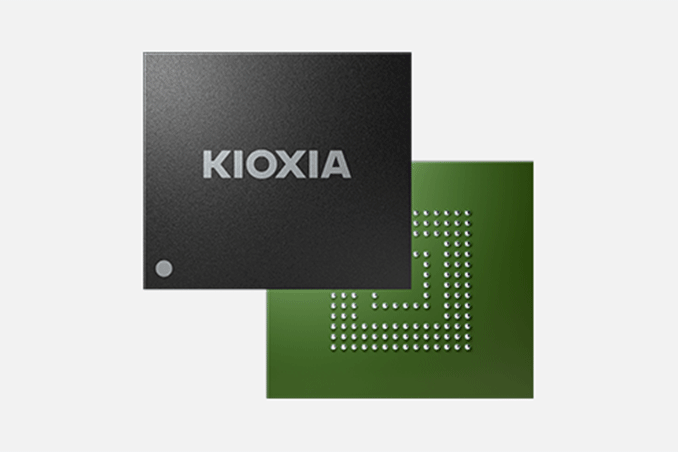

This week, Kioxia introduced its new 3D QLC NAND devices aimed at high-performance, high-capacity drives that could redefine what we typically expect from QLC-based SSDs. The components are 1 Tb and 2 Tb 3D QLC NAND ICs with a 3600 MT/s interface speed that could enable M.2-2230 SSDs with a 4 TB capacity and decent performance.
Kioxia's 1 Tb (128 MB) and 2 Tb (256 TB) 3D QLC NAND devices are made on the company's BICS 8 process technology and feature 238 active layers as well as CMOS directly Bonded to Array (CBA) design, which implies that CMOS (including interface and buffers circuitry) is built on a specialized node and bonded to the memory array. Such a manufacturing process enabled Kioxia (and its manufacturing partner Western Digital) to achieve a particularly high interface speed of 3600 MT/s.
In addition to being one of the industry's first 2 Tb QLC NAND devices, the component features a 70% higher write power efficiency compared to Kioxia's BICS 5 3D QLC NAND devices, which is a bit vague statement as the new ICs have higher capacity and performance in general. This feature will be valuable for data centre applications, though I do not expect someone to use 3D QLC memory for write-intensive applications in general. Yet, these devices will be just what the doctor ordered for AI: read-intensive, content distribution, and backup storage.
It is interesting to note that Kioxia's 1 Tb 3D QLC NAND, optimized for performance, has a 30% faster sequential write performance and a 15% lower read latency than the 2 Tb 3D QLC component. These qualities (alongside a 3600 MT/s interface) promise to make Kioxia's 1 Tb 3D QLC competitive even for higher-end PCIe Gen5 x4 SSDs, which currently exclusively use 3D TLC memory.
The remarkable storage density of Kioxia's 2Tb 3D QLC NAND devices will allow customers to create high-capacity SSDs in compact form factors. For instance, a 16-Hi stacked package (measuring 11.5 mm × 13.5 mm × 1.5 mm) can be used to build a 4TB M.2-2230 drive or a 16TB M.2-2280 drive. Even a single 16-Hi package could be enough to build a particularly fast client SSD.
Kioxia is now sampling its 2 Tb 3D QLC NAND BiCS 8 memory with customers, such as Pure Storage.
"We have a long-standing relationship with Kioxia and are delighted to incorporate their eighth-generation BiCS Flash 2Tb QLC flash memory products to enhance the performance and efficiency of our all-flash storage solutions," said Charles Giancarlo, CEO of Pure Storage. "Pure's unified all-flash data storage platform is able to meet the demanding needs of artificial intelligence as well as the aggressive costs of backup storage. Backed by Kioxia technology, Pure Storage will continue to offer unmatched performance, power efficiency, and reliability, delivering exceptional value to our customers."
"We are pleased to be shipping samples of our new 2Tb QLC with the new eighth-generation BiCS flash technology," said Hideshi Miyajima, CTO of Kioxia. "With its industry-leading high bit density, high speed data transfer, and superior power efficiency, the 2Tb QLC product will offer new value for rapidly emerging AI applications and large storage applications demanding power and space savings."
There is no word on when the 1 Tb 3D QLC BiCS 8 memory will be sampled or released to the market.
SSDs

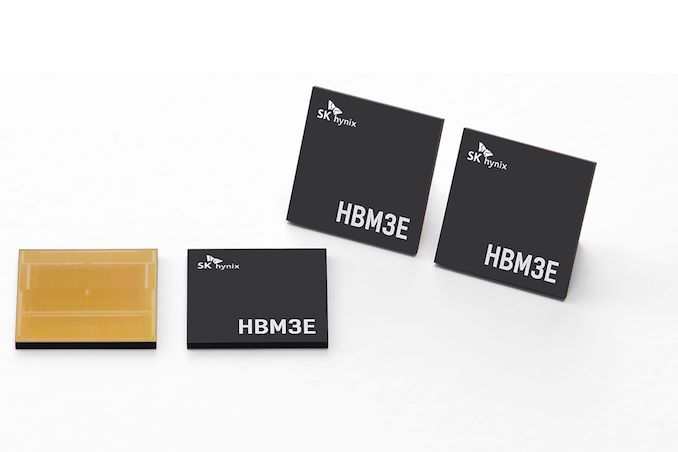
Demand for high-performance processors for AI training is skyrocketing, and consequently so is the demand for the components that go into these processors. So much so that SK hynix this week is very publicly announcing that the company's high-bandwidth memory (HBM) production capacity has already sold out for the rest of 2024, and even most of 2025 has already sold out as well.
SK hynix currently produces various types of HBM memory for customers like Amazon, AMD, Facebook, Google (Broadcom), Intel, Microsoft, and, of course, NVIDIA. The latter is an especially prolific consumer of HBM3 and HBM3E memory for its H100/H200/GH200 accelerators, as NVIDIA is also working to fill what remains an insatiable (and unmet) demand for its accelerators.
As a result, HBM memory orders, which are already placed months in advance, are now backlogging well into 2025 as chip vendors look to secure supplies of the memory stacks critical to their success.
This has made SK hynix the secnd HBM memory vendor in recent months to announce that they've sold out into 2025, following an earlier announcement from Micron regarding its HBM3E production. But of the two announcements, SK hynix's is arguably the most significant yet, as the South Korean firm's HBM production capacity is far greater than Micron's. So while things were merely "interesting" with the smallest of the Big Three memory manufacturers being sold out into 2025, things are taking a more concerning (and constrained) outlook now that SK hynix is as well.
SK hynix currently controls roughly 46% - 49% of HBM market, and its share is not expected to drop significantly in 2025, according to market tracking firm TrendForce. By contrast, Micron's share on HBM memory market is between 4% and 6%. Since HBM supply of both companies is sold out through the most of 2025, we're likely looking at a scenario where over 50% of the industry's total HBM3/HBM3E supply for the coming quarters is already sold out.
This leaves Samsung as the only member of the group not to comment on HBM demand so far. Though with memory being a highly fungible commodity product, it would be surprising if Samsung wasn't facing similar demand. And, ultimately, all of this is pointing towards the indusry entering an HBM3 memory shortage.
Separately, SK hynix said that it is sampling 12-Hi 36GB HBM3E stacks with customers and will begin volume shipments in the third quarter.
Memory
Demand for high-performance processors for AI training is skyrocketing, and consequently so is the demand for the components that go into these processors. So much so that SK hynix this week is very publicly announcing that the company's high-bandwidth memory (HBM) production capacity has already sold out for the rest of 2024, and even most of 2025 has already sold out as well.
SK hynix currently produces various types of HBM memory for customers like Amazon, AMD, Facebook, Google (Broadcom), Intel, Microsoft, and, of course, NVIDIA. The latter is an especially prolific consumer of HBM3 and HBM3E memory for its H100/H200/GH200 accelerators, as NVIDIA is also working to fill what remains an insatiable (and unmet) demand for its accelerators.
As a result, HBM memory orders, which are already placed months in advance, are now backlogging well into 2025 as chip vendors look to secure supplies of the memory stacks critical to their success.
This has made SK hynix the secnd HBM memory vendor in recent months to announce that they've sold out into 2025, following an earlier announcement from Micron regarding its HBM3E production. But of the two announcements, SK hynix's is arguably the most significant yet, as the South Korean firm's HBM production capacity is far greater than Micron's. So while things were merely "interesting" with the smallest of the Big Three memory manufacturers being sold out into 2025, things are taking a more concerning (and constrained) outlook now that SK hynix is as well.
SK hynix currently controls roughly 46% - 49% of HBM market, and its share is not expected to drop significantly in 2025, according to market tracking firm TrendForce. By contrast, Micron's share on HBM memory market is between 4% and 6%. Since HBM supply of both companies is sold out through the most of 2025, we're likely looking at a scenario where over 50% of the industry's total HBM3/HBM3E supply for the coming quarters is already sold out.
This leaves Samsung as the only member of the group not to comment on HBM demand so far. Though with memory being a highly fungible commodity product, it would be surprising if Samsung wasn't facing similar demand. And, ultimately, all of this is pointing towards the indusry entering an HBM3 memory shortage.
Separately, SK hynix said that it is sampling 12-Hi 36GB HBM3E stacks with customers and will begin volume shipments in the third quarter.
Memory
Lorem Ipsum is simply dummy text of the printing and typesetting industry. Lorem Ipsum has been the industry's.
Demand for high-performance processors for AI training is skyrocketing, and consequently so is the demand for the components that go into these processors. So much so that SK hynix this week is very publicly announcing that the company's high-bandwidth memory (HBM) production capacity has already sold out for the rest of 2024, and even most of 2025 has already sold out as well.
SK hynix currently produces various types of HBM memory for customers like Amazon, AMD, Facebook, Google (Broadcom), Intel, Microsoft, and, of course, NVIDIA. The latter is an especially prolific consumer of HBM3 and HBM3E memory for its H100/H200/GH200 accelerators, as NVIDIA is also working to fill what remains an insatiable (and unmet) demand for its accelerators.
As a result, HBM memory orders, which are already placed months in advance, are now backlogging well into 2025 as chip vendors look to secure supplies of the memory stacks critical to their success.
This has made SK hynix the secnd HBM memory vendor in recent months to announce that they've sold out into 2025, following an earlier announcement from Micron regarding its HBM3E production. But of the two announcements, SK hynix's is arguably the most significant yet, as the South Korean firm's HBM production capacity is far greater than Micron's. So while things were merely "interesting" with the smallest of the Big Three memory manufacturers being sold out into 2025, things are taking a more concerning (and constrained) outlook now that SK hynix is as well.
SK hynix currently controls roughly 46% - 49% of HBM market, and its share is not expected to drop significantly in 2025, according to market tracking firm TrendForce. By contrast, Micron's share on HBM memory market is between 4% and 6%. Since HBM supply of both companies is sold out through the most of 2025, we're likely looking at a scenario where over 50% of the industry's total HBM3/HBM3E supply for the coming quarters is already sold out.
This leaves Samsung as the only member of the group not to comment on HBM demand so far. Though with memory being a highly fungible commodity product, it would be surprising if Samsung wasn't facing similar demand. And, ultimately, all of this is pointing towards the indusry entering an HBM3 memory shortage.
Separately, SK hynix said that it is sampling 12-Hi 36GB HBM3E stacks with customers and will begin volume shipments in the third quarter.
Memory



 and 2 Tb (256 TB) 3D QLC NAND devices are made on the company's BICS 8 process technology and feature 238 active layers as well as CMOS directly Bonded to Array (CBA) design, which implies that CMOS (including interface and buffers circuitry) is built on a specialized node and bonded to the memory array. Such a manufacturing process enabled Kioxia (and its manufacturing partner Western Digital) to achieve a particularly high interface speed of 3600 MT/s.</p>
<p>In addition to being one of the industry's first 2 Tb QLC NAND devices, the component features a 70% higher write power efficiency compared to Kioxia's BICS 5 3D QLC NAND devices, which is a bit vague statement as the new ICs have higher capacity and performance in general. This feature will be valuable for data centre applications, though I do not expect someone to use 3D QLC memory for write-intensive applications in general. Yet, these devices will be just what the doctor ordered for AI: read-intensive, content distribution, and backup storage.</p>
<p>It is interesting to note that Kioxia's 1 Tb 3D QLC NAND, optimized for performance, has a 30% faster sequential write performance and a 15% lower read latency than the 2 Tb 3D QLC component. These qualities (alongside a 3600 MT/s interface) promise to make Kioxia's 1 Tb 3D QLC competitive even for higher-end PCIe Gen5 x4 SSDs, which currently exclusively use 3D TLC memory.</p>
<p>The remarkable storage density of Kioxia's 2Tb 3D QLC NAND devices will allow customers to create high-capacity SSDs in compact form factors. For instance, a 16-Hi stacked package (measuring 11.5 mm × 13.5 mm × 1.5 mm) can be used to build a 4TB M.2-2230 drive or a 16TB M.2-2280 drive. Even a single 16-Hi package could be enough to build a particularly fast client SSD.</p>
<p>Kioxia is now sampling its 2 Tb 3D QLC NAND BiCS 8 memory with customers, such as Pure Storage.</p>
<p>"<em>We have a long-standing relationship with Kioxia and are delighted to incorporate their eighth-generation BiCS Flash 2Tb QLC flash memory products to enhance the performance and efficiency of our all-flash storage solutions,</em>" said Charles Giancarlo, CEO of Pure Storage. "<em>Pure's unified all-flash data storage platform is able to meet the demanding needs of artificial intelligence as well as the aggressive costs of backup storage. Backed by Kioxia technology, Pure Storage will continue to offer unmatched performance, power efficiency, and reliability, delivering exceptional value to our customers.</em>"</p>
<p>"<em>We are pleased to be shipping samples of our new 2Tb QLC with the new eighth-generation BiCS flash technology,</em>" said Hideshi Miyajima, CTO of Kioxia. "<em>With its industry-leading high bit density, high speed data transfer, and superior power efficiency, the 2Tb QLC product will offer new value for rapidly emerging AI applications and large storage applications demanding power and space savings.</em>"</p>
<p>There is no word on when the 1 Tb 3D QLC BiCS 8 memory will be sampled or released to the market.</p>
</p> SSDs)
 and 2 Tb (256 TB) 3D QLC NAND devices are made on the company's BICS 8 process technology and feature 238 active layers as well as CMOS directly Bonded to Array (CBA) design, which implies that CMOS (including interface and buffers circuitry) is built on a specialized node and bonded to the memory array. Such a manufacturing process enabled Kioxia (and its manufacturing partner Western Digital) to achieve a particularly high interface speed of 3600 MT/s.</p>
<p>In addition to being one of the industry's first 2 Tb QLC NAND devices, the component features a 70% higher write power efficiency compared to Kioxia's BICS 5 3D QLC NAND devices, which is a bit vague statement as the new ICs have higher capacity and performance in general. This feature will be valuable for data centre applications, though I do not expect someone to use 3D QLC memory for write-intensive applications in general. Yet, these devices will be just what the doctor ordered for AI: read-intensive, content distribution, and backup storage.</p>
<p>It is interesting to note that Kioxia's 1 Tb 3D QLC NAND, optimized for performance, has a 30% faster sequential write performance and a 15% lower read latency than the 2 Tb 3D QLC component. These qualities (alongside a 3600 MT/s interface) promise to make Kioxia's 1 Tb 3D QLC competitive even for higher-end PCIe Gen5 x4 SSDs, which currently exclusively use 3D TLC memory.</p>
<p>The remarkable storage density of Kioxia's 2Tb 3D QLC NAND devices will allow customers to create high-capacity SSDs in compact form factors. For instance, a 16-Hi stacked package (measuring 11.5 mm × 13.5 mm × 1.5 mm) can be used to build a 4TB M.2-2230 drive or a 16TB M.2-2280 drive. Even a single 16-Hi package could be enough to build a particularly fast client SSD.</p>
<p>Kioxia is now sampling its 2 Tb 3D QLC NAND BiCS 8 memory with customers, such as Pure Storage.</p>
<p>"<em>We have a long-standing relationship with Kioxia and are delighted to incorporate their eighth-generation BiCS Flash 2Tb QLC flash memory products to enhance the performance and efficiency of our all-flash storage solutions,</em>" said Charles Giancarlo, CEO of Pure Storage. "<em>Pure's unified all-flash data storage platform is able to meet the demanding needs of artificial intelligence as well as the aggressive costs of backup storage. Backed by Kioxia technology, Pure Storage will continue to offer unmatched performance, power efficiency, and reliability, delivering exceptional value to our customers.</em>"</p>
<p>"<em>We are pleased to be shipping samples of our new 2Tb QLC with the new eighth-generation BiCS flash technology,</em>" said Hideshi Miyajima, CTO of Kioxia. "<em>With its industry-leading high bit density, high speed data transfer, and superior power efficiency, the 2Tb QLC product will offer new value for rapidly emerging AI applications and large storage applications demanding power and space savings.</em>"</p>
<p>There is no word on when the 1 Tb 3D QLC BiCS 8 memory will be sampled or released to the market.</p>
</p> SSDs)
 and 2 Tb (256 TB) 3D QLC NAND devices are made on the company's BICS 8 process technology and feature 238 active layers as well as CMOS directly Bonded to Array (CBA) design, which implies that CMOS (including interface and buffers circuitry) is built on a specialized node and bonded to the memory array. Such a manufacturing process enabled Kioxia (and its manufacturing partner Western Digital) to achieve a particularly high interface speed of 3600 MT/s.</p>
<p>In addition to being one of the industry's first 2 Tb QLC NAND devices, the component features a 70% higher write power efficiency compared to Kioxia's BICS 5 3D QLC NAND devices, which is a bit vague statement as the new ICs have higher capacity and performance in general. This feature will be valuable for data centre applications, though I do not expect someone to use 3D QLC memory for write-intensive applications in general. Yet, these devices will be just what the doctor ordered for AI: read-intensive, content distribution, and backup storage.</p>
<p>It is interesting to note that Kioxia's 1 Tb 3D QLC NAND, optimized for performance, has a 30% faster sequential write performance and a 15% lower read latency than the 2 Tb 3D QLC component. These qualities (alongside a 3600 MT/s interface) promise to make Kioxia's 1 Tb 3D QLC competitive even for higher-end PCIe Gen5 x4 SSDs, which currently exclusively use 3D TLC memory.</p>
<p>The remarkable storage density of Kioxia's 2Tb 3D QLC NAND devices will allow customers to create high-capacity SSDs in compact form factors. For instance, a 16-Hi stacked package (measuring 11.5 mm × 13.5 mm × 1.5 mm) can be used to build a 4TB M.2-2230 drive or a 16TB M.2-2280 drive. Even a single 16-Hi package could be enough to build a particularly fast client SSD.</p>
<p>Kioxia is now sampling its 2 Tb 3D QLC NAND BiCS 8 memory with customers, such as Pure Storage.</p>
<p>"<em>We have a long-standing relationship with Kioxia and are delighted to incorporate their eighth-generation BiCS Flash 2Tb QLC flash memory products to enhance the performance and efficiency of our all-flash storage solutions,</em>" said Charles Giancarlo, CEO of Pure Storage. "<em>Pure's unified all-flash data storage platform is able to meet the demanding needs of artificial intelligence as well as the aggressive costs of backup storage. Backed by Kioxia technology, Pure Storage will continue to offer unmatched performance, power efficiency, and reliability, delivering exceptional value to our customers.</em>"</p>
<p>"<em>We are pleased to be shipping samples of our new 2Tb QLC with the new eighth-generation BiCS flash technology,</em>" said Hideshi Miyajima, CTO of Kioxia. "<em>With its industry-leading high bit density, high speed data transfer, and superior power efficiency, the 2Tb QLC product will offer new value for rapidly emerging AI applications and large storage applications demanding power and space savings.</em>"</p>
<p>There is no word on when the 1 Tb 3D QLC BiCS 8 memory will be sampled or released to the market.</p>
</p> SSDs | https://compbuddey.blogspot.com/2024/07/kioxias-high-performance-3d-qlc-nand.html)
 and 2 Tb (256 TB) 3D QLC NAND devices are made on the company's BICS 8 process technology and feature 238 active layers as well as CMOS directly Bonded to Array (CBA) design, which implies that CMOS (including interface and buffers circuitry) is built on a specialized node and bonded to the memory array. Such a manufacturing process enabled Kioxia (and its manufacturing partner Western Digital) to achieve a particularly high interface speed of 3600 MT/s.</p>
<p>In addition to being one of the industry's first 2 Tb QLC NAND devices, the component features a 70% higher write power efficiency compared to Kioxia's BICS 5 3D QLC NAND devices, which is a bit vague statement as the new ICs have higher capacity and performance in general. This feature will be valuable for data centre applications, though I do not expect someone to use 3D QLC memory for write-intensive applications in general. Yet, these devices will be just what the doctor ordered for AI: read-intensive, content distribution, and backup storage.</p>
<p>It is interesting to note that Kioxia's 1 Tb 3D QLC NAND, optimized for performance, has a 30% faster sequential write performance and a 15% lower read latency than the 2 Tb 3D QLC component. These qualities (alongside a 3600 MT/s interface) promise to make Kioxia's 1 Tb 3D QLC competitive even for higher-end PCIe Gen5 x4 SSDs, which currently exclusively use 3D TLC memory.</p>
<p>The remarkable storage density of Kioxia's 2Tb 3D QLC NAND devices will allow customers to create high-capacity SSDs in compact form factors. For instance, a 16-Hi stacked package (measuring 11.5 mm × 13.5 mm × 1.5 mm) can be used to build a 4TB M.2-2230 drive or a 16TB M.2-2280 drive. Even a single 16-Hi package could be enough to build a particularly fast client SSD.</p>
<p>Kioxia is now sampling its 2 Tb 3D QLC NAND BiCS 8 memory with customers, such as Pure Storage.</p>
<p>"<em>We have a long-standing relationship with Kioxia and are delighted to incorporate their eighth-generation BiCS Flash 2Tb QLC flash memory products to enhance the performance and efficiency of our all-flash storage solutions,</em>" said Charles Giancarlo, CEO of Pure Storage. "<em>Pure's unified all-flash data storage platform is able to meet the demanding needs of artificial intelligence as well as the aggressive costs of backup storage. Backed by Kioxia technology, Pure Storage will continue to offer unmatched performance, power efficiency, and reliability, delivering exceptional value to our customers.</em>"</p>
<p>"<em>We are pleased to be shipping samples of our new 2Tb QLC with the new eighth-generation BiCS flash technology,</em>" said Hideshi Miyajima, CTO of Kioxia. "<em>With its industry-leading high bit density, high speed data transfer, and superior power efficiency, the 2Tb QLC product will offer new value for rapidly emerging AI applications and large storage applications demanding power and space savings.</em>"</p>
<p>There is no word on when the 1 Tb 3D QLC BiCS 8 memory will be sampled or released to the market.</p>
</p> SSDs&body=https://compbuddey.blogspot.com/2024/07/kioxias-high-performance-3d-qlc-nand.html)


0 Comments