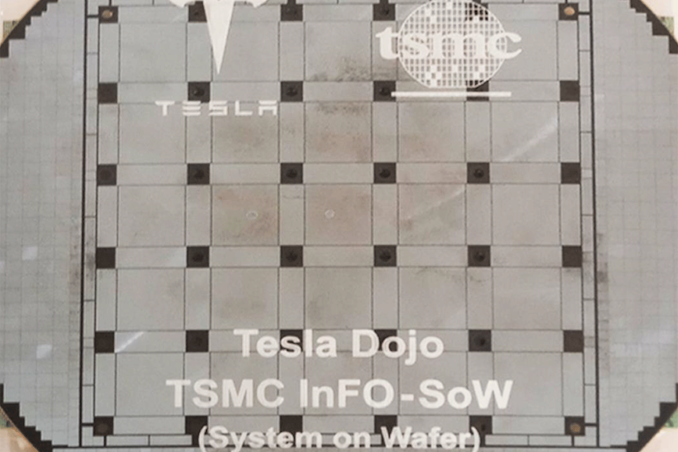

TSMC has been offering its System-on-Wafer integration technology, InFO-SoW, since 2020. For now, only Cerebras and Tesla have developed wafer scale processor designs using it, as while they have fantastic performance and power efficiency, wafer-scale processors are extremely complex to develop and produce. But TSMC believes that not only will wafer-scale designs ramp up in usage, but that megatrends like AI and HPC will call for even more complex solutions: vertically stacked system-on-wafer designs.

Tesla Dojo's wafer-scale processors — the first solutions based based on TSMC's InFO-SoW technology that are in mass production — have a number of benefits over typical system-in-packages (SiPs), including low-latency high-bandwidth core-to-core communications, very high performance and bandwidth density, relatively low power delivery network impendance, high performance efficiency, and redunancy.
But with InFO-SoW and other wafer scale integration methods, processor designers have to rely solely on on-chip memory. This is perfectly adequate for many applications, but it may not be enough for next-generation AI workloads. Furthermore, with InFO-SoW, the whole wafer has to be processed using one fabrication technology, which may not be optimal, or too expensive for certain designs.

So, with its next-generation system-on-wafer platform, TSMC plans to bring together two of its packaging technologies: InFO-SoW and System on Integrated Chips (SoIC), which will allow it to stack memory or logic on top of a system-on-wafer using its Chip-on-Wafer (CoW) method. The CoW-SoW technology, which the company announced at its North American Technology Symposium, will be ready for mass production in 2027.
For now, TSMC is mostly talking about wedding wafer scale processors with HBM4 memory. And given that HBM4 stacks will feature a 2048-bit interface, its tighter integration with logic is something that the industry is considering.
"So, in the future, using wafer level integrations [will allow] our customers to integrate even more logic and memory together," said Kevin Zhang, Vice President of Business Development at TSMC. "SoW is no longer a fiction, this is something we already work with our customers [on] to produce some of the products already in place. This we think by leveraging our advanced wafer level integration technology, we can provide our customer a very important the path allow them to continue to grow their capability to bring in more computation, more energy efficient computation, to their AI cluster or [supercomputer]."


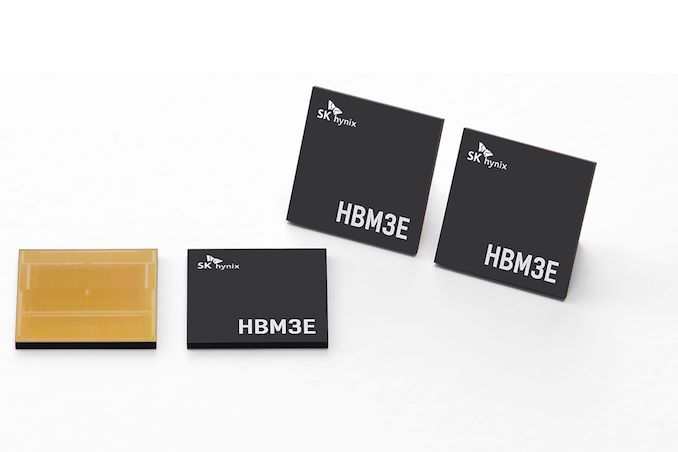
Demand for high-performance processors for AI training is skyrocketing, and consequently so is the demand for the components that go into these processors. So much so that SK hynix this week is very publicly announcing that the company's high-bandwidth memory (HBM) production capacity has already sold out for the rest of 2024, and even most of 2025 has already sold out as well.
SK hynix currently produces various types of HBM memory for customers like Amazon, AMD, Facebook, Google (Broadcom), Intel, Microsoft, and, of course, NVIDIA. The latter is an especially prolific consumer of HBM3 and HBM3E memory for its H100/H200/GH200 accelerators, as NVIDIA is also working to fill what remains an insatiable (and unmet) demand for its accelerators.
As a result, HBM memory orders, which are already placed months in advance, are now backlogging well into 2025 as chip vendors look to secure supplies of the memory stacks critical to their success.
This has made SK hynix the secnd HBM memory vendor in recent months to announce that they've sold out into 2025, following an earlier announcement from Micron regarding its HBM3E production. But of the two announcements, SK hynix's is arguably the most significant yet, as the South Korean firm's HBM production capacity is far greater than Micron's. So while things were merely "interesting" with the smallest of the Big Three memory manufacturers being sold out into 2025, things are taking a more concerning (and constrained) outlook now that SK hynix is as well.
SK hynix currently controls roughly 46% - 49% of HBM market, and its share is not expected to drop significantly in 2025, according to market tracking firm TrendForce. By contrast, Micron's share on HBM memory market is between 4% and 6%. Since HBM supply of both companies is sold out through the most of 2025, we're likely looking at a scenario where over 50% of the industry's total HBM3/HBM3E supply for the coming quarters is already sold out.
This leaves Samsung as the only member of the group not to comment on HBM demand so far. Though with memory being a highly fungible commodity product, it would be surprising if Samsung wasn't facing similar demand. And, ultimately, all of this is pointing towards the indusry entering an HBM3 memory shortage.
Separately, SK hynix said that it is sampling 12-Hi 36GB HBM3E stacks with customers and will begin volume shipments in the third quarter.
Memory
Demand for high-performance processors for AI training is skyrocketing, and consequently so is the demand for the components that go into these processors. So much so that SK hynix this week is very publicly announcing that the company's high-bandwidth memory (HBM) production capacity has already sold out for the rest of 2024, and even most of 2025 has already sold out as well.
SK hynix currently produces various types of HBM memory for customers like Amazon, AMD, Facebook, Google (Broadcom), Intel, Microsoft, and, of course, NVIDIA. The latter is an especially prolific consumer of HBM3 and HBM3E memory for its H100/H200/GH200 accelerators, as NVIDIA is also working to fill what remains an insatiable (and unmet) demand for its accelerators.
As a result, HBM memory orders, which are already placed months in advance, are now backlogging well into 2025 as chip vendors look to secure supplies of the memory stacks critical to their success.
This has made SK hynix the secnd HBM memory vendor in recent months to announce that they've sold out into 2025, following an earlier announcement from Micron regarding its HBM3E production. But of the two announcements, SK hynix's is arguably the most significant yet, as the South Korean firm's HBM production capacity is far greater than Micron's. So while things were merely "interesting" with the smallest of the Big Three memory manufacturers being sold out into 2025, things are taking a more concerning (and constrained) outlook now that SK hynix is as well.
SK hynix currently controls roughly 46% - 49% of HBM market, and its share is not expected to drop significantly in 2025, according to market tracking firm TrendForce. By contrast, Micron's share on HBM memory market is between 4% and 6%. Since HBM supply of both companies is sold out through the most of 2025, we're likely looking at a scenario where over 50% of the industry's total HBM3/HBM3E supply for the coming quarters is already sold out.
This leaves Samsung as the only member of the group not to comment on HBM demand so far. Though with memory being a highly fungible commodity product, it would be surprising if Samsung wasn't facing similar demand. And, ultimately, all of this is pointing towards the indusry entering an HBM3 memory shortage.
Separately, SK hynix said that it is sampling 12-Hi 36GB HBM3E stacks with customers and will begin volume shipments in the third quarter.
Memory
Lorem Ipsum is simply dummy text of the printing and typesetting industry. Lorem Ipsum has been the industry's.
Demand for high-performance processors for AI training is skyrocketing, and consequently so is the demand for the components that go into these processors. So much so that SK hynix this week is very publicly announcing that the company's high-bandwidth memory (HBM) production capacity has already sold out for the rest of 2024, and even most of 2025 has already sold out as well.
SK hynix currently produces various types of HBM memory for customers like Amazon, AMD, Facebook, Google (Broadcom), Intel, Microsoft, and, of course, NVIDIA. The latter is an especially prolific consumer of HBM3 and HBM3E memory for its H100/H200/GH200 accelerators, as NVIDIA is also working to fill what remains an insatiable (and unmet) demand for its accelerators.
As a result, HBM memory orders, which are already placed months in advance, are now backlogging well into 2025 as chip vendors look to secure supplies of the memory stacks critical to their success.
This has made SK hynix the secnd HBM memory vendor in recent months to announce that they've sold out into 2025, following an earlier announcement from Micron regarding its HBM3E production. But of the two announcements, SK hynix's is arguably the most significant yet, as the South Korean firm's HBM production capacity is far greater than Micron's. So while things were merely "interesting" with the smallest of the Big Three memory manufacturers being sold out into 2025, things are taking a more concerning (and constrained) outlook now that SK hynix is as well.
SK hynix currently controls roughly 46% - 49% of HBM market, and its share is not expected to drop significantly in 2025, according to market tracking firm TrendForce. By contrast, Micron's share on HBM memory market is between 4% and 6%. Since HBM supply of both companies is sold out through the most of 2025, we're likely looking at a scenario where over 50% of the industry's total HBM3/HBM3E supply for the coming quarters is already sold out.
This leaves Samsung as the only member of the group not to comment on HBM demand so far. Though with memory being a highly fungible commodity product, it would be surprising if Samsung wasn't facing similar demand. And, ultimately, all of this is pointing towards the indusry entering an HBM3 memory shortage.
Separately, SK hynix said that it is sampling 12-Hi 36GB HBM3E stacks with customers and will begin volume shipments in the third quarter.
Memory



, including low-latency high-bandwidth core-to-core communications, very high performance and bandwidth density, relatively low power delivery network impendance, high performance efficiency, and redunancy.</p>
<p>But with InFO-SoW and other wafer scale integration methods, processor designers have to rely solely on on-chip memory. This is perfectly adequate for many applications, but it may not be enough for next-generation AI workloads. Furthermore, with InFO-SoW, the whole wafer has to be processed using one fabrication technology, which may not be optimal, or too expensive for certain designs.</p>
<p style="text-align: center;"><a href="https://www.anandtech.com/show/21372/tsmcs-system-on-wafer-platform-goes-3d-cow-sow"><img alt="" src="https://images.anandtech.com/doci/21372/tsmc-sow-cowos-evolution-575px.png" /></a></p>
<p>So, with its next-generation system-on-wafer platform, TSMC plans to bring together two of its packaging technologies: InFO-SoW and System on Integrated Chips (SoIC), which will allow it to stack memory or logic on top of a system-on-wafer using its Chip-on-Wafer (CoW) method. The CoW-SoW technology, which the company announced at its North American Technology Symposium, will be ready for mass production in 2027.</p>
<p>For now, TSMC is mostly talking about wedding wafer scale processors with HBM4 memory. And given that HBM4 stacks will feature a 2048-bit interface, its tighter integration with logic is something that the industry is considering.</p>
<p>"So, in the future, using wafer level integrations [will allow] our customers to integrate even more logic and memory together," said Kevin Zhang, Vice President of Business Development at TSMC. "SoW is no longer a fiction, this is something we already work with our customers [on] to produce some of the products already in place. This we think by leveraging our advanced wafer level integration technology, we can provide our customer a very important the path allow them to continue to grow their capability to bring in more computation, more energy efficient computation, to their AI cluster or [supercomputer]."</p>
<h3><strong>Related Reading</strong></h3>
<ul>
<li><a href="https://www.anandtech.com/show/21369/tsmcs-16nm-technology-announced-for-late-2026-a16-with-super-power-rail-bspdn">TSMC's 1.6nm Technology Announced for Late 2026: A16 with "Super Power Rail" Backside Power</a></li>
<li><a href="https://www.anandtech.com/show/21370/tsmc-2nm-update-n2-in-2025-n2p-loses-bspdn-nanoflex-optimizations">TSMC 2nm Update: N2 In 2025, N2P Loses Backside Power, and NanoFlex Brings Optimal Cells</a></li>
<li><a href="https://www.anandtech.com/show/21371/tsmc-preps-lower-cost-4nm-n4c-process-for-2025">TSMC Preps Cheaper 4nm N4C Process For 2025, Aiming For 8.5% Cost Reduction</a></li>
</ul>
</p> Semiconductors)
, including low-latency high-bandwidth core-to-core communications, very high performance and bandwidth density, relatively low power delivery network impendance, high performance efficiency, and redunancy.</p>
<p>But with InFO-SoW and other wafer scale integration methods, processor designers have to rely solely on on-chip memory. This is perfectly adequate for many applications, but it may not be enough for next-generation AI workloads. Furthermore, with InFO-SoW, the whole wafer has to be processed using one fabrication technology, which may not be optimal, or too expensive for certain designs.</p>
<p style="text-align: center;"><a href="https://www.anandtech.com/show/21372/tsmcs-system-on-wafer-platform-goes-3d-cow-sow"><img alt="" src="https://images.anandtech.com/doci/21372/tsmc-sow-cowos-evolution-575px.png" /></a></p>
<p>So, with its next-generation system-on-wafer platform, TSMC plans to bring together two of its packaging technologies: InFO-SoW and System on Integrated Chips (SoIC), which will allow it to stack memory or logic on top of a system-on-wafer using its Chip-on-Wafer (CoW) method. The CoW-SoW technology, which the company announced at its North American Technology Symposium, will be ready for mass production in 2027.</p>
<p>For now, TSMC is mostly talking about wedding wafer scale processors with HBM4 memory. And given that HBM4 stacks will feature a 2048-bit interface, its tighter integration with logic is something that the industry is considering.</p>
<p>"So, in the future, using wafer level integrations [will allow] our customers to integrate even more logic and memory together," said Kevin Zhang, Vice President of Business Development at TSMC. "SoW is no longer a fiction, this is something we already work with our customers [on] to produce some of the products already in place. This we think by leveraging our advanced wafer level integration technology, we can provide our customer a very important the path allow them to continue to grow their capability to bring in more computation, more energy efficient computation, to their AI cluster or [supercomputer]."</p>
<h3><strong>Related Reading</strong></h3>
<ul>
<li><a href="https://www.anandtech.com/show/21369/tsmcs-16nm-technology-announced-for-late-2026-a16-with-super-power-rail-bspdn">TSMC's 1.6nm Technology Announced for Late 2026: A16 with "Super Power Rail" Backside Power</a></li>
<li><a href="https://www.anandtech.com/show/21370/tsmc-2nm-update-n2-in-2025-n2p-loses-bspdn-nanoflex-optimizations">TSMC 2nm Update: N2 In 2025, N2P Loses Backside Power, and NanoFlex Brings Optimal Cells</a></li>
<li><a href="https://www.anandtech.com/show/21371/tsmc-preps-lower-cost-4nm-n4c-process-for-2025">TSMC Preps Cheaper 4nm N4C Process For 2025, Aiming For 8.5% Cost Reduction</a></li>
</ul>
</p> Semiconductors)
, including low-latency high-bandwidth core-to-core communications, very high performance and bandwidth density, relatively low power delivery network impendance, high performance efficiency, and redunancy.</p>
<p>But with InFO-SoW and other wafer scale integration methods, processor designers have to rely solely on on-chip memory. This is perfectly adequate for many applications, but it may not be enough for next-generation AI workloads. Furthermore, with InFO-SoW, the whole wafer has to be processed using one fabrication technology, which may not be optimal, or too expensive for certain designs.</p>
<p style="text-align: center;"><a href="https://www.anandtech.com/show/21372/tsmcs-system-on-wafer-platform-goes-3d-cow-sow"><img alt="" src="https://images.anandtech.com/doci/21372/tsmc-sow-cowos-evolution-575px.png" /></a></p>
<p>So, with its next-generation system-on-wafer platform, TSMC plans to bring together two of its packaging technologies: InFO-SoW and System on Integrated Chips (SoIC), which will allow it to stack memory or logic on top of a system-on-wafer using its Chip-on-Wafer (CoW) method. The CoW-SoW technology, which the company announced at its North American Technology Symposium, will be ready for mass production in 2027.</p>
<p>For now, TSMC is mostly talking about wedding wafer scale processors with HBM4 memory. And given that HBM4 stacks will feature a 2048-bit interface, its tighter integration with logic is something that the industry is considering.</p>
<p>"So, in the future, using wafer level integrations [will allow] our customers to integrate even more logic and memory together," said Kevin Zhang, Vice President of Business Development at TSMC. "SoW is no longer a fiction, this is something we already work with our customers [on] to produce some of the products already in place. This we think by leveraging our advanced wafer level integration technology, we can provide our customer a very important the path allow them to continue to grow their capability to bring in more computation, more energy efficient computation, to their AI cluster or [supercomputer]."</p>
<h3><strong>Related Reading</strong></h3>
<ul>
<li><a href="https://www.anandtech.com/show/21369/tsmcs-16nm-technology-announced-for-late-2026-a16-with-super-power-rail-bspdn">TSMC's 1.6nm Technology Announced for Late 2026: A16 with "Super Power Rail" Backside Power</a></li>
<li><a href="https://www.anandtech.com/show/21370/tsmc-2nm-update-n2-in-2025-n2p-loses-bspdn-nanoflex-optimizations">TSMC 2nm Update: N2 In 2025, N2P Loses Backside Power, and NanoFlex Brings Optimal Cells</a></li>
<li><a href="https://www.anandtech.com/show/21371/tsmc-preps-lower-cost-4nm-n4c-process-for-2025">TSMC Preps Cheaper 4nm N4C Process For 2025, Aiming For 8.5% Cost Reduction</a></li>
</ul>
</p> Semiconductors | https://compbuddey.blogspot.com/2024/05/tsmcs-system-on-wafer-platform-goes-3d_5.html)
, including low-latency high-bandwidth core-to-core communications, very high performance and bandwidth density, relatively low power delivery network impendance, high performance efficiency, and redunancy.</p>
<p>But with InFO-SoW and other wafer scale integration methods, processor designers have to rely solely on on-chip memory. This is perfectly adequate for many applications, but it may not be enough for next-generation AI workloads. Furthermore, with InFO-SoW, the whole wafer has to be processed using one fabrication technology, which may not be optimal, or too expensive for certain designs.</p>
<p style="text-align: center;"><a href="https://www.anandtech.com/show/21372/tsmcs-system-on-wafer-platform-goes-3d-cow-sow"><img alt="" src="https://images.anandtech.com/doci/21372/tsmc-sow-cowos-evolution-575px.png" /></a></p>
<p>So, with its next-generation system-on-wafer platform, TSMC plans to bring together two of its packaging technologies: InFO-SoW and System on Integrated Chips (SoIC), which will allow it to stack memory or logic on top of a system-on-wafer using its Chip-on-Wafer (CoW) method. The CoW-SoW technology, which the company announced at its North American Technology Symposium, will be ready for mass production in 2027.</p>
<p>For now, TSMC is mostly talking about wedding wafer scale processors with HBM4 memory. And given that HBM4 stacks will feature a 2048-bit interface, its tighter integration with logic is something that the industry is considering.</p>
<p>"So, in the future, using wafer level integrations [will allow] our customers to integrate even more logic and memory together," said Kevin Zhang, Vice President of Business Development at TSMC. "SoW is no longer a fiction, this is something we already work with our customers [on] to produce some of the products already in place. This we think by leveraging our advanced wafer level integration technology, we can provide our customer a very important the path allow them to continue to grow their capability to bring in more computation, more energy efficient computation, to their AI cluster or [supercomputer]."</p>
<h3><strong>Related Reading</strong></h3>
<ul>
<li><a href="https://www.anandtech.com/show/21369/tsmcs-16nm-technology-announced-for-late-2026-a16-with-super-power-rail-bspdn">TSMC's 1.6nm Technology Announced for Late 2026: A16 with "Super Power Rail" Backside Power</a></li>
<li><a href="https://www.anandtech.com/show/21370/tsmc-2nm-update-n2-in-2025-n2p-loses-bspdn-nanoflex-optimizations">TSMC 2nm Update: N2 In 2025, N2P Loses Backside Power, and NanoFlex Brings Optimal Cells</a></li>
<li><a href="https://www.anandtech.com/show/21371/tsmc-preps-lower-cost-4nm-n4c-process-for-2025">TSMC Preps Cheaper 4nm N4C Process For 2025, Aiming For 8.5% Cost Reduction</a></li>
</ul>
</p> Semiconductors&body=https://compbuddey.blogspot.com/2024/05/tsmcs-system-on-wafer-platform-goes-3d_5.html)


0 Comments