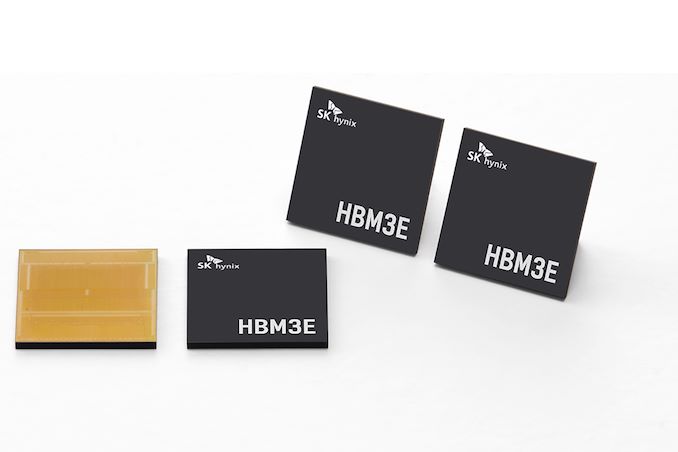

Offering some rare insight into the scale of HBM memory sales – and on its growth in the face of unprecedented demand from AI accelerator vendors – the company recently disclosed that it expects HBM sales to make up "a double-digit percentage of its DRAM chip sales" this year. Which if it comes to pass, would represent a significant jump in sales for the high-bandwidth, high-priced memory.
As first reported by Reuters, SK hynix CEO Kwak Noh-Jung has commented that he expects HBM sales will constitute a double-digit percentage of its DRAM chip sales in 2024. This prediction corroborate with estimates from TrendForce, who believe that, industry-wide, HBM will account for 20.1% of DRAM revenue in 2024, more than doubling HBM's 8.4% revenue share in 2023.
And while SK hynix does not break down its DRAM revenue by memory type on a regular basis, a bit of extrapolation indicates that they're on track to take in billions in HBM revenue for 2024 – having likely already crossed the billion dollar mark itself in 2023. Last year, SK hynix's DRAM revenue $15.941 billion, according to Statista and TrendForce. So SK hynix only needs 12.5% of its 2024 revenues to come from HBM (assuming flat or positive revenue overall) in order to pass 2 billion in HBM sales. And even this is a low-ball estimate.
Overall, SK hynix currently commands about 50% of HBM market, having largely split the market with Samsung over the last couple of years. Given that share, and that DRAM industry revenue is expected to increase to $84.150 billion in 2024, SK hynix could earn as much as $8.45 billion on HBM in 2024 if TrendForce's estimates prove accurate.
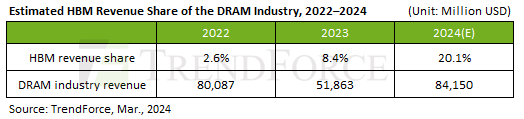
It should be noted that with demand for AI servers at record levels, all three leading makers of DRAM are poised to increase their HBM production capacity this year. Most notable here is a nearly-absent Micron, who was the first vendor to start shipping HBM3E memory to NVIDIA earlier this year. So SK hynix's near-majority of the HBM market may falter some this year, though with a growing pie they'll have little reason to complain. Ultimately, if sales of HBM reach $16.9 billion as projected, then all memory makers will be enjoying significant HBM revenue growth in the coming months.
Sources: Reuters, TrendForce
Memory

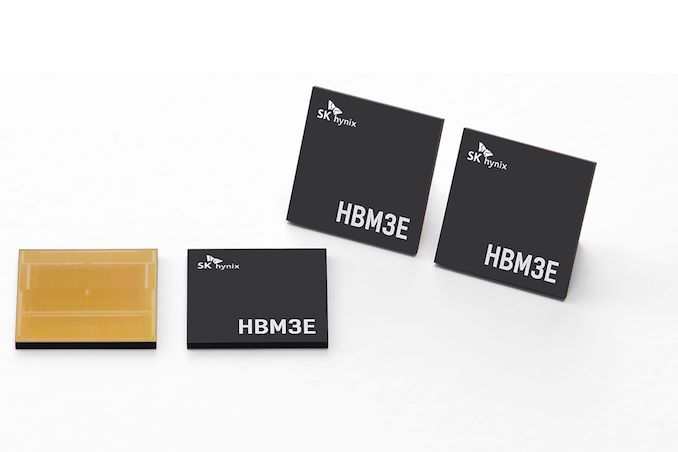
Demand for high-performance processors for AI training is skyrocketing, and consequently so is the demand for the components that go into these processors. So much so that SK hynix this week is very publicly announcing that the company's high-bandwidth memory (HBM) production capacity has already sold out for the rest of 2024, and even most of 2025 has already sold out as well.
SK hynix currently produces various types of HBM memory for customers like Amazon, AMD, Facebook, Google (Broadcom), Intel, Microsoft, and, of course, NVIDIA. The latter is an especially prolific consumer of HBM3 and HBM3E memory for its H100/H200/GH200 accelerators, as NVIDIA is also working to fill what remains an insatiable (and unmet) demand for its accelerators.
As a result, HBM memory orders, which are already placed months in advance, are now backlogging well into 2025 as chip vendors look to secure supplies of the memory stacks critical to their success.
This has made SK hynix the secnd HBM memory vendor in recent months to announce that they've sold out into 2025, following an earlier announcement from Micron regarding its HBM3E production. But of the two announcements, SK hynix's is arguably the most significant yet, as the South Korean firm's HBM production capacity is far greater than Micron's. So while things were merely "interesting" with the smallest of the Big Three memory manufacturers being sold out into 2025, things are taking a more concerning (and constrained) outlook now that SK hynix is as well.
SK hynix currently controls roughly 46% - 49% of HBM market, and its share is not expected to drop significantly in 2025, according to market tracking firm TrendForce. By contrast, Micron's share on HBM memory market is between 4% and 6%. Since HBM supply of both companies is sold out through the most of 2025, we're likely looking at a scenario where over 50% of the industry's total HBM3/HBM3E supply for the coming quarters is already sold out.
This leaves Samsung as the only member of the group not to comment on HBM demand so far. Though with memory being a highly fungible commodity product, it would be surprising if Samsung wasn't facing similar demand. And, ultimately, all of this is pointing towards the indusry entering an HBM3 memory shortage.
Separately, SK hynix said that it is sampling 12-Hi 36GB HBM3E stacks with customers and will begin volume shipments in the third quarter.
Memory
Demand for high-performance processors for AI training is skyrocketing, and consequently so is the demand for the components that go into these processors. So much so that SK hynix this week is very publicly announcing that the company's high-bandwidth memory (HBM) production capacity has already sold out for the rest of 2024, and even most of 2025 has already sold out as well.
SK hynix currently produces various types of HBM memory for customers like Amazon, AMD, Facebook, Google (Broadcom), Intel, Microsoft, and, of course, NVIDIA. The latter is an especially prolific consumer of HBM3 and HBM3E memory for its H100/H200/GH200 accelerators, as NVIDIA is also working to fill what remains an insatiable (and unmet) demand for its accelerators.
As a result, HBM memory orders, which are already placed months in advance, are now backlogging well into 2025 as chip vendors look to secure supplies of the memory stacks critical to their success.
This has made SK hynix the secnd HBM memory vendor in recent months to announce that they've sold out into 2025, following an earlier announcement from Micron regarding its HBM3E production. But of the two announcements, SK hynix's is arguably the most significant yet, as the South Korean firm's HBM production capacity is far greater than Micron's. So while things were merely "interesting" with the smallest of the Big Three memory manufacturers being sold out into 2025, things are taking a more concerning (and constrained) outlook now that SK hynix is as well.
SK hynix currently controls roughly 46% - 49% of HBM market, and its share is not expected to drop significantly in 2025, according to market tracking firm TrendForce. By contrast, Micron's share on HBM memory market is between 4% and 6%. Since HBM supply of both companies is sold out through the most of 2025, we're likely looking at a scenario where over 50% of the industry's total HBM3/HBM3E supply for the coming quarters is already sold out.
This leaves Samsung as the only member of the group not to comment on HBM demand so far. Though with memory being a highly fungible commodity product, it would be surprising if Samsung wasn't facing similar demand. And, ultimately, all of this is pointing towards the indusry entering an HBM3 memory shortage.
Separately, SK hynix said that it is sampling 12-Hi 36GB HBM3E stacks with customers and will begin volume shipments in the third quarter.
Memory
Lorem Ipsum is simply dummy text of the printing and typesetting industry. Lorem Ipsum has been the industry's.
Demand for high-performance processors for AI training is skyrocketing, and consequently so is the demand for the components that go into these processors. So much so that SK hynix this week is very publicly announcing that the company's high-bandwidth memory (HBM) production capacity has already sold out for the rest of 2024, and even most of 2025 has already sold out as well.
SK hynix currently produces various types of HBM memory for customers like Amazon, AMD, Facebook, Google (Broadcom), Intel, Microsoft, and, of course, NVIDIA. The latter is an especially prolific consumer of HBM3 and HBM3E memory for its H100/H200/GH200 accelerators, as NVIDIA is also working to fill what remains an insatiable (and unmet) demand for its accelerators.
As a result, HBM memory orders, which are already placed months in advance, are now backlogging well into 2025 as chip vendors look to secure supplies of the memory stacks critical to their success.
This has made SK hynix the secnd HBM memory vendor in recent months to announce that they've sold out into 2025, following an earlier announcement from Micron regarding its HBM3E production. But of the two announcements, SK hynix's is arguably the most significant yet, as the South Korean firm's HBM production capacity is far greater than Micron's. So while things were merely "interesting" with the smallest of the Big Three memory manufacturers being sold out into 2025, things are taking a more concerning (and constrained) outlook now that SK hynix is as well.
SK hynix currently controls roughly 46% - 49% of HBM market, and its share is not expected to drop significantly in 2025, according to market tracking firm TrendForce. By contrast, Micron's share on HBM memory market is between 4% and 6%. Since HBM supply of both companies is sold out through the most of 2025, we're likely looking at a scenario where over 50% of the industry's total HBM3/HBM3E supply for the coming quarters is already sold out.
This leaves Samsung as the only member of the group not to comment on HBM demand so far. Though with memory being a highly fungible commodity product, it would be surprising if Samsung wasn't facing similar demand. And, ultimately, all of this is pointing towards the indusry entering an HBM3 memory shortage.
Separately, SK hynix said that it is sampling 12-Hi 36GB HBM3E stacks with customers and will begin volume shipments in the third quarter.
Memory



 in order to pass 2 billion in HBM sales. And even this is a low-ball estimate.</p>
<p>Overall, SK hynix currently commands about <a href="https://www.trendforce.com/news/2024/01/16/news-increasing-hbm-capacity-to-sustain-market-share-sk-hynix-rumored-to-upgrade-wuxi-plant/">50% of HBM market</a>, having largely split the market with Samsung over the last couple of years. Given that share, and that DRAM industry revenue is expected to increase to <a href="https://www.trendforce.com/presscenter/news/20240318-12081.html">$84.150 billion in 2024</a>, SK hynix could earn as much as $8.45 billion on HBM in 2024 if TrendForce's estimates prove accurate.</p>
<p style="text-align: center;"><a href="https://www.anandtech.com/show/21327/hbm-revenue-poised-to-cross-10b-double-digit-revenue-share-at-sk-hynix"><img alt="" src="https://images.anandtech.com/doci/21327/20240318_111035_2024-03-18_110749_575px.png" /></a></p>
<p>It should be noted that with demand for AI servers at record levels, all three leading makers of DRAM are poised to increase their HBM production capacity this year. Most notable here is a nearly-absent Micron, who was the first vendor to start shipping HBM3E memory to NVIDIA earlier this year. So SK hynix's near-majority of the HBM market may falter some this year, though with a growing pie they'll have little reason to complain. Ultimately, if sales of HBM reach $16.9 billion as projected, then all memory makers will be enjoying significant HBM revenue growth in the coming months.</p>
<p>Sources: <a href="https://www.reuters.com/technology/sk-hynix-chief-says-hbm-chips-be-double-digit-percentage-2024-dram-chip-sales-2024-03-27/">Reuters</a>, <a href="https://www.trendforce.com/presscenter/news/20240318-12081.html">TrendForce</a></p>
</p> Memory)
 in order to pass 2 billion in HBM sales. And even this is a low-ball estimate.</p>
<p>Overall, SK hynix currently commands about <a href="https://www.trendforce.com/news/2024/01/16/news-increasing-hbm-capacity-to-sustain-market-share-sk-hynix-rumored-to-upgrade-wuxi-plant/">50% of HBM market</a>, having largely split the market with Samsung over the last couple of years. Given that share, and that DRAM industry revenue is expected to increase to <a href="https://www.trendforce.com/presscenter/news/20240318-12081.html">$84.150 billion in 2024</a>, SK hynix could earn as much as $8.45 billion on HBM in 2024 if TrendForce's estimates prove accurate.</p>
<p style="text-align: center;"><a href="https://www.anandtech.com/show/21327/hbm-revenue-poised-to-cross-10b-double-digit-revenue-share-at-sk-hynix"><img alt="" src="https://images.anandtech.com/doci/21327/20240318_111035_2024-03-18_110749_575px.png" /></a></p>
<p>It should be noted that with demand for AI servers at record levels, all three leading makers of DRAM are poised to increase their HBM production capacity this year. Most notable here is a nearly-absent Micron, who was the first vendor to start shipping HBM3E memory to NVIDIA earlier this year. So SK hynix's near-majority of the HBM market may falter some this year, though with a growing pie they'll have little reason to complain. Ultimately, if sales of HBM reach $16.9 billion as projected, then all memory makers will be enjoying significant HBM revenue growth in the coming months.</p>
<p>Sources: <a href="https://www.reuters.com/technology/sk-hynix-chief-says-hbm-chips-be-double-digit-percentage-2024-dram-chip-sales-2024-03-27/">Reuters</a>, <a href="https://www.trendforce.com/presscenter/news/20240318-12081.html">TrendForce</a></p>
</p> Memory)
 in order to pass 2 billion in HBM sales. And even this is a low-ball estimate.</p>
<p>Overall, SK hynix currently commands about <a href="https://www.trendforce.com/news/2024/01/16/news-increasing-hbm-capacity-to-sustain-market-share-sk-hynix-rumored-to-upgrade-wuxi-plant/">50% of HBM market</a>, having largely split the market with Samsung over the last couple of years. Given that share, and that DRAM industry revenue is expected to increase to <a href="https://www.trendforce.com/presscenter/news/20240318-12081.html">$84.150 billion in 2024</a>, SK hynix could earn as much as $8.45 billion on HBM in 2024 if TrendForce's estimates prove accurate.</p>
<p style="text-align: center;"><a href="https://www.anandtech.com/show/21327/hbm-revenue-poised-to-cross-10b-double-digit-revenue-share-at-sk-hynix"><img alt="" src="https://images.anandtech.com/doci/21327/20240318_111035_2024-03-18_110749_575px.png" /></a></p>
<p>It should be noted that with demand for AI servers at record levels, all three leading makers of DRAM are poised to increase their HBM production capacity this year. Most notable here is a nearly-absent Micron, who was the first vendor to start shipping HBM3E memory to NVIDIA earlier this year. So SK hynix's near-majority of the HBM market may falter some this year, though with a growing pie they'll have little reason to complain. Ultimately, if sales of HBM reach $16.9 billion as projected, then all memory makers will be enjoying significant HBM revenue growth in the coming months.</p>
<p>Sources: <a href="https://www.reuters.com/technology/sk-hynix-chief-says-hbm-chips-be-double-digit-percentage-2024-dram-chip-sales-2024-03-27/">Reuters</a>, <a href="https://www.trendforce.com/presscenter/news/20240318-12081.html">TrendForce</a></p>
</p> Memory | https://compbuddey.blogspot.com/2024/04/hbm-revenue-poised-to-cross-10b-as-sk_26.html)
 in order to pass 2 billion in HBM sales. And even this is a low-ball estimate.</p>
<p>Overall, SK hynix currently commands about <a href="https://www.trendforce.com/news/2024/01/16/news-increasing-hbm-capacity-to-sustain-market-share-sk-hynix-rumored-to-upgrade-wuxi-plant/">50% of HBM market</a>, having largely split the market with Samsung over the last couple of years. Given that share, and that DRAM industry revenue is expected to increase to <a href="https://www.trendforce.com/presscenter/news/20240318-12081.html">$84.150 billion in 2024</a>, SK hynix could earn as much as $8.45 billion on HBM in 2024 if TrendForce's estimates prove accurate.</p>
<p style="text-align: center;"><a href="https://www.anandtech.com/show/21327/hbm-revenue-poised-to-cross-10b-double-digit-revenue-share-at-sk-hynix"><img alt="" src="https://images.anandtech.com/doci/21327/20240318_111035_2024-03-18_110749_575px.png" /></a></p>
<p>It should be noted that with demand for AI servers at record levels, all three leading makers of DRAM are poised to increase their HBM production capacity this year. Most notable here is a nearly-absent Micron, who was the first vendor to start shipping HBM3E memory to NVIDIA earlier this year. So SK hynix's near-majority of the HBM market may falter some this year, though with a growing pie they'll have little reason to complain. Ultimately, if sales of HBM reach $16.9 billion as projected, then all memory makers will be enjoying significant HBM revenue growth in the coming months.</p>
<p>Sources: <a href="https://www.reuters.com/technology/sk-hynix-chief-says-hbm-chips-be-double-digit-percentage-2024-dram-chip-sales-2024-03-27/">Reuters</a>, <a href="https://www.trendforce.com/presscenter/news/20240318-12081.html">TrendForce</a></p>
</p> Memory&body=https://compbuddey.blogspot.com/2024/04/hbm-revenue-poised-to-cross-10b-as-sk_26.html)


0 Comments